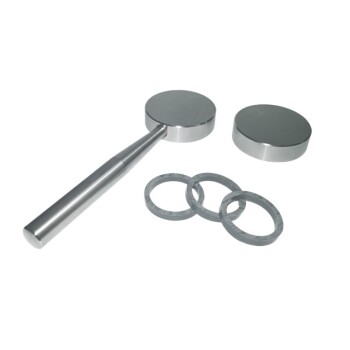
Graphite molds function fundamentally as both a high-temperature containment vessel and a mechanical transmission interface. In the context of vacuum hot pressing sintering for particle-reinforced aluminum matrix composites, these molds act as the primary container for the mixed powder, defining the component's final geometry. Crucially, they serve as the physical medium that transfers immense force from the hydraulic press to the powder, forcing particles into close contact to ensure consolidation.
Core Takeaway: The graphite mold is not merely a passive container; it is an active processing component that enables densification by maintaining structural integrity and thermal uniformity under extreme heat and pressure.
The Mechanics of Pressure and Shaping
Acting as the Primary Container
The most immediate function of the graphite mold is to serve as the containment vessel for the mixed powder or cold-pressed preforms.
It defines the boundaries of the material, restricting the space in which the composite can expand or shift. This ensures the material maintains the correct geometric shape throughout the transition from loose powder to solid composite.
Facilitating Load Transmission
The mold is the critical link between the furnace's hydraulic system and the composite material.
It must withstand significant axial pressures—ranging from moderate loads of 20 MPa to extreme pressures exceeding 50 MPa—and transmit this force directly to the powder. This transmission forces the aluminum matrix and reinforcing particles into a dense arrangement, minimizing voids.
Enabling Plastic Deformation
By effectively transferring uniaxial pressure, the mold facilitates the plastic deformation of the aluminum matrix.
This deformation allows the metal to flow around the harder reinforcing particles. The result is the filling of internal pores and the successful consolidation of the material into a cohesive unit.
Thermal Regulation and Stability
Ensuring Uniform Heating
Graphite possesses excellent thermal conductivity, which is vital during the sintering process.
The mold absorbs heat from the furnace elements and distributes it evenly across the sample. This prevents thermal gradients (hot or cold spots) that could lead to uneven sintering or internal stresses within the aluminum composite.
High-Temperature Structural Integrity
The process requires temperatures often exceeding 600°C (and up to 1200°C for other composites), an environment where many materials lose strength.
Graphite molds are engineered to maintain their mechanical strength and dimensional stability at these elevated temperatures. This ensures the mold does not deform under the combined stress of heat and hydraulic load, preserving the dimensional precision of the final part.
Understanding the Operational Demands
The Pressure-Temperature Trade-off
While graphite is robust, it acts as a consumable component with physical limits.
The mold must be specifically rated for the combination of heat and pressure required; pushing a standard mold beyond its pressure rating (e.g., attempting 50 MPa when rated for 20 MPa) will result in catastrophic fracture. The mold's wall thickness and graphite grade must be matched to the specific mechanical load of the project.
Thermal Shock Sensitivity
Graphite has good thermal shock resistance, but it is not immune to rapid temperature changes.
Extreme heating or cooling rates can induce stress fractures in the mold. While it facilitates heat transfer, the ramping cycles of the vacuum furnace must be controlled to protect the integrity of the mold, and by extension, the composite sample inside.
Making the Right Choice for Your Goal
When selecting or designing graphite molds for aluminum matrix composites, consider your specific processing objectives:
- If your primary focus is Maximum Density: Prioritize high-strength graphite grades capable of withstanding axial pressures exceeding 50 MPa to ensure complete pore elimination.
- If your primary focus is Geometric Precision: Focus on the machining quality of the mold and the thermal expansion coefficient of the specific graphite grade to minimize dimensional variance at 600°C.
The success of your sintering process relies on viewing the graphite mold not just as a holder, but as a critical tool for thermal and mechanical control.
Summary Table:
| Function | Role in Sintering Process | Impact on Composite Quality |
|---|---|---|
| Containment | Defines geometric shape and restricts powder expansion | Ensures dimensional accuracy and structural integrity |
| Load Transmission | Transfers hydraulic force (20-50+ MPa) to the powder | Facilitates plastic deformation and eliminates internal pores |
| Thermal Regulation | Evenly distributes heat across the sample | Prevents thermal gradients and reduces internal stresses |
| Structural Stability | Maintains mechanical strength at temperatures >600°C | Prevents mold deformation under high-pressure loads |
Elevate Your Material Research with KINTEK Precision Solutions
Achieving the perfect density and geometric precision in particle-reinforced aluminum matrix composites requires more than just high temperatures—it demands high-performance tools. KINTEK specializes in advanced laboratory equipment designed for the most rigorous sintering environments.
Our expertise covers a comprehensive range of solutions, including:
- High-Temperature Furnaces: Muffle, vacuum, and CVD systems for precise thermal control.
- Hydraulic Presses: Pellet, hot, and isostatic presses to ensure optimal load transmission.
- Specialized Consumables: Premium ceramics, crucibles, and high-strength graphite interfaces.
- Comprehensive Lab Tools: From crushing and milling systems to cooling solutions like ULT freezers.
Don't let subpar tooling compromise your research outcomes. Partner with KINTEK for durable, high-precision equipment tailored to your specific mechanical and thermal requirements.
Contact our technical experts today to find the right equipment for your lab!
Related Products
- 2200 ℃ Graphite Vacuum Heat Treat Furnace
- Ultra-High Temperature Graphite Vacuum Graphitization Furnace
- Ball Press Mold for Lab
- Vacuum Heat Treat and Molybdenum Wire Sintering Furnace for Vacuum Sintering
- Vacuum Heat Treat and Pressure Sintering Furnace for High Temperature Applications
People Also Ask
- Why do you heat treat in a vacuum? Achieve Perfect Surface Finish and Material Integrity
- How does heat transmit in a vacuum? Mastering Thermal Radiation for Purity & Precision
- What is the process of vacuum heat treating? Achieve Superior Hardening with a Clean, Bright Finish
- How does a vacuum heat treat furnace work? Achieve Pristine, Oxide-Free Metal Parts
- What is graphite heating? A Guide to Durable, High-Temp Industrial Furnace Solutions