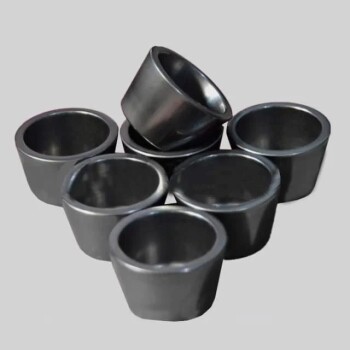
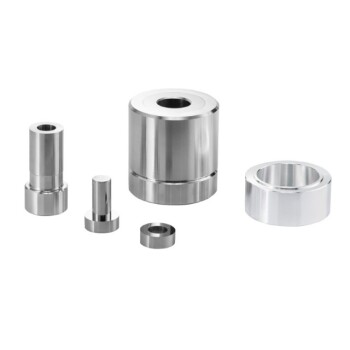
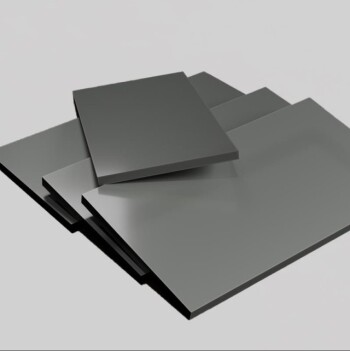
High-purity graphite molds act primarily as dual-purpose vessels that define the geometry of the composite while serving as the essential interface for mechanical force. In the specific context of vacuum hot pressing Al0.6CoCrFeNi/5052Al composites, they confine the mixed powder into cylindrical shapes (such as φ45 x 15mm) and maintain structural integrity under high heat to facilitate the sintering process.
Core Takeaway The graphite mold is not merely a container; it is an active transmission medium. Its high-temperature mechanical strength ensures that the 30MPa of hydraulic pressure is transferred uniformly to the powder at 823K, which is the deciding factor in achieving effective densification and dimensional precision.
The Mechanics of Pressure Transmission
Bridging the Hydraulic System and the Powder
The most critical technical function of the mold is acting as a pressure transmission medium. The hydraulic system generates force, but the graphite mold is responsible for delivering that force to the loose powder.
Achieving Uniform Uniaxial Pressure
For Al0.6CoCrFeNi/5052Al composites, the process requires a specific uniaxial pressure of 30MPa. The graphite mold must possess sufficient rigidity to transfer this load without absorbing the energy through its own deformation.
Forcing Particle Contact
By effectively transmitting this pressure, the mold forces the powder particles into a restricted space. This creates the close contact necessary for plastic deformation and diffusion bonding between the 5052Al matrix and the reinforcement particles.
Thermal Stability and Shaping
Withstanding Sintering Temperatures
The vacuum hot pressing process for this composite occurs at a sintering temperature of 823K. At this temperature, standard metal molds might soften, deform, or react with the sample.
Ensuring Dimensional Accuracy
High-purity graphite retains excellent mechanical properties at 823K. This thermal stability ensures that the mold maintains the precise cylindrical dimensions (e.g., φ45 x 15mm) throughout the heating cycle, preventing the final composite sample from warping.
Preventing Chemical Interaction
While the primary goal is physical shaping, the use of "high-purity" graphite is strategic. It limits the risk of the mold chemically reacting with the aluminum matrix at elevated temperatures, which preserves the purity and surface quality of the composite.
Understanding the Trade-offs
Mechanical Limits and Brittleness
While graphite has excellent high-temperature strength, it is inherently brittle compared to metallic alloys. It can withstand significant compressive force (like the 30MPa required here), but it has low tolerance for tensile stress or impact. Misalignment in the hydraulic press can easily crack the mold.
The Necessity of High Purity
Standard graphite may contain impurities that could diffuse into the Al0.6CoCrFeNi/5052Al composite at 823K. Using high-purity graphite is a necessary expense to ensure the metallurgical bonding interface remains uncontaminated, but this increases the consumable cost of the process.
Making the Right Choice for Your Goal
When optimizing the vacuum hot pressing process for these composites, consider how the mold influences your specific objectives:
- If your primary focus is Densification: Ensure the mold wall thickness is sufficient to withstand the full 30MPa without microscopic deflection, maximizing the pressure actually reaching the powder.
- If your primary focus is Dimensional Precision: Verify the machining tolerance of the graphite mold before use, as the final composite will mirror the mold's internal geometry exactly at 823K.
The success of the sintering process relies on the graphite mold acting as a rigid, non-reactive bridge between the heat/pressure source and the raw material.
Summary Table:
| Feature | Function in Vacuum Hot Pressing | Impact on Al0.6CoCrFeNi/5052Al |
|---|---|---|
| Pressure Transmission | Delivers 30MPa uniaxial force to powder | Ensures particle contact and densification |
| Thermal Stability | Maintains integrity at 823K sintering | Prevents warping and ensures dimensional accuracy |
| High Purity | Minimizes chemical interaction | Preserves purity of the metallurgical bonding interface |
| Geometry Definition | Confines powder to specific dimensions | Produces precise cylindrical shapes (e.g., φ45x15mm) |
Elevate Your Materials Research with KINTEK Precision Engineering
Achieving high-density Al-matrix composites requires more than just heat—it demands the highest quality consumables and equipment. KINTEK specializes in providing the precision-engineered high-purity graphite molds and vacuum hot pressing systems essential for advanced material synthesis.
From high-temperature furnaces and hydraulic presses to specialized consumables like crucibles and ceramic tooling, our portfolio is designed to meet the rigorous demands of modern laboratory research. Partner with KINTEK to ensure your sintering processes achieve maximum densification and dimensional accuracy.
Ready to optimize your lab's performance? Contact our technical experts today to find the perfect solution for your composite research.
Related Products
- High Purity Pure Graphite Crucible for Evaporation
- Ultra-High Temperature Graphite Vacuum Graphitization Furnace
- Horizontal High Temperature Graphite Vacuum Graphitization Furnace
- Vertical High Temperature Graphite Vacuum Graphitization Furnace
- Anti-Cracking Press Mold for Lab Use
People Also Ask
- Why are high-purity graphite crucibles preferred for sulfide solid electrolytes? Achieve Superior Material Purity
- Why is a high-purity graphite crucible required for Chromel-TaC composites? Ensure Peak Purity at 1400°C
- What role do high-purity graphite crucibles play in molten salt corrosion research? Ensure Reactor-Grade Precision
- Why are high-purity graphite crucibles used for magnesium distillation? Ensure 3N8 Purity & Thermal Stability
- Why is a high-purity graphite crucible ideal for nitrogen-doped graphene at 1500 °C? Maximize Purity and Stability