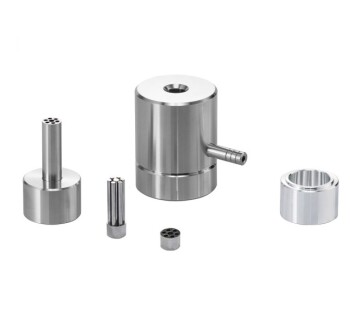
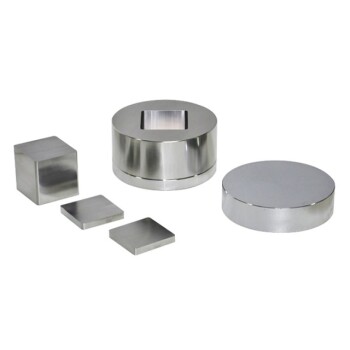
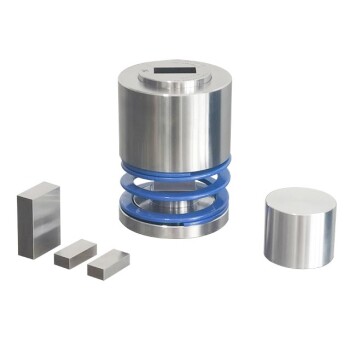
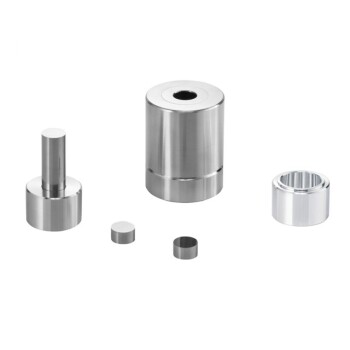
High-strength graphite molds serve as the structural foundation during the hot pressing of Ti2AlNb/TA15 laminated composites. Their primary function is twofold: to rigidly constrain the shape of the stacked preforms and to act as a robust medium for transmitting mechanical pressure. By maintaining their integrity under extreme heat, these molds ensure the laminated layers are compressed into tight contact, a prerequisite for successful bonding.
The critical value of these molds lies in their ability to withstand the harsh intersection of high thermal load and mechanical stress. They must endure temperatures exceeding 1000°C and pressures of tens of megapascals without deforming, ensuring that the force applied to the composite remains uniform and effective.
Preserving Geometry Under Extreme Conditions
Withstanding High-Temperature Deformation
The hot pressing process for Ti2AlNb/TA15 composites requires temperatures exceeding 1000°C. At this thermal tier, many standard tooling materials would soften, creep, or lose their dimensional stability. High-strength graphite is selected specifically because it retains its mechanical rigidity in this extreme environment.
Defining the Composite Shape
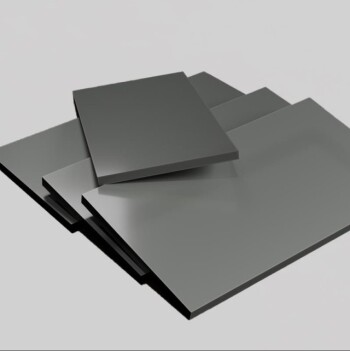
The mold acts as the primary containment vessel for the laminated preforms. It secures the loose stack of Ti2AlNb and TA15 plates, preventing lateral shifting or misalignment. The internal geometry of the mold dictates the final shape of the composite, meaning any deformation in the mold would result in a defective final part.
The Mechanics of Pressure Transmission
Delivering Massive Uniaxial Force
These molds are not passive containers; they are active transmission components. They must transfer mechanical pressures amounting to several tens of megapascals from the hydraulic ram to the composite sample. The graphite must be strong enough to transfer this load without fracturing or absorbing the energy through its own compression.
Ensuring Uniform Pressure Distribution
A critical function of the graphite mold is the uniform distribution of pressure across the surface of the composite. If pressure were applied unevenly, the laminated plates would not bond consistent. The mold acts as a stiff buffer, equalizing the force to ensure every square millimeter of the interface experiences the same consolidating pressure.
Facilitating Inter-Layer Contact
The ultimate goal of the pressure transmission is to force the Ti2AlNb and TA15 plates into tight contact. The mold compresses the layers to eliminate microscopic gaps. This intimate contact is essential for the diffusion bonding process that occurs during hot pressing, creating a solid, laminated structure.
Understanding the Trade-offs
Brittleness and Handling
While high-strength graphite is excellent at resisting compressive forces at high temperatures, it remains a brittle material. It lacks the ductility of metals, meaning it is susceptible to cracking if subjected to sudden impact, shear forces, or misalignment during the setup of the press.
Environmental Sensitivity
Graphite is highly susceptible to oxidation at the operating temperatures required for these composites (>1000°C). Consequently, these molds generally require a vacuum or inert atmosphere to function. Exposure to oxygen at these temperatures would cause the mold to degrade rapidly, compromising the geometry of the sample.
Potential for Surface Interaction
While generally chemically stable, the interface between the graphite and the reactive titanium-based composite must be managed. There is often a need to consider release agents or barriers to prevent the composite from adhering to the mold or reacting with the carbon surface, which could affect the surface finish or ease of demolding.
Making the Right Choice for Your Goal
To ensure the successful fabrication of Ti2AlNb/TA15 composites, you must select mold materials based on your specific processing parameters.
- If your primary focus is Dimensional Accuracy: Prioritize graphite grades with the highest available compressive strength and thermal stability to prevent even micro-deformation at 1000°C.
- If your primary focus is Bond Homogeneity: Ensure the mold design and fit tolerances are precise to guarantee uniform pressure distribution across the entire laminar interface.
Ultimately, the high-strength graphite mold must act as an invisible force, transferring heat and pressure perfectly without imposing its own physical limitations on the final composite structure.
Summary Table:
| Feature | Function in Hot Pressing | Impact on Final Composite |
|---|---|---|
| Structural Rigidity | Constrains preform geometry at >1000°C | Ensures dimensional accuracy and prevents misalignment |
| Pressure Transmission | Delivers tens of megapascals uniaxially | Facilitates tight inter-layer contact for diffusion bonding |
| Load Distribution | Equalizes force across the laminate surface | Guarantees bond homogeneity and eliminates gaps |
| Thermal Stability | Resists deformation under extreme heat | Maintains consistent part geometry throughout the cycle |
| Inert Compatibility | Works within vacuum/inert atmospheres | Prevents mold degradation and material contamination |
Elevate Your Material Research with KINTEK Precision Solutions
Precision in hot pressing starts with the right tooling and equipment. KINTEK specializes in providing high-performance laboratory solutions tailored for advanced material science. Whether you are fabricating complex Ti2AlNb/TA15 laminates or exploring new alloy systems, we offer the expert tools you need to succeed:
- High-Temperature & Vacuum Furnaces: Muffle, tube, and atmosphere furnaces designed for stable thermal processing.
- Hydraulic Presses: Advanced pellet, hot, and isostatic presses to ensure uniform pressure distribution.
- Specialized Consumables: High-purity graphite, ceramics, and crucibles engineered to withstand extreme conditions.
Ready to achieve superior bonding and dimensional accuracy in your composites? Contact KINTEK today to discuss your specific research requirements and discover how our comprehensive portfolio can optimize your laboratory workflow.
Related Products
- Anti-Cracking Press Mold for Lab Use
- Special Shape Press Mold for Lab
- Ball Press Mold for Lab
- Double Plate Heating Press Mold for Lab
- Lab Infrared Press Mold
People Also Ask
- What is the press mould method? A Guide to Consistent, Detailed Ceramic Forms
- How to use a press mold? Master the Art of Creating Consistent Ceramic Forms
- What is the function of press molds during the preparation of SiCf/Ti-43Al-9V composites? Achieve Structural Precision
- What is a press mold used for? Achieve Repeatable Precision and Efficiency
- What is the purpose of specialized pressure devices in sulfide solid-state batteries? Ensure Chemo-Mechanical Stability