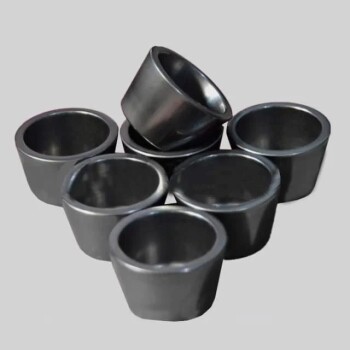
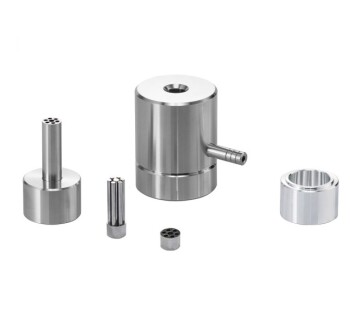
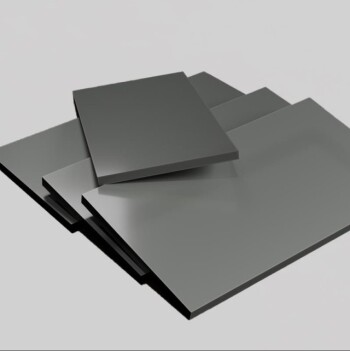
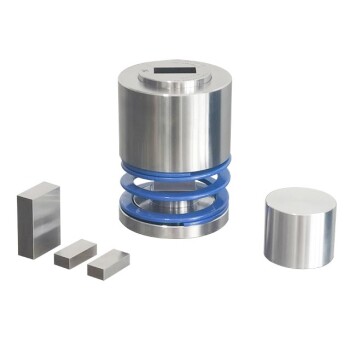
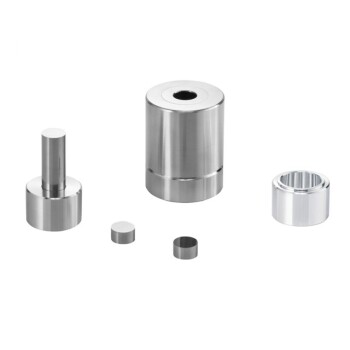
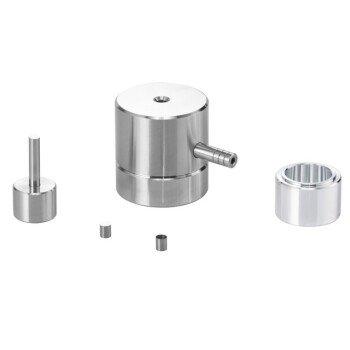
High-Strength Graphite Molds act as the primary containment and pressure transmission vessel during the Vacuum Hot Pressing Sintering (VHPS) of high-entropy alloy powders. They function as a structural interface, transmitting significant hydraulic force to the metal powder while maintaining geometrical integrity at temperatures high enough to induce sintering.
Core Takeaway The fundamental purpose of the graphite mold in VHPS is to enable the simultaneous densification and net-shaping of metal powders. By maintaining high-temperature strength while transmitting uniaxial pressure, the mold creates the specific physical conditions required to turn loose alloy particles into a solid, fully dense bulk material.
The Mechanics of Pressure Transmission
Bridging the Hydraulic System and the Powder
The mold serves as the physical medium that connects the external hydraulic press to the internal alloy powder.
While the furnace provides the heat, the graphite mold is responsible for transmitting uniaxial pressure. According to standard processing parameters, this often involves transferring pressures around 30 MPa directly to the powder bed.
Facilitating Plastic Flow
The pressure applied through the mold is not merely for containment; it is a catalyst for microstructural change.
This mechanical force promotes particle contact and plastic flow between the alloy granules. By mechanically forcing particles together via the mold, the process significantly reduces the activation energy required for densification compared to pressureless sintering.
Thermal Stability and Shaping
Withstanding Extreme Environments
The defining characteristic of these molds is their ability to retain strength at elevated temperatures where metals would soften or melt.
During the sintering of high-entropy alloys, temperatures frequently reach 1373 K (1100°C) or higher. The graphite mold must possess superior thermal stability to withstand this heat without deforming, ensuring the pressure remains uniform throughout the cycle.
Simultaneous Densification and Shaping
The mold performs two critical operations at once: it compacts the material and defines its final geometry.
As the alloy powder undergoes diffusion and eliminates pores to achieve a fully dense microstructure, it takes the shape of the mold's internal cavity. This allows for the production of near-net-shape components, reducing the need for extensive post-process machining.
The Role of the Vacuum Environment
Protecting the Alloy and the Mold
While the mold provides the structure, the vacuum environment within the furnace is critical for the mold's survival and the alloy's purity.
At high temperatures, graphite creates a reducing environment. The vacuum prevents the oxidation of alloy elements, ensuring the chemical composition of the high-entropy alloy remains pure.
Enhancing Diffusion Kinetics
The combination of the mold's pressure and the vacuum environment accelerates the sintering process.
By removing gases that could be trapped in pores and applying pressure via the mold, the system maximizes high-temperature diffusion kinetics. This allows the material to reach full density at relatively lower temperatures than would be required in atmospheric conditions.
Understanding the Trade-offs
Mechanical Limitations
While graphite has excellent high-temperature strength, it is a brittle ceramic material.
It handles compressive loads (squeezing) exceptionally well, which makes it ideal for VHPS. However, it has low tensile strength. Misalignment in the hydraulic ram or uneven powder loading can cause the mold to crack under the uniaxial pressure.
Chemical Reactivity
Graphite is generally inert, but at extreme temperatures, carbon diffusion can occur.
Operators must be aware of the potential for carbon contamination on the surface of the alloy. While the mold contains the powder, slight interactions at the interface can alter the surface chemistry of the final part, occasionally requiring surface machining.
Making the Right Choice for Your Project
The selection and design of your graphite mold directly dictate the quality of your final high-entropy alloy component.
- If your primary focus is Maximum Density: Ensure the mold wall thickness is sufficient to withstand pressures exceeding 30 MPa without deflection, maximizing particle plastic flow.
- If your primary focus is Complex Geometry: Prioritize the precision of the mold's internal cavity machining, as the VHPS process will replicate this shape exactly during densification.
Summary: The High-Strength Graphite Mold is the structural enabler of the VHPS process, translating raw heat and hydraulic force into a dense, precisely shaped high-performance alloy.
Summary Table:
| Feature | Function in VHPS | Impact on High-Entropy Alloys |
|---|---|---|
| Pressure Transmission | Transfers uniaxial force (~30 MPa) | Promotes particle contact and plastic flow |
| Thermal Stability | Maintains strength at 1100°C+ | Ensures uniform sintering without mold deformation |
| Geometry Control | Provides internal cavity shape | Achieves near-net-shape, fully dense bulk material |
| Vacuum Interface | Works with vacuum environment | Prevents oxidation and enhances diffusion kinetics |
Elevate Your Advanced Material Synthesis with KINTEK
Precision in Vacuum Hot Pressing Sintering starts with the right equipment. KINTEK specializes in high-performance laboratory solutions, providing the specialized high-temperature vacuum furnaces and high-strength graphite tooling necessary to produce fully dense high-entropy alloys.
Whether you are working with crushing and milling systems for powder preparation or require robust hydraulic presses and vacuum/atmosphere furnaces for sintering, our comprehensive portfolio is designed to meet the rigorous demands of battery research and metallurgy.
Ready to optimize your sintering process? Contact KINTEK today to discuss how our high-temperature furnaces and precision consumables can enhance your research outcomes.
Related Products
- High Purity Pure Graphite Crucible for Evaporation
- High Purity Pure Graphite Crucible for Electron Beam Evaporation
- Special Shape Press Mold for Lab
- Carbon Graphite Plate Manufactured by Isostatic Pressing Method
- Vertical High Temperature Graphite Vacuum Graphitization Furnace
People Also Ask
- Why are high-purity graphite crucibles preferred for sulfide solid electrolytes? Achieve Superior Material Purity
- Why is a high-purity graphite crucible required for Chromel-TaC composites? Ensure Peak Purity at 1400°C
- What role do high-purity graphite crucibles play in molten salt corrosion research? Ensure Reactor-Grade Precision
- Why are high-purity graphite crucibles used for magnesium distillation? Ensure 3N8 Purity & Thermal Stability
- Why is a high-purity graphite crucible ideal for nitrogen-doped graphene at 1500 °C? Maximize Purity and Stability