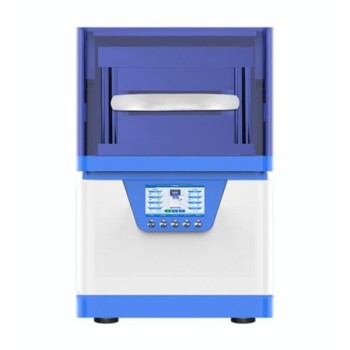
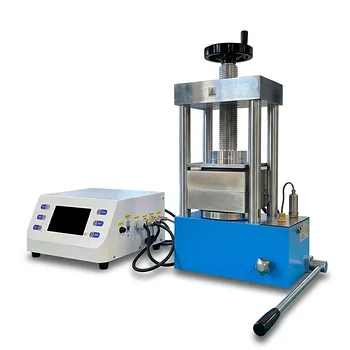
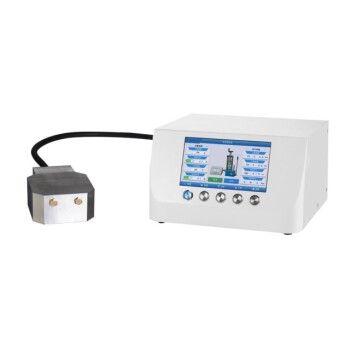
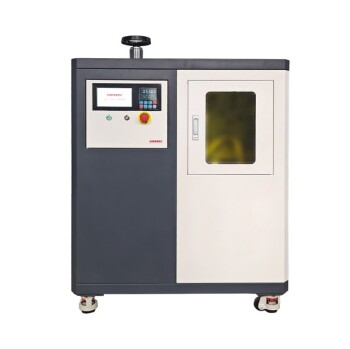
The primary function of Hot Pressing equipment is to densify and shape material. It utilizes the synergistic effect of high temperatures (specifically 455-465°C) and high mechanical force (approximately 30 kN) to compress purified Thallium Bromide (TlBr) raw materials into dense, solid blanks.
By replacing traditional crystal growth methods with a controlled pressure-solidification process, hot pressing significantly reduces thermal stress and microscopic defects, directly enabling the high energy resolution required for semiconductor radiation detectors.
The Mechanics of Densification
Synergistic Application of Heat and Force
The core mechanism involves the simultaneous application of thermal energy and mechanical pressure. The equipment maintains a precise temperature range between 455°C and 465°C while applying a continuous constant load of roughly 30 kN.
Eliminating Internal Voids
This process is distinct from simple molding; it is a densification technique. The combination of heat and pressure forces the purified powder to compact fully, effectively eliminating internal pores and microscopic defects that naturally occur in looser aggregate states.
Quasi-In-Situ Molding
The equipment acts as a precision mold, creating "quasi-in-situ" formation. This approach creates high-density bulk crystals directly in the desired shape (such as 2 mm x 2 mm x 2.5 mm specimens), ensuring the final geometric dimensions are accurate immediately upon cooling.
Enhancing Material Properties
Reducing Thermal Stress
A critical advantage of Hot Pressing over traditional crystal growth methods is the mitigation of stress. By controlling the solidification environment so tightly, the equipment significantly reduces the thermal stress that typically accumulates during fabrication, preventing fractures or structural weaknesses.
Controlling Crystal Orientation
The equipment allows for superior control over the internal structure of the material. The application of pressure improves the uniformity of crystal orientation, which is vital for the consistent movement of charge carriers within the semiconductor.
Ensuring Geometric Consistency
Beyond internal structure, the equipment ensures external uniformity. It produces plate-like crystals with high geometric consistency, which is a prerequisite for predictable photoelectric performance in the final device.
Impact on Detector Performance
Optimizing Energy Resolution
The ultimate "why" behind using this equipment is performance. By producing denser, lower-stress crystals with better orientation, the hot press directly contributes to higher energy resolution in the final detector.
Enhancing Detection Efficiency
The reduction of internal defects means fewer traps for charge carriers. This leads to improved detection efficiency, making the material suitable for demanding applications like photon-counting detectors used in X-ray and gamma-ray sensing.
Understanding the Trade-offs
The Requirement for Pre-Purified Material
It is critical to note that the Hot Pressing equipment is not a purification tool. It requires raw material that has already undergone deep purification (e.g., via zone refining) to remove impurities. If the input material is impure, the hot press will simply create a dense, high-quality shape composed of low-quality material.
Sensitivity to Process Parameters
The benefits of this equipment rely on precision. Deviating from the narrow temperature window (455-465°C) or the specific pressure (30 kN) risks incomplete densification or excessive strain. The equipment's value lies entirely in its ability to maintain these specific parameters without fluctuation.
Making the Right Choice for Your Goal
To maximize the efficacy of your TlBr material preparation:
- If your primary focus is Structural Integrity: Rely on the hot press to minimize thermal stress and eliminate internal pores through its pressure-solidification process.
- If your primary focus is Performance Consistency: Use the precise geometric controls of the hot press to ensure uniform crystal orientation and stable current-voltage characteristics across all samples.
- If your primary focus is Material Purity: Do not rely on the hot press; ensure you utilize a multi-stage zone refining furnace before the material ever enters the hot press mold.
The Hot Press serves as the critical bridge between raw chemical purity and final mechanical utility, transforming purified powder into a functional semiconductor component.
Summary Table:
| Parameter/Feature | Function & Specification | Impact on Material |
|---|---|---|
| Temperature Range | 455°C - 465°C | Enables controlled solidification & reduces thermal stress |
| Mechanical Force | Approx. 30 kN | Eliminates internal voids and ensures full densification |
| Molding Process | Quasi-in-situ formation | Provides precise geometric consistency and shape |
| Internal Structure | Crystal Orientation Control | Enhances charge carrier movement and energy resolution |
| Pre-requisite | Deeply Purified Raw Material | Ensures final device performance via zone-refined inputs |
Elevate Your Semiconductor Research with KINTEK
Precision matters when developing high-performance radiation detectors. KINTEK specializes in advanced laboratory equipment, providing the exact temperature and pressure control required for sensitive materials like Thallium Bromide.
Our extensive portfolio supports your entire workflow—from multi-stage zone refining for raw material purity to precision hydraulic hot presses for superior densification. Whether you need high-temperature furnaces, specialized crushing systems, or essential consumables like ceramics and crucibles, KINTEK delivers the reliability researchers demand.
Ready to optimize your material properties? Contact our technical experts today to find the perfect solution for your laboratory!
References
- Raluca Ivan. Fabrication of hybrid nanostructures by laser technique for water decontamination. DOI: 10.21175/rad.abstr.book.2023.15.4
This article is also based on technical information from Kintek Solution Knowledge Base .
Related Products
- Automatic Heated Hydraulic Press Machine with Heated Plates for Laboratory Hot Press
- Automatic Heated Hydraulic Press Machine with Heated Plates for Laboratory Hot Press 25T 30T 50T
- Heated Hydraulic Press Machine with Heated Plates for Vacuum Box Laboratory Hot Press
- 30T 40T Split Automatic Heated Hydraulic Press Machine with Heated Plates for Laboratory Hot Press
- Heated Hydraulic Press Machine with Heated Plates Split Manual Laboratory Hot Press
People Also Ask
- What are the core advantages of using a laboratory hot press to produce Bi2Se3? Achieve 93% Density & High Conductivity
- How does a laboratory hot press contribute to LATP/polymer composite electrolytes? Achieving Dense, High-Conductivity Films
- How does a three-stage pressure program affect rice husk particleboards? Optimize Bond Strength & Stability
- What is the purpose of a laboratory hot press in the encapsulation stage of solar cell assembly? Ensure Hermetic Seals
- What are the primary advantages of using a laboratory hot press in forming PEO/LLZTO? Unlock Solvent-Free Efficiency