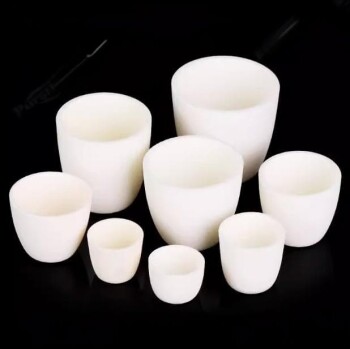
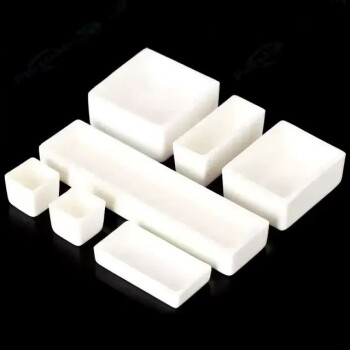
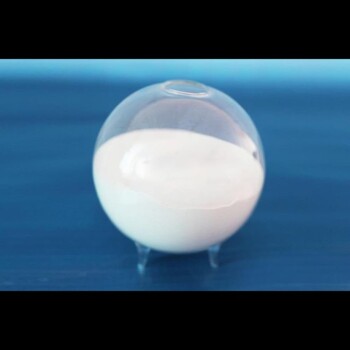
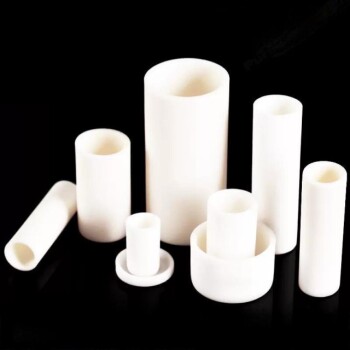
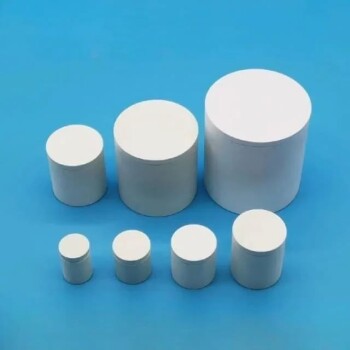
Pre-dried high-purity alumina crucibles provide a chemically inert environment and a stable mass baseline for high-temperature corrosion studies.
In these experiments, these crucibles serve as containers that do not react with corrosive salts, liquid metals, or specimens, ensuring no impurities are introduced. Pre-drying is a critical step that eliminates adsorbed moisture, which would otherwise skew gravimetric data during weight-change analysis. By capturing spalled oxide scales and preventing secondary reactions with furnace walls, they ensure that all recorded mass changes originate solely from the specimen’s interaction with the corrosive medium.
Core Takeaway: High-purity alumina crucibles act as an analytical safeguard; they ensure experimental "noise"—such as moisture weight, container reactions, or lost corrosion products—does not interfere with the precision of oxidation and corrosion kinetic data.
Ensuring Chemical and Thermal Integrity
Absolute Chemical Inertness
High-purity alumina (typically >99.7% Al₂O₃) is chosen for its exceptional chemical stability across a wide range of aggressive environments. It remains non-reactive when in contact with corrosive salts like NaCl and Na₂SO₄, as well as liquid metals like Lead-Bismuth Eutectic (LBE) at 600°C.
This inertness ensures that no metallic impurities leach from the container into the specimen. It also prevents the crucible from participating in the reaction, which would otherwise contaminate the results and invalidate the chemical analysis of the corrosion products.
Stability Under Extreme Temperatures
These crucibles maintain structural and chemical integrity at temperatures ranging from 600°C to as high as 1500°C. They are effective in varied atmospheres, including reducing environments and high-temperature steam.
Because they do not react with graphite or oxygen at elevated temperatures (e.g., 1273 K), they are ideal for measuring the oxidation kinetics of carbon-based materials. Their thermal stability ensures they do not deform or degrade, providing a consistent physical support for the specimen.
Precision in Gravimetric Analysis
The Role of Pre-drying
Alumina is porous enough to adsorb atmospheric moisture, which can add significant "phantom" weight to the crucible. Pre-drying eliminates this influence, ensuring the initial weight is a true baseline.
Without pre-drying, the heat of the experiment would drive off moisture, causing a weight loss that could be misinterpreted as a reaction. This step is non-negotiable when using the weight loss method to determine alloy specimen mass changes.
Capturing Spalled Oxide Scales
During cyclic hot corrosion, oxide scales often crack and peel (spall) off the specimen surface. High-purity alumina crucibles act as collection vessels for these fragments.
By containing all spalled material, the crucible allows researchers to calculate the total mass change per unit area accurately. Without this containment, lost fragments would result in an overestimation of corrosion rates.
Isolation and Protection of Equipment
Prevention of Secondary Reactions
In experiments involving high-pressure vessels or specialized furnaces, alumina crucibles act as protective liners. They isolate corrosive liquid metals or salts from the metal walls of the pressure vessel.
This prevents secondary reactions between the corrosive medium and the test equipment (such as T91 or HT9 steel vessels). This isolation ensures the data reflects only the interaction between the corrosive agent and the specific specimen under study.
Physical Support and Separation
At extreme temperatures (e.g., 1500°C), specimens may produce liquid oxidation products that cause them to adhere to the container. A layer of alumina powder can be placed at the bottom of the crucible to provide a buffer.
This prevents the specimen from bonding to the crucible walls. It allows for the safe removal of the sample after cooling without damaging the delicate oxide scale, preserving the integrity of the kinetic data.
Understanding the Trade-offs
Brittleness and Thermal Shock
While alumina is thermally stable, it is a ceramic and inherently brittle. Rapid heating or cooling cycles can cause the crucible to crack due to thermal shock, potentially leaking corrosive contents.
Adhesion Issues
Despite its inertness, certain liquid oxidation products (like boron oxide) can cause specimens to stick to the alumina surface. If not managed with alumina powder buffers, removing the specimen can lead to the fracture of the oxide scale or the crucible itself.
Porosity and Cleaning
Even high-purity alumina can have micro-porosity that may trap trace contaminants from previous experiments. To maintain the highest accuracy, crucibles must be meticulously cleaned and pre-fired before each use to ensure they are truly "blank" for the next test.
How to Apply This to Your Project
Recommendations for Experimental Success
The use of pre-dried alumina crucibles should be tailored to the specific goals of your corrosion study to ensure maximum data reliability.
- If your primary focus is precise mass change (Gravimetric Data): You must pre-dry the crucible and weigh it immediately before the experiment to ensure no moisture re-adsorption occurs.
- If your primary focus is high-temperature cyclic oxidation: Ensure the crucible is deep enough to capture all spalled oxide flakes, as missing fragments will invalidate your mass-gain calculations.
- If your primary focus is liquid metal (LBE) corrosion: Use high-purity (99.7%+) alumina liners to prevent the liquid metal from attacking your secondary containment vessels or introducing furnace impurities.
- If your primary focus is preventing specimen damage at 1300°C+: Always utilize a bed of high-purity alumina powder at the crucible base to prevent the specimen from fusing to the ceramic.
By treating the crucible as a calibrated analytical component rather than just a container, you ensure the integrity of your high-temperature experimental data.
Summary Table:
| Feature | Function in Experiments | Impact on Data Accuracy |
|---|---|---|
| High-Purity Alumina | Provides a chemically inert environment (600°C–1500°C). | Prevents specimen contamination and leaching. |
| Pre-drying Process | Eliminates adsorbed atmospheric moisture. | Ensures a stable mass baseline for gravimetric analysis. |
| Containment Design | Captures spalled oxide scales and fragments. | Enables accurate calculation of total mass change. |
| Equipment Isolation | Protects furnace walls and pressure vessels from salts/metals. | Prevents secondary reactions with testing hardware. |
Elevate Your Research Precision with KINTEK
Achieving accurate data in high-temperature corrosion studies requires more than just a container; it requires high-performance analytical tools. KINTEK specializes in laboratory equipment and consumables, offering a comprehensive range of high-purity alumina crucibles, ceramics, and PTFE products designed for the most demanding environments.
From advanced high-temperature furnaces (muffle, tube, and vacuum) to specialized crushing, milling, and hydraulic press systems, we provide the end-to-end solutions your lab needs to ensure chemical integrity and thermal stability. Our portfolio also features high-pressure reactors, cooling solutions, and battery research tools tailored for industry-leading experts.
Ready to optimize your experimental workflow? Contact KINTEK today to consult with our specialists and find the perfect high-temperature solutions for your specific application.
References
- Shanshan Chen, Fulai Liu. High-Temperature Corrosion Characteristics of Ni-20Cr-xSi Alloy Laser Cladding Layer in NaCl-KCl-Na2SO4-K2SO4 Mixed Salt Environment. DOI: 10.3390/coatings13081320
This article is also based on technical information from Kintek Solution Knowledge Base .
Related Products
- Arc-Shaped Alumina Ceramic Crucible High Temperature Resistant for Engineering Advanced Fine Ceramics
- Engineering Advanced Fine Alumina Al2O3 Ceramic Crucible for Laboratory Muffle Furnace
- High Purity Alumina Granulated Powder for Engineering Advanced Fine Ceramics
- Engineering Advanced Fine Ceramics Alumina Al2O3 Crucible With Lid Cylindrical Laboratory Crucible
- Engineering Advanced Fine Ceramics Alumina Crucibles (Al2O3) for Thermal Analysis TGA DTA
People Also Ask
- Why Use Alumina Crucibles & Powder Burial for NaSICON? Ensure Phase Purity and Prevent Elemental Volatilization
- What is the primary purpose of using alumina crucibles for LLTO ceramics? Optimize Your High-Temperature Sintering
- Why are alumina crucibles and mother powder essential for LATP sintering? Optimize Your Solid Electrolyte Performance
- Why are high-purity alumina crucibles used for liquid lead corrosion experiments? Ensure Data Accuracy at 550°C
- Primary considerations for choosing alumina crucibles and quartz tubes in indium intercalation: Ensure Material Purity