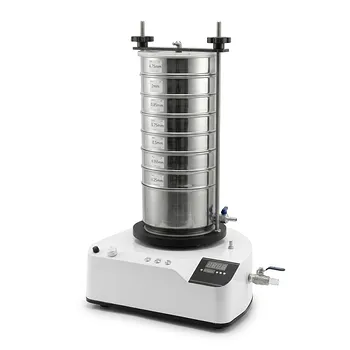
Ultrasonic dispersion equipment acts as the primary homogenization agent during the pretreatment phase of graphene-reinforced aluminum-tin (Al-Sn) nanocomposite preparation. It employs high-frequency mechanical vibrations to generate cavitation effects within a liquid medium, effectively shattering agglomerated graphene layers. This ensures the graphene is uniformly mixed with aluminum and tin powders, preventing clustering and guaranteeing the even distribution of the reinforcement phase throughout the metal matrix.
The primary goal of ultrasonic treatment is to overcome the strong cohesive forces between graphene layers. By converting electrical energy into intense mechanical shock waves, the equipment transforms a disparate mixture of powders into a homogeneous suspension, creating the essential foundation for a structurally sound composite.
The Mechanics of De-agglomeration
Harnessing Cavitation Effects
The equipment functions by creating acoustic cavitation—the formation, growth, and violent collapse of microscopic vacuum bubbles in the liquid. When these bubbles collapse, they release intense localized energy and shock waves. This mechanism provides the physical force required to separate particles that static mixing cannot move.
Breaking Particle Clusters
Graphene has a natural tendency to stack and clump due to Van der Waals forces. The high-frequency vibrations generated by the ultrasonic equipment disrupt these bonds. This process breaks down large agglomerates into individual or few-layer sheets, preparing them for integration with the metal powders.
Ensuring Homogeneity in the Matrix
Preliminary Uniform Mixing
Before the composite is solidified, the graphene, aluminum, and tin powders must be mixed in a liquid medium. Ultrasonic dispersion facilitates a preliminary uniform mixing state. This step is critical because once the liquid is removed or the metal is processed, redistribution of the nanoparticles becomes nearly impossible.
Optimizing the Reinforcement Phase
For a nanocomposite to exhibit enhanced properties, the "reinforcement phase" (the graphene) must be evenly spread within the "matrix" (the Al-Sn alloy). Ultrasonic treatment ensures that the graphene does not remain distinct from the metal powders but is physically dispersed among them, maximizing the contact surface area between the reinforcement and the matrix.
Understanding the Trade-offs
Intensity vs. Preservation
While ultrasonic dispersion is highly effective at de-agglomeration, it relies on intense shear forces. It is far more powerful than traditional methods like magnetic stirring, which often fail to break nanoscale agglomerations. However, the process must be carefully controlled; excessive sonication energy or duration could potentially damage the structural integrity of the graphene sheets or alter the morphology of the metal powders excessively.
Dependence on Liquid Media
This process is strictly dependent on the presence of a liquid medium. The cavitation effect cannot occur in dry powders. Therefore, the choice of the liquid solvent is integral to the success of the dispersion, as it must support the cavitation process without chemically reacting adversely with the aluminum or tin precursors.
Making the Right Choice for Your Goal
To maximize the quality of your Al-Sn nanocomposites, consider your specific processing objectives:
- If your primary focus is Structural Homogeneity: Prioritize ultrasonic dispersion to completely eliminate graphene agglomerates, ensuring isotropic properties in the final material.
- If your primary focus is Process Efficiency: Utilize ultrasonic treatment to achieve rapid mixing and de-agglomeration that mechanical stirring cannot achieve in a comparable timeframe.
Ultrasonic dispersion is not merely a mixing step; it is the fundamental process that enables the nanoscale integration of graphene into the aluminum-tin matrix.
Summary Table:
| Feature | Role in Pretreatment | Benefit for Al-Sn Composites |
|---|---|---|
| Acoustic Cavitation | Generates intense localized shock waves | Breaks strong Van der Waals forces between graphene layers |
| De-agglomeration | Shatters particle clusters into individual sheets | Prevents clustering and ensures nanoscale integration |
| High-Frequency Vibration | Converts electrical energy to mechanical force | Achieves homogeneity faster than traditional magnetic stirring |
| Matrix Uniformity | Distributes reinforcement phase evenly | Maximizes contact surface area for enhanced structural properties |
Elevate Your Material Research with KINTEK
Precise dispersion is the foundation of high-performance nanocomposites. At KINTEK, we specialize in providing the advanced laboratory equipment necessary for cutting-edge material science. Whether you are preparing graphene-reinforced matrices or developing new alloys, our high-frequency ultrasonic dispersion tools, crushing and milling systems, and hydraulic presses ensure your materials achieve the structural homogeneity required for success.
From high-temperature furnaces for sintering to specialized battery research tools and cooling solutions, KINTEK offers a comprehensive range of equipment designed for precision and durability. Don't let agglomeration compromise your results. Contact us today to discover how our tailored laboratory solutions can optimize your Al-Sn nanocomposite production and enhance your research efficiency.
Related Products
- Filter Testing Machine FPV for Dispersion Properties of Polymers and Pigments
- Customizable XRD Sample Holders for Diverse Research Applications
- Lab Sterile Slapping Type Homogenizer for Tissue Mashing and Dispersing
- Laboratory Test Sieves and Vibratory Sieve Shaker Machine
- Three-dimensional electromagnetic sieving instrument
People Also Ask
- What is a filter tester? A Guide to Measuring Filtration Efficiency & Performance
- What is the role of high-purity nitrogen in a supercritical water test loop? Ensure Test Data Integrity
- Why are porous ceramic filters utilized in methane pyrolysis? Protect Your Assets with High-Precision Filtration
- How is a laboratory analytical balance utilized in studies of capillary water absorption kinetics? | Precision Data
- What is the best solvent for FTIR? Master Solvent Selection for Clear, Accurate Spectra