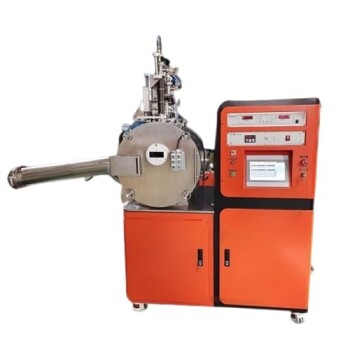
Vacuum Induction Melting (VIM) functions as the critical initial processing step for Ni–Ti-based shape memory alloys, designed to melt high-purity raw materials like nickel, titanium, and iron via electromagnetic induction. Its primary purpose is to establish a high-vacuum environment that strictly prevents oxidation and gas contamination, which are otherwise inevitable when processing reactive metals. By eliminating these contaminants, VIM ensures precise control over the alloy’s chemical composition before any further structural optimization occurs.
Core Takeaway The defining value of VIM is its ability to handle the high reactivity of titanium without compromising material integrity. It solves the "purity problem" by isolating the melt from oxygen, establishing the exact chemical baseline required for the sensitive performance of shape memory alloys.
The Mechanism of Action
Electromagnetic Induction Heating
VIM equipment does not rely on external heat sources like combustion. Instead, it utilizes medium-frequency electromagnetic induction.
Induction coils generate eddy currents directly within the metal conductor (the charge). This internal resistance heats the charge rapidly, allowing for a short melting cycle and efficient energy use.
The Protective Vacuum Environment
The entire melting process occurs within a sealed chamber under vacuum conditions (often concluding around 0.005 Torr for high-value alloys).
This vacuum is not merely for pressure control; it is an isolation barrier. It facilitates the outgassing of volatile impurities that might be present in the raw stock, ensuring they are removed rather than trapped in the final alloy.
Why VIM is Essential for Ni–Ti Alloys
Managing Titanium Reactivity
Titanium is the "problem child" in this alloy pairing because it is highly reactive with oxygen.
If melted in open air, titanium would instantly oxidize, ruining the material properties. The VIM vacuum environment is the primary safeguard against this oxidation contamination, preserving the metallic titanium for the alloy matrix.
Precise Composition Control
Shape memory alloys rely on exact atomic ratios to function correctly.
Because VIM prevents the loss of elements to oxidation or gas inhalation, it allows for accurate control of the alloy's composition. Manufacturers can be certain that the ratio of Nickel to Titanium put into the furnace is maintained in the final output.
Thermal Cycle Management
The equipment offers high control over both heating and cooling rates.
Induction coils allow for rapid melting, but once power is cut, the system permits rapid cooling and solidification. This control is beneficial for establishing the initial microstructure and minimizing the segregation of elements during solidification.
Understanding the Limitations
It Is Primarily an Initial Step
While VIM is excellent for chemical purity, it is often not the final step for structural perfection.
VIM produces the "initial experimental metal electrodes" or blanks. These ingots often require subsequent structural optimization, such as Vacuum Arc Remelting (VAR), to further refine the grain structure and eliminate microscopic defects.
Scale and Complexity
VIM is a batch process restricted by the size of the melting chamber.
While it allows for easy control of temperature and pressure, the evacuation time and chamber size limit the throughput compared to continuous casting methods. It is best reserved for high-value materials where purity is more critical than volume.
Making the Right Choice for Your Goal
VIM is rarely a standalone solution for finished components, but it is the non-negotiable starting point for high-performance Ni–Ti alloys.
- If your primary focus is Chemical Purity: VIM is mandatory to prevent titanium oxidation and ensure the alloy meets strict compositional specifications.
- If your primary focus is Structural Refinement: You must view VIM as the "setup" phase that creates the clean feedstock required for secondary processing like Vacuum Arc Remelting.
Summary: VIM provides the chemically pure, oxide-free foundation necessary for Ni–Ti alloys to achieve their unique shape memory properties.
Summary Table:
| Feature | VIM Function & Benefit |
|---|---|
| Primary Heating | Medium-frequency electromagnetic induction for rapid, internal heating |
| Environment | High-vacuum chamber (approx. 0.005 Torr) to eliminate oxygen/nitrogen |
| Material Integrity | Prevents titanium oxidation and facilitates outgassing of volatile impurities |
| Composition Control | Maintains exact atomic ratios required for shape memory performance |
| Key Outcome | Produces chemically pure initial electrodes/blanks for further refinement |
Elevate Your Material Research with KINTEK Precision
High-performance Ni–Ti alloys demand an environment free from contamination. KINTEK specializes in advanced laboratory equipment, offering high-temperature vacuum furnaces and induction melting systems designed to meet the rigorous standards of shape memory alloy production.
Whether you are focusing on vacuum or atmosphere furnaces, induction melting, or secondary refinement using our hydraulic presses and crushing systems, KINTEK provides the comprehensive tools necessary for precise metallurgical control.
Ready to achieve superior chemical purity in your alloys? Contact our experts today to discover how our tailored solutions can optimize your lab's research and development workflow.
References
- Kinshuk Dasgupta, Vivekanand Kain. A journey of materials development illustrated through shape memory alloy and carbon-based materials. DOI: 10.18520/cs/v123/i3/417-428
This article is also based on technical information from Kintek Solution Knowledge Base .
Related Products
- Lab-Scale Vacuum Induction Melting Furnace
- Vacuum Induction Melting Spinning System Arc Melting Furnace
- Vacuum Heat Treat Furnace and Levitation Induction Melting Furnace
- Vacuum Arc Induction Melting Furnace
- Non Consumable Vacuum Arc Induction Melting Furnace
People Also Ask
- How do vacuum induction or arc melting furnaces facilitate the synthesis of U-Al-C MAX phases? Precision Heat & Purity
- Why use VIM for rare earth steel? Essential Precision for Melting Reactive Lanthanum and Cerium
- What types of metals are typically processed in a vacuum induction melting furnace? High-Purity Alloys for Critical Applications
- What is the primary function of a vacuum induction melting furnace in Ni-Mo-Cr-Fe master alloy prep? Ensure High Purity
- What are the advantages of a vacuum induction melting furnace? Achieve High-Purity Alloys with Precision VIM