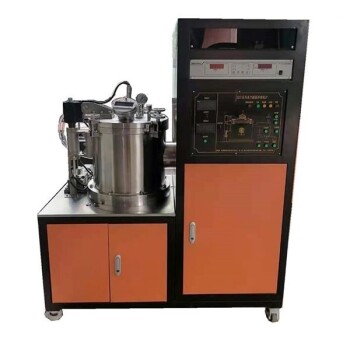
Precision is the defining requirement for manufacturing functional Nickel-Titanium (TiNi) alloys. The induction melting furnace serves as the critical processing tool that melts titanium sponge and nickel under strictly controlled conditions to achieve exact chemical ratios. This process is not merely about liquefying metal; it is the fundamental step that secures the alloy's advanced mechanical properties for high-stakes applications.
The core value of an induction melting furnace is its ability to ensure precise compositional control through rapid, uniform heating. Without this specific melting environment, it is impossible to reliably stabilize the shape memory and superelasticity effects required for critical medical implants.
The Critical Role of Compositional Accuracy
Defining Material Performance
The utility of a TiNi alloy is entirely dependent on its chemical composition. The induction melting furnace allows manufacturers to achieve specific compositional ratios with high accuracy. This precision is what dictates the alloy's shape memory effect (the ability to return to a pre-defined shape) and superelasticity (the ability to withstand immense deformation without permanent damage).
Meeting Medical Standards
For industries like healthcare, "close enough" is not acceptable. The mechanical performance of medical implants—such as stents or orthopedic devices—relies on the high damping characteristics and durability of the base material. The induction furnace provides the controlled environment necessary to produce base materials that meet these rigorous safety and performance standards.
Mechanisms of Homogeneity and Purity
Electromagnetic Stirring for Uniformity
Achieving a precise ratio is difficult if the elements do not mix perfectly. While the primary function is melting, the induction process inherently generates an electromagnetic stirring effect. This force creates movement within the liquid melt, ensuring that the nickel and titanium are mixed thoroughly at the atomic scale, preventing the segregation of elements that would lead to inconsistent performance.
Controlled Environmental Protection
Titanium is highly reactive to oxygen and nitrogen when molten. The induction melting furnace operates within a controlled environment (often vacuum or inert gas). This isolation prevents atmospheric contamination, ensuring the final alloy retains high purity and creating a clean foundation for subsequent processing steps.
Understanding the Process Sensitivities
While induction melting is superior for TiNi preparation, it requires rigorous management of process variables to be effective.
The Risk of Contamination
Because the process relies on high temperatures and reactive materials like titanium, the integrity of the controlled environment is paramount. Any breach in the vacuum or inert gas shield will lead to immediate oxidation, destroying the material's properties.
Crucible Compatibility
The high heat required to melt titanium sponge can sometimes lead to reactions with the containment vessel (crucible). Operators must ensure the induction parameters allow for rapid melting to minimize the time the molten alloy is in contact with the crucible walls, thereby reducing the risk of impurity uptake.
Making the Right Choice for Your Goal
To maximize the potential of your TiNi base materials, align your processing controls with your specific end-use requirements:
- If your primary focus is Medical Safety: Prioritize the controlled environment aspects of the furnace to eliminate impurities and guarantee the biocompatibility of the implant material.
- If your primary focus is Mechanical Consistency: Focus on the electromagnetic stirring capabilities to ensure a homogeneous mixture, which guarantees uniform superelasticity across the entire ingot.
The induction melting furnace is not just a heat source; it is the primary instrument of quality control in the creation of advanced smart materials.
Summary Table:
| Feature | Role in TiNi Alloy Preparation | Key Benefit |
|---|---|---|
| Compositional Control | Precise ratio of Ni to Ti elements | Ensures stable shape memory & superelasticity |
| Electromagnetic Stirring | Atomic-scale mixing of molten metals | Guarantees material homogeneity & consistent performance |
| Controlled Environment | Vacuum or inert gas protection | Prevents oxidation & atmospheric contamination |
| Rapid Heating | High-efficiency thermal transfer | Minimizes crucible reaction time & maintains purity |
Elevate Your Material Science with KINTEK Precision
Achieving the perfect Nickel-Titanium alloy requires more than just heat; it requires absolute control. KINTEK specializes in advanced laboratory equipment designed for the most demanding applications. Our high-performance induction melting furnaces provide the electromagnetic stirring and atmospheric purity essential for medical-grade TiNi alloys.
Beyond melting, KINTEK offers a comprehensive suite of solutions, including:
- Thermal Processing: Muffle, tube, and vacuum furnaces for precise heat treatment.
- Sample Preparation: Crushing, milling systems, and hydraulic presses (pellet, hot, isostatic).
- Advanced Research Tools: CVD/PECVD systems, high-pressure reactors, and battery research consumables.
- Lab Essentials: High-purity ceramics, crucibles, and cooling solutions.
Ready to secure the mechanical properties of your next innovation? Contact our technical experts today to find the ideal induction melting system for your laboratory.
References
- E. S. Vikulova, N. B. Morozova. MOCVD of Noble Metal Film Materials for Medical Implants: Microstructure and Biocompatibility of Ir and Au/Ir Coatings on TiNi. DOI: 10.3390/coatings11060638
This article is also based on technical information from Kintek Solution Knowledge Base .
Related Products
- Lab-Scale Vacuum Induction Melting Furnace
- Vacuum Heat Treat Furnace and Levitation Induction Melting Furnace
- Non Consumable Vacuum Arc Induction Melting Furnace
- Vacuum Arc Induction Melting Furnace
- 600T Vacuum Induction Hot Press Furnace for Heat Treat and Sintering
People Also Ask
- How do vacuum induction or arc melting furnaces facilitate the synthesis of U-Al-C MAX phases? Precision Heat & Purity
- Why use VIM for rare earth steel? Essential Precision for Melting Reactive Lanthanum and Cerium
- What is the primary function of a vacuum induction melting furnace in Ni-Mo-Cr-Fe master alloy prep? Ensure High Purity
- What types of metals are typically processed in a vacuum induction melting furnace? High-Purity Alloys for Critical Applications
- What are the key components inside the vacuum chamber of a vacuum induction melting furnace? A Guide to the Core Melting Assembly