Knowledge What is the importance of ash determination in foods? A Key to Quality, Nutrition & Purity
Author avatar

Tech Team · Kintek Solution

Updated 1 week ago

What is the importance of ash determination in foods? A Key to Quality, Nutrition & Purity


At its core, ash determination in food science is the process of measuring the total amount of inorganic minerals remaining after all organic matter has been burned away. This simple measurement serves as a fundamental indicator of a food's nutritional value, processing quality, and overall purity.

While ash determination provides a single number representing total mineral content, its true importance lies in what that number reveals about a food's nutritional profile, production integrity, and potential adulteration.
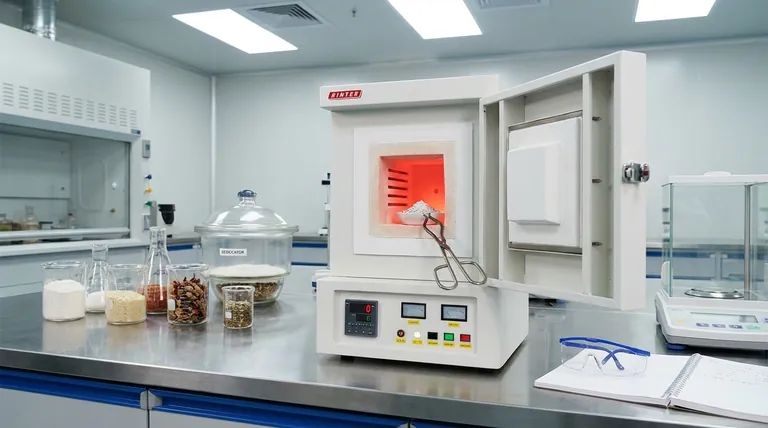
What is the importance of ash determination in foods? A Key to Quality, Nutrition & Purity

Ash as a Measure of Nutritional Value

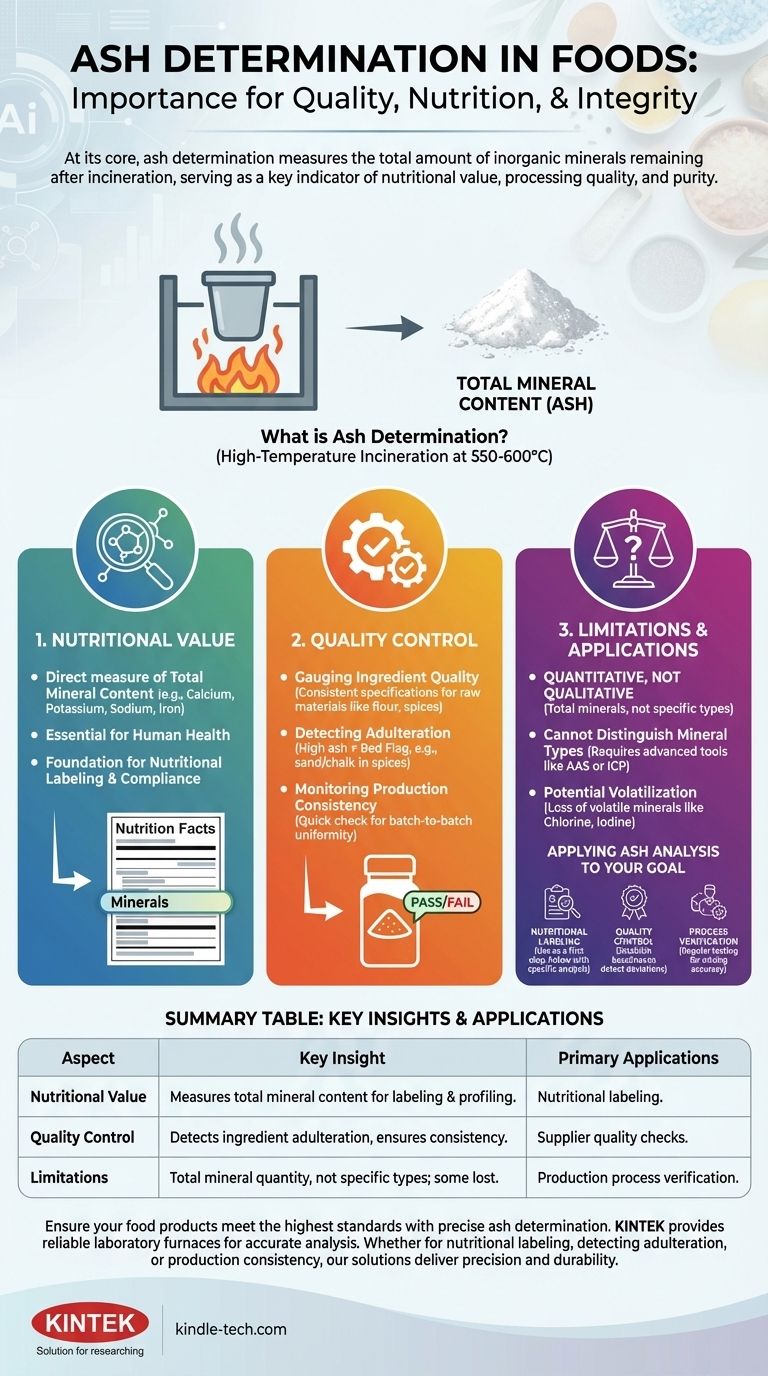
Ash is what remains after a food sample is subjected to high temperatures (typically 550-600°C), a process called incineration. This residue is primarily composed of inorganic minerals.

The Link to Mineral Content

The ash content is a direct measure of the total mineral content in a food. These minerals, such as calcium, potassium, sodium, and iron, are essential nutrients for human health.

Foundation for Nutritional Labeling

For food manufacturers, determining ash content is a crucial first step in nutritional analysis. It provides the total mineral figure, which is a component of the overall nutritional profile required for labeling and compliance.

A Critical Tool for Quality Control

Beyond nutrition, ash measurement is a powerful and efficient tool for maintaining quality and safety standards throughout the food production chain.

Gauging Ingredient Quality

The ash content of raw materials like flour, spices, or juice concentrates should be consistent. A deviation from the established specification can indicate a lower quality ingredient or a problem with the supplier's process.

Detecting Adulteration

An abnormally high ash content is a classic red flag for adulteration. For example, ground spices with a higher-than-expected ash value may have been diluted with sand, chalk, or other cheap inorganic fillers.

Monitoring Production Consistency

For multi-ingredient products, a consistent ash value in the final product confirms that the formulation and mixing process are performing correctly. It is a quick check to ensure batch-to-batch uniformity.

Understanding the Limitations of Ash Analysis

While invaluable, it is critical to understand what ash determination does and does not tell you. Its power lies in its simplicity, but that is also its main limitation.

It's a Total, Not a Specific, Measurement

Ash analysis provides a quantitative, but not qualitative, result. It tells you the total amount of minerals present but does not identify which specific minerals are there or in what quantity.

It Cannot Distinguish Mineral Types

An ash test cannot differentiate between a nutritionally valuable mineral like calcium and a less desirable one like sodium. For that, more advanced and expensive techniques like Atomic Absorption Spectroscopy (AAS) or Inductively Coupled Plasma (ICP) are required.

Potential for Volatilization

The high heat of incineration can cause some volatile minerals (such as chlorine, iodine, and selenium) to be lost. This can lead to a slight underestimation of the true total mineral content, a factor that must be understood when interpreting results.

Applying Ash Analysis to Your Objective

How you use ash data depends entirely on your goal. It is a versatile tool that can be applied in different ways to ensure product integrity.

  • If your primary focus is nutritional labeling: Use total ash as a fundamental first step, but recognize it must be followed by specific mineral analysis for accurate claims on nutrients like calcium or iron.
  • If your primary focus is quality control: Establish a baseline ash specification for your raw materials and finished products to quickly and cost-effectively detect deviations and potential adulteration.
  • If your primary focus is process verification: Regularly test finished product ash content to ensure your batching and mixing systems are operating with consistent accuracy.

Ultimately, ash determination is a foundational, cost-effective analysis that provides a powerful snapshot of a food product's overall integrity.

Summary Table:

Aspect Key Insight
Nutritional Value Measures total mineral content (e.g., calcium, potassium) for labeling and profiling.
Quality Control Detects ingredient adulteration (e.g., sand in spices) and ensures batch consistency.
Limitations Provides total mineral quantity, not specific types; volatile minerals may be lost during incineration.
Primary Applications Nutritional labeling, supplier quality checks, and production process verification.

Ensure your food products meet the highest standards of quality and safety with precise ash determination. KINTEK provides reliable laboratory furnaces and equipment essential for accurate ash content analysis. Whether you're focused on nutritional labeling, detecting adulteration, or maintaining production consistency, our solutions deliver the precision and durability your lab needs. Contact us today to learn how KINTEK can support your laboratory's quality control and analytical workflows!

Visual Guide
What is the importance of ash determination in foods? A Key to Quality, Nutrition & Purity Visual Guide

Related Products

People Also Ask

Related Products

1700℃ Muffle Oven Furnace for Laboratory

1700℃ Muffle Oven Furnace for Laboratory

Get superior heat control with our 1700℃ Muffle Furnace. Equipped with intelligent temperature microprocessor, TFT touch screen controller & advanced insulation materials for precise heating up to 1700C. Order now!

1800℃ Muffle Oven Furnace for Laboratory

1800℃ Muffle Oven Furnace for Laboratory

KT-18 muffle furnace with Japan Al2O3 polycrystalline fibe and Silicon Molybdenum heating element, up to 1900℃, PID temperature control and 7" smart touch screen. Compact design, low heat loss, and high energy efficiency. Safety interlock system and versatile functions.

1400℃ Muffle Oven Furnace for Laboratory

1400℃ Muffle Oven Furnace for Laboratory

Get precise high-temperature control up to 1500℃ with KT-14M Muffle furnace. Equipped with a smart touch screen controller and advanced insulation materials.

Laboratory Muffle Oven Furnace Bottom Lifting Muffle Furnace

Laboratory Muffle Oven Furnace Bottom Lifting Muffle Furnace

Efficiently produce batches with excellent temperature uniformity using our Bottom Lifting Furnace. Features two electric lifting stages and advanced temperature control up to 1600℃.

High Temperature Muffle Oven Furnace for Laboratory Debinding and Pre Sintering

High Temperature Muffle Oven Furnace for Laboratory Debinding and Pre Sintering

KT-MD High temperature debinding and pre-sintering furnace for ceramic materials with various molding processes. Ideal for electronic components such as MLCC and NFC.

1400℃ Laboratory Quartz Tube Furnace with Alumina Tube Tubular Furnace

1400℃ Laboratory Quartz Tube Furnace with Alumina Tube Tubular Furnace

Looking for a tube furnace for high-temperature applications? Our 1400℃ Tube Furnace with Alumina Tube is perfect for research and industrial use.

Vertical Laboratory Quartz Tube Furnace Tubular Furnace

Vertical Laboratory Quartz Tube Furnace Tubular Furnace

Elevate your experiments with our Vertical Tube Furnace. Versatile design allows for operation under various environments and heat treatment applications. Order now for precise results!

1700℃ Laboratory Quartz Tube Furnace with Alumina Tube Tubular Furnace

1700℃ Laboratory Quartz Tube Furnace with Alumina Tube Tubular Furnace

Looking for a high-temperature tube furnace? Check out our 1700℃ Tube Furnace with Alumina Tube. Perfect for research and industrial applications up to 1700C.

Multi Zone Laboratory Quartz Tube Furnace Tubular Furnace

Multi Zone Laboratory Quartz Tube Furnace Tubular Furnace

Experience precise, efficient thermal testing with our Multi Zone Tube Furnace. Independent heating zones and temperature sensors allow for controlled high-temperature gradient heating fields. Order now for advanced thermal analysis!

Laboratory Quartz Tube Furnace Tubular RTP Heating Furnace

Laboratory Quartz Tube Furnace Tubular RTP Heating Furnace

Get lightning-fast heating with our RTP Rapid Heating Tube Furnace. Designed for precise, high-speed heating and cooling with convenient sliding rail and TFT touch screen controller. Order now for ideal thermal processing!

1200℃ Split Tube Furnace with Quartz Tube Laboratory Tubular Furnace

1200℃ Split Tube Furnace with Quartz Tube Laboratory Tubular Furnace

KT-TF12 split tube furnace: high-purity insulation, embedded heating wire coils, and max. 1200C. Widely used for new materials and chemical vapour deposition.

1700℃ Controlled Atmosphere Furnace Nitrogen Inert Atmosphere Furnace

1700℃ Controlled Atmosphere Furnace Nitrogen Inert Atmosphere Furnace

KT-17A Controlled atmosphere furnace: 1700℃ heating, vacuum sealing technology, PID temperature control, and versatile TFT smart touch screen controller for laboratory and industrial use.

Rotary Tube Furnace Split Multi Heating Zone Rotating Tube Furnace

Rotary Tube Furnace Split Multi Heating Zone Rotating Tube Furnace

Multi zone rotary furnace for high-precision temperature control with 2-8 independent heating zones. Ideal for lithium ion battery electrode materials and high-temperature reactions. Can work under vacuum and controlled atmosphere.

High Pressure Laboratory Vacuum Tube Furnace Quartz Tubular Furnace

High Pressure Laboratory Vacuum Tube Furnace Quartz Tubular Furnace

KT-PTF High Pressure Tube Furnace: Compact split tube furnace with strong positive pressure resistance. Working temp up to 1100°C and pressure up to 15Mpa. Also works under controller atmosphere or high vacuum.

Laboratory Vacuum Tilt Rotary Tube Furnace Rotating Tube Furnace

Laboratory Vacuum Tilt Rotary Tube Furnace Rotating Tube Furnace

Discover the versatility of Laboratory Rotary Furnace: Ideal for calcination, drying, sintering, and high-temperature reactions. Adjustable rotating and tilting functions for optimal heating. Suitable for vacuum and controlled atmosphere environments. Learn more now!

1400℃ Controlled Atmosphere Furnace with Nitrogen and Inert Atmosphere

1400℃ Controlled Atmosphere Furnace with Nitrogen and Inert Atmosphere

Achieve precise heat treatment with KT-14A controlled atmosphere furnace. Vacuum sealed with a smart controller, it's ideal for lab and industrial use up to 1400℃.

Vacuum Sealed Continuous Working Rotary Tube Furnace Rotating Tube Furnace

Vacuum Sealed Continuous Working Rotary Tube Furnace Rotating Tube Furnace

Experience efficient material processing with our vacuum-sealed rotary tube furnace. Perfect for experiments or industrial production, equipped with optional features for controlled feeding and optimized results. Order now.

Dental Porcelain Zirconia Sintering Ceramic Furnace Chairside with Transformer

Dental Porcelain Zirconia Sintering Ceramic Furnace Chairside with Transformer

Experience top-notch sintering with Chairside Sintering Furnace with Transformer. Easy to operate, noise-free pallet, and automatic temperature calibration. Order now!

Vacuum Heat Treat and Sintering Furnace with 9MPa Air Pressure

Vacuum Heat Treat and Sintering Furnace with 9MPa Air Pressure

The air pressure sintering furnace is a high-tech equipment commonly used for the sintering of advanced ceramic materials. It combines vacuum sintering and pressure sintering techniques to achieve high-density and high-strength ceramics.

Customer Made Versatile CVD Tube Furnace Chemical Vapor Deposition Chamber System Equipment

Customer Made Versatile CVD Tube Furnace Chemical Vapor Deposition Chamber System Equipment

Get your exclusive CVD furnace with KT-CTF16 Customer Made Versatile Furnace. Customizable sliding, rotating, and tilting functions for precise reactions. Order now!


Leave Your Message