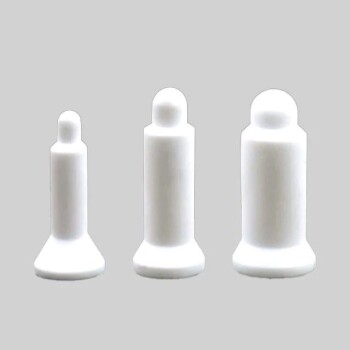
High-purity aluminum crucibles are essential in DSC wood powder analysis because they provide superior thermal conductivity and chemical inertness, ensuring rapid, uniform heat transfer. These properties allow for the precise detection of subtle heat flow changes associated with thermal stability and moisture content. Furthermore, the ability to hermetically seal these crucibles prevents the loss of volatile compounds from skewing baseline measurements.
The central value of high-purity aluminum crucibles lies in their ability to act as a high-fidelity interface between the sample and the sensor. By maximizing thermal sensitivity and minimizing chemical interference, they ensure that the resulting DSC data is an accurate reflection of the wood powder’s intrinsic properties.
Optimizing Heat Flow and Sensitivity
Achieving Rapid Thermal Equilibrium
Aluminum’s high thermal conductivity ensures the wood powder sample reaches temperature parity with the furnace quickly. This is vital for wood research, where small endothermic or exothermic events might otherwise be masked by thermal lag.
Capturing Subtle Transitions
High-purity vessels allow the DSC to detect minute changes in heat flow related to improved thermal stability or shifts in hygroscopicity (moisture absorption). Without this sensitivity, the subtle impacts of wood treatments or chemical modifications would be impossible to quantify.
Ensuring Uniform Distribution
The material properties of aluminum facilitate a uniform temperature profile throughout the sample mass. This prevents "hot spots" within the wood powder that could lead to inconsistent decomposition data or broad, unusable peaks on the DSC curve.
Preserving Sample Composition and Data Integrity
Preventing Volatile Interference
Wood naturally contains moisture and volatile organic compounds that escape upon heating. Sealed aluminum crucibles trap these substances, preventing mass loss from creating "noise" or artifacts that would otherwise disrupt the heat flow baseline.
Chemical Neutrality and Inertness
High-purity aluminum does not react with the organic polymers—cellulose, hemicellulose, and lignin—found in wood at standard testing temperatures. This ensures that the recorded signals originate solely from the wood's internal phase transitions and not from a secondary reaction with the container.
Baseline Stability
Because high-purity aluminum is manufactured to strict standards, it lacks the impurities that could cause unexpected catalytic effects. This results in a clean, reproducible baseline, which is the foundation for calculating accurate thermodynamic data.
Understanding the Trade-offs
Temperature Limitations
Aluminum has a relatively low melting point compared to ceramic alternatives like alumina (corundum). It is generally restricted to use below 600°C, making it unsuitable for high-temperature wood gasification or ash melting studies.
Pressure Risks in Sealed Pans
While sealed pans prevent volatile loss, they can build up significant internal pressure during wood decomposition. If the sample size is too large or the moisture content is too high, the crucible may deform or "burst," leading to a sudden baseline shift and potential damage to the DSC sensor.
One-Time Use Reality
Unlike ceramic crucibles that can often be cleaned and reused, aluminum pans are typically deformed during the sealing process and are intended for single use. While this increases the cost per test, it eliminates the risk of cross-contamination between different wood species or treatments.
Making the Right Choice for Your Goal
When selecting crucibles for wood powder analysis, your choice should be driven by the specific thermal phenomena you intend to measure.
- If your primary focus is detecting subtle phase changes or moisture effects: Utilize high-purity, hermetically sealed aluminum pans to maximize thermal sensitivity and prevent volatile interference.
- If your primary focus is high-temperature decomposition or carbonization (above 600°C): Opt for high-purity alumina (ceramic) crucibles, which offer the necessary heat resistance and chemical stability for extreme environments.
- If your primary focus is kinetic modeling of wood degradation: Ensure the use of high-purity aluminum to maintain the most consistent and rapid heat transfer possible, which is critical for accurate kinetic calculations.
Selecting the appropriate high-purity vessel is not merely a logistical detail, but a fundamental requirement for generating credible and reproducible thermal analysis data.
Summary Table:
| Key Feature | Benefit for Wood Powder DSC | Analysis Focus |
|---|---|---|
| High Thermal Conductivity | Ensures rapid equilibrium and detects subtle phase changes | Moisture & thermal stability |
| Chemical Inertness | Prevents reactions with cellulose, hemicellulose, and lignin | Data integrity & baseline purity |
| Hermetic Sealing | Traps volatiles and moisture to prevent baseline noise | Volatile compound retention |
| Uniform Heat Distribution | Eliminates hot spots for consistent decomposition data | Kinetic modeling & degradation |
Elevate Your Thermal Analysis Precision with KINTEK
Achieving credible and reproducible results in wood research requires high-fidelity interfaces between your sample and sensor. KINTEK specializes in providing premium laboratory consumables, including high-purity aluminum and ceramic crucibles specifically designed for demanding DSC and TGA applications.
Our extensive portfolio supports every stage of your material research:
- Sample Preparation: Advanced crushing and milling systems to produce uniform wood powders.
- Thermal Equipment: A full range of high-temperature furnaces (muffle, tube, vacuum) and high-pressure reactors.
- Laboratory Essentials: Precise hydraulic presses, electrolytic cells, and high-quality ceramic labware.
Whether you are analyzing subtle phase transitions or high-temperature carbonization, KINTEK provides the reliability and expertise your lab needs to succeed.
Contact our specialists today to find the perfect solution for your research!
References
- Ziheng Wang, Weiqi Leng. Mechanistic Study of the Synergistic Interaction of Furfuryl Alcohol and Caprolactam in the Modification of Pinus massoniana Earlywood and Latewood. DOI: 10.3390/f14061242
This article is also based on technical information from Kintek Solution Knowledge Base .
Related Products
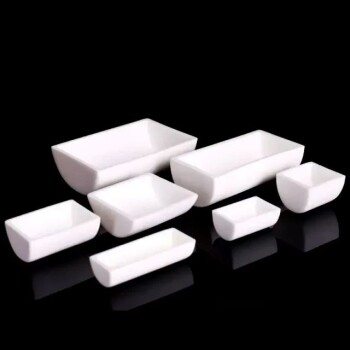
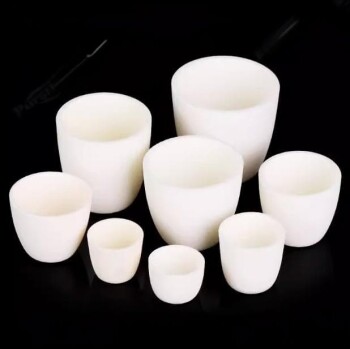
- Engineering Advanced Fine Alumina Al2O3 Ceramic Crucible for Laboratory Muffle Furnace
- Engineering Advanced Fine Ceramics Alumina Crucibles (Al2O3) for Thermal Analysis TGA DTA
- Engineering Advanced Fine Ceramics Alumina Al2O3 Crucible With Lid Cylindrical Laboratory Crucible
- High Purity Pure Graphite Crucible for Evaporation
- Alumina Al2O3 Ceramic Crucible Semicircle Boat with Lid for Engineering Advanced Fine Ceramics
People Also Ask
- What crucible is used in muffle furnace? Select the Right Material for Your Application
- Why are alumina crucibles and mother powder essential for LATP sintering? Optimize Your Solid Electrolyte Performance
- Why are high-purity alumina crucibles used for liquid lead corrosion experiments? Ensure Data Accuracy at 550°C
- Why Use Alumina Crucibles & Powder Burial for NaSICON? Ensure Phase Purity and Prevent Elemental Volatilization
- What is the primary purpose of using alumina crucibles for LLTO ceramics? Optimize Your High-Temperature Sintering