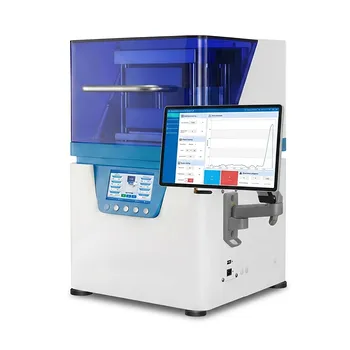
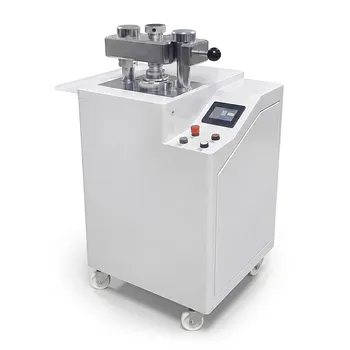
Hydraulic presses are the cornerstone of electrode uniformity. They ensure that nitrogen-doped carbon fiber electrodes possess identical mass loading and density across the entire assembly. This symmetry is critical because any disparity between the two electrodes in a symmetrical supercapacitor will skew the measurements of energy density, power density, and cycle life, leading to inaccurate performance data.
Pressure-forming equipment eliminates the variability inherent in manual electrode preparation by standardizing mass loading and minimizing interfacial contact resistance. This process ensures the supercapacitor's electrochemical profile is a reflection of material science rather than assembly defects.
Achieving Electrode Symmetry and Consistency
Standardizing Mass Loading
In a symmetrical supercapacitor, the performance is limited by the weaker of the two electrodes. Pressure-forming equipment allows for the precise control of electrode thickness and mass, ensuring both sides of the cell are perfectly balanced.
Ensuring Performance Accuracy
Consistency between electrodes is essential for accurately reflecting a material's real-world performance. Without uniform pressure, variations in compactness can lead to misleading data regarding the material's true energy density and power density.
Optimizing Volumetric Density
By applying controlled force, hydraulic presses increase the packing density of the carbon fiber material. This maximizes the amount of active material within a fixed volume, which is a key metric for practical energy storage applications.
Optimizing Electrical and Mechanical Interconnects
Reducing Interfacial Contact Resistance
High-pressure application, often ranging from 10 to 30 MPa, forces the active material into intimate contact with the current collector. This physical compression significantly minimizes the resistance at the interface where the carbon fiber meets the metal substrate.
Improving Charge Transfer Efficiency
When the active material, conductive agents, and binders are tightly pressed, the internal electron pathways are shortened. This optimization leads to enhanced charge transfer efficiency and superior rate performance under high current densities.
Enhancing Structural Integrity
The mechanical bonding created by a hydraulic press prevents the electrode material from delaminating during electrolyte immersion. This structural stability is vital for maintaining electrode shape and function over thousands of charge-discharge cycles.
Understanding the Trade-offs and Limitations
Risk of Over-compression
Applying excessive pressure can lead to the "crushing" of the porous structure within carbon fiber electrodes. If the pores are closed off, the electrolyte cannot penetrate the material, which actually decreases the available surface area and reduces capacitance.
Current Collector Deformation
High pressures, particularly those exceeding 30 MPa, can physically deform delicate current collectors like nickel foam or thin foils. Such deformation can create uneven stress points that lead to premature mechanical failure of the electrode during testing.
Binder Distribution Issues
While pressure aids in bonding, it can also cause the migration of liquid binders if the slurry is not properly dried. This can result in a "skin" of binder on the surface, which increases electrical resistance and blocks ion transport.
Applying Pressure-Forming Strategies to Your Project
Making the Right Choice for Your Goal
To achieve the best results from your pressure-forming equipment, tailor the application to your specific research or production objectives.
- If your primary focus is maximizing rate performance: Apply higher pressures (up to 30 MPa) to minimize contact resistance, ensuring the fastest possible electron transport during high-current cycling.
- If your primary focus is long-term cycle life: Focus on the consistency of the pressure application to ensure the mechanical bond between the carbon fiber and the current collector remains stable throughout electrolyte expansion and contraction.
- If your primary focus is material characterization: Prioritize electrode symmetry by using precision molds to ensure the mass loading of the anode and cathode are identical within a fraction of a milligram.
Precise pressure control transforms a raw material mixture into a high-performance electrode capable of delivering reliable and reproducible energy storage data.
Summary Table:
| Key Benefit | Technical Impact | Research Outcome |
|---|---|---|
| Electrode Uniformity | Standardized mass loading & density | Reliable, reproducible performance data |
| Reduced Resistance | Minimized interfacial contact resistance | Enhanced charge transfer & rate performance |
| Structural Integrity | Stronger mechanical bonding | Improved cycle life & prevents delamination |
| Volumetric Density | Increased material packing density | Maximized active material in fixed volumes |
Precision Engineering for Your Energy Storage Research
Achieving perfect symmetry in carbon fiber electrodes requires the highest level of pressure control. KINTEK specializes in advanced laboratory equipment designed to eliminate assembly defects and maximize material performance. Whether you need high-precision hydraulic presses (pellet, hot, or isostatic) for electrode forming or high-temperature furnaces for material synthesis, KINTEK provides the tools necessary for breakthrough results.
Our extensive portfolio also includes:
- High-temperature high-pressure reactors and autoclaves
- Electrolytic cells and electrodes for electrochemical testing
- Battery research tools, consumables, and cooling solutions
- Crushing, milling, and sieving systems for material preparation
Ready to enhance your lab's efficiency and data accuracy? Contact KINTEK today to discuss your specific application and find the perfect equipment solution for your research goals.
References
- Zhen Zhang, Yiqiang Wu. N-Doped Carbon Fibers Derived from Porous Wood Fibers Encapsulated in a Zeolitic Imidazolate Framework as an Electrode Material for Supercapacitors. DOI: 10.3390/molecules28073081
This article is also based on technical information from Kintek Solution Knowledge Base .
Related Products
- Automatic Hydraulic Hot Press with 500x500mm Heating Plates and Multi Stage PLC Control for Material Sintering
- Heated Hydraulic Press Machine with Heated Plates for Vacuum Box Laboratory Hot Press
- Automatic High Temperature Heated Hydraulic Press Machine with Heated Plates for Lab
- Manual High Temperature Heated Hydraulic Press Machine with Heated Plates for Lab
- 24T 30T 60T Heated Hydraulic Press Machine with Heated Plates for Laboratory Hot Press
People Also Ask
- How do hydraulic presses facilitate material solidification in Low-Temperature LPS? Optimize Your Material Densification
- Why is 800 MPa required for TiNiPdCu alloy green bodies? Master High-Density Compaction for Superior Material Strength
- How does KBr pellet preparation facilitate FTIR of high-ash mud? Precision Sample Prep for Structural Analysis
- Why is an industrial hydraulic press with precision stainless steel molds used? For Uniform Mo-Fe Precursor Compacts.
- Purpose of Coaxial Ring Molds & Presses in EM Testing? Achieve Precise VNA Data & Fit