Knowledge muffle furnace What is the material used in muffle furnace? Discover the Heat-Resistant Layers Inside
Author avatar

Tech Team · Kintek Solution

Updated 2 months ago

What is the material used in muffle furnace? Discover the Heat-Resistant Layers Inside


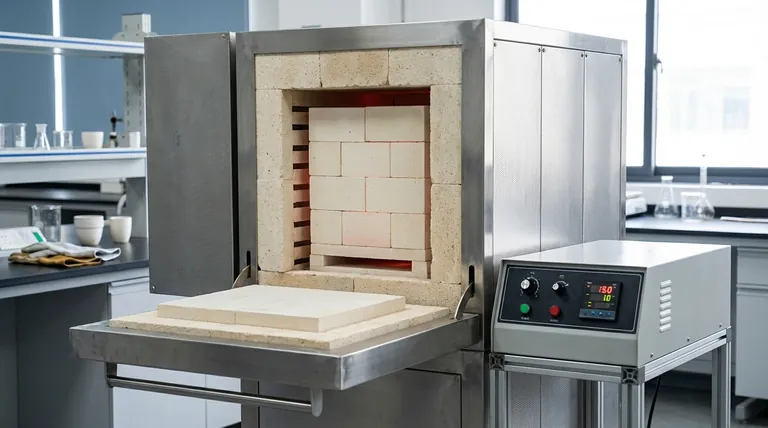
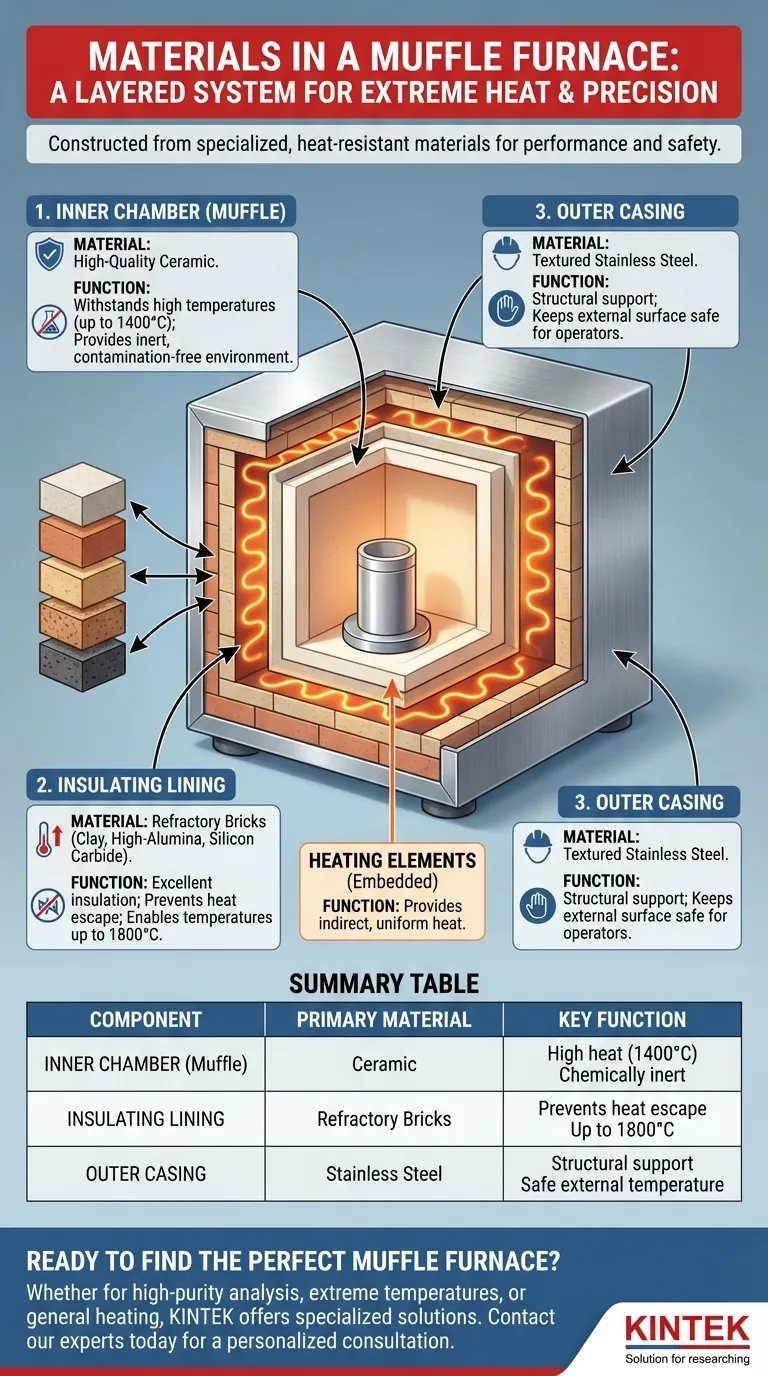
At its core, a muffle furnace is constructed from a combination of specialized, heat-resistant materials. The inner chamber, or "muffle," is made of ceramic to withstand high temperatures and isolate the sample. This chamber is then surrounded by an insulating lining of refractory bricks, all of which is contained within a durable outer casing, typically made of stainless steel.

A muffle furnace is not made of a single material, but is a layered system. Each material is selected for its specific role in containing extreme heat, insulating the chamber, and providing structural integrity, ensuring both performance and safety.
What is the material used in muffle furnace? Discover the Heat-Resistant Layers Inside

The Core Components and Their Materials

To understand a muffle furnace, you must understand its layered construction. Each layer serves a distinct and critical purpose, from the innermost chamber that holds the sample to the external housing that protects the user.

The Inner Chamber (The Muffle)

The heart of the furnace is the muffle, a box-like inner chamber. This component is almost always made from a high-quality ceramic material.

The choice of ceramic is deliberate. It can withstand constant high temperatures, often up to 1400°C, without melting or degrading. Critically, it also provides a chemically inert environment, preventing the sample from being contaminated by the heating elements or fuel combustion byproducts.

The Insulating Lining

Surrounding the ceramic muffle is a thick lining of refractory materials. These are materials specifically designed to resist heat and provide excellent insulation.

Common refractory materials include clay brick, high-alumina brick, silicon carbide, and refractory concrete. The primary job of this layer is to prevent heat from escaping, which ensures the furnace operates efficiently and can reach its maximum temperature, sometimes as high as 1800°C.

The Heating Elements

The heating elements are embedded between the ceramic muffle and the refractory lining. This design is fundamental to how a muffle furnace works.

By enclosing the elements, the furnace provides indirect heat. This prevents direct contact between the heating source and the sample, which is essential for ensuring uniform heating and preventing contamination.

The Outer Casing

The entire internal assembly is housed within a casing made of textured stainless steel sheets. This outer shell provides structural support and protects the internal components. More importantly, thanks to the effective refractory insulation, it keeps the external surface at a safe temperature for operators.

Understanding the Trade-offs and Material Choices

The specific materials used in a muffle furnace are chosen based on its intended temperature range and application. Not all furnaces are built alike, and these differences have practical implications.

Not All Refractories Are Equal

The choice of refractory brick directly impacts the furnace's maximum operating temperature. A furnace using standard clay brick will have a lower temperature limit than one built with high-alumina or silicon carbide bricks, which are reserved for more demanding, higher-temperature processes.

The Critical Role of the Muffle

The ceramic muffle's primary function is to isolate the sample. This is non-negotiable for sensitive scientific applications like determining the ash content of a polymer or heat-treating a material in a controlled atmosphere where purity is paramount.

Thermal Shock and Durability

Both ceramic and refractory materials can be susceptible to thermal shock—cracking caused by rapid temperature changes. This is a key operational constraint. High-quality furnaces use materials engineered to better withstand this stress, but users must still follow proper heating and cooling protocols to extend the furnace's life.

Making the Right Choice for Your Goal

Understanding the material construction allows you to select the right tool for your specific task and use it effectively.

  • If your primary focus is high-purity analysis (e.g., ashing): The integrity of the ceramic muffle is your most critical feature, as it guarantees sample isolation.
  • If your primary focus is high-temperature metal treatment (e.g., annealing or sintering): The furnace's refractory lining (e.g., high-alumina) is key, as it determines the ability to reach and sustain temperatures up to 1800°C.
  • If your primary focus is general laboratory heating: A standard furnace combining a ceramic muffle with a reliable refractory brick insulation offers the best balance of performance and versatility.

By appreciating how these materials work together, you can better match the equipment's capabilities to your specific technical requirements.

Summary Table:

Component Primary Material Key Function
Inner Chamber (Muffle) Ceramic Withstands high heat (up to 1400°C); provides a chemically inert, contamination-free environment.
Insulating Lining Refractory Bricks (e.g., clay, high-alumina, silicon carbide) Prevents heat escape; enables higher temperatures (up to 1800°C) and efficient operation.
Outer Casing Stainless Steel Provides structural support and maintains a safe external temperature for operators.

Ready to find the perfect muffle furnace for your lab's specific needs?

Whether your priority is high-purity analysis, extreme temperature applications, or general laboratory heating, the right material construction is critical for performance, safety, and accurate results.

KINTEK specializes in lab equipment and consumables, serving laboratory needs. Our experts can help you select a muffle furnace with the ideal ceramic, refractory, and steel components to match your technical requirements and budget.

Contact us today for a personalized consultation and ensure your lab has the right tool for the job!

Visual Guide
What is the material used in muffle furnace? Discover the Heat-Resistant Layers Inside Visual Guide

Related Products

People Also Ask

Related Products

1200℃ Muffle Furnace Oven for Laboratory

1200℃ Muffle Furnace Oven for Laboratory

Upgrade your lab with our 1200℃ Muffle Furnace. Achieve fast, precise heating with Japan alumina fibers and Molybdenum coils. Features TFT touch screen controller for easy programming and data analysis. Order now!

1800℃ Muffle Oven Furnace for Laboratory

1800℃ Muffle Oven Furnace for Laboratory

KT-18 muffle furnace with Japan Al2O3 polycrystalline fibe and Silicon Molybdenum heating element, up to 1900℃, PID temperature control and 7" smart touch screen. Compact design, low heat loss, and high energy efficiency. Safety interlock system and versatile functions.

1400℃ Muffle Oven Furnace for Laboratory

1400℃ Muffle Oven Furnace for Laboratory

Get precise high-temperature control up to 1500℃ with KT-14M Muffle furnace. Equipped with a smart touch screen controller and advanced insulation materials.

1700℃ Muffle Oven Furnace for Laboratory

1700℃ Muffle Oven Furnace for Laboratory

Get superior heat control with our 1700℃ Muffle Furnace. Equipped with intelligent temperature microprocessor, TFT touch screen controller & advanced insulation materials for precise heating up to 1700C. Order now!

High Temperature Muffle Oven Furnace for Laboratory Debinding and Pre Sintering

High Temperature Muffle Oven Furnace for Laboratory Debinding and Pre Sintering

KT-MD High temperature debinding and pre-sintering furnace for ceramic materials with various molding processes. Ideal for electronic components such as MLCC and NFC.

Laboratory Muffle Oven Furnace Bottom Lifting Muffle Furnace

Laboratory Muffle Oven Furnace Bottom Lifting Muffle Furnace

Efficiently produce batches with excellent temperature uniformity using our Bottom Lifting Furnace. Features two electric lifting stages and advanced temperature control up to 1600℃.

Molybdenum Vacuum Heat Treat Furnace

Molybdenum Vacuum Heat Treat Furnace

Discover the benefits of a high-configuration molybdenum vacuum furnace with heat shield insulation. Ideal for high-purity, vacuum environments like sapphire crystal growth and heat treatment.

Multi-zone Laboratory Tube Furnace

Multi-zone Laboratory Tube Furnace

Experience precise, efficient thermal testing with our Multi Zone Tube Furnace. Independent heating zones and temperature sensors allow for controlled high-temperature gradient heating fields. Order now for advanced thermal analysis!

Ultra-High Temperature Graphite Vacuum Graphitization Furnace

Ultra-High Temperature Graphite Vacuum Graphitization Furnace

The ultra-high temperature graphitization furnace utilizes medium frequency induction heating in a vacuum or inert gas environment. The induction coil generates an alternating magnetic field, inducing eddy currents in the graphite crucible, which heats up and radiates heat to the workpiece, bringing it to the desired temperature. This furnace is primarily used for graphitization and sintering of carbon materials, carbon fiber materials, and other composite materials.

Vacuum Hot Press Furnace Machine Heated Vacuum Press

Vacuum Hot Press Furnace Machine Heated Vacuum Press

Discover the advantages of Vacuum Hot Press Furnace! Manufacture dense refractory metals & compounds, ceramics, and composites under high temp and pressure.

Vacuum Heat Treat and Molybdenum Wire Sintering Furnace for Vacuum Sintering

Vacuum Heat Treat and Molybdenum Wire Sintering Furnace for Vacuum Sintering

A vacuum molybdenum wire sintering furnace is a vertical or bedroom structure, which is suitable for withdrawal, brazing, sintering and degassing of metal materials under high vacuum and high temperature conditions. It is also suitable for dehydroxylation treatment of quartz materials.

Multi Heating Zones CVD Tube Furnace Machine Chemical Vapor Deposition Chamber System Equipment

Multi Heating Zones CVD Tube Furnace Machine Chemical Vapor Deposition Chamber System Equipment

KT-CTF14 Multi Heating Zones CVD Furnace - Precise Temperature Control and Gas Flow for Advanced Applications. Max temp up to 1200℃, 4 channels MFC mass flow meter, and 7" TFT touch screen controller.

Graphite Vacuum Furnace High Thermal Conductivity Film Graphitization Furnace

Graphite Vacuum Furnace High Thermal Conductivity Film Graphitization Furnace

The high thermal conductivity film graphitization furnace has uniform temperature, low energy consumption and can operate continuously.

600T Vacuum Induction Hot Press Furnace for Heat Treat and Sintering

600T Vacuum Induction Hot Press Furnace for Heat Treat and Sintering

Discover the 600T Vacuum Induction Hot Press Furnace, designed for high-temperature sintering experiments in vacuum or protected atmospheres. Its precise temperature and pressure control, adjustable working pressure, and advanced safety features make it ideal for nonmetal materials, carbon composites, ceramics, and metal powders.

Lab-Scale Vacuum Induction Melting Furnace

Lab-Scale Vacuum Induction Melting Furnace

Get precise alloy composition with our Vacuum Induction Melting Furnace. Ideal for aerospace, nuclear energy, and electronic industries. Order now for effective smelting and casting of metals and alloys.

Mesh belt controlled atmosphere furnace

Mesh belt controlled atmosphere furnace

Discover our KT-MB mesh belt sintering furnace - perfect for high-temperature sintering of electronic components & glass insulators. Available for open air or controlled atmosphere environments.

Horizontal High Temperature Graphite Vacuum Graphitization Furnace

Horizontal High Temperature Graphite Vacuum Graphitization Furnace

Horizontal Graphitization Furnace: This type of furnace is designed with the heating elements placed horizontally, allowing for uniform heating of the sample. It's well-suited for graphitizing large or bulky samples that require precise temperature control and uniformity.

Vacuum Heat Treat and Pressure Sintering Furnace for High Temperature Applications

Vacuum Heat Treat and Pressure Sintering Furnace for High Temperature Applications

Vacuum pressure sintering furnaces are designed for high temperature hot pressing applications in metal and ceramic sintering. Its advanced features ensure precise temperature control, reliable pressure maintenance, and a robust design for seamless operation.

1200℃ Controlled Atmosphere Furnace Nitrogen Inert Atmosphere Furnace

1200℃ Controlled Atmosphere Furnace Nitrogen Inert Atmosphere Furnace

Discover our KT-12A Pro Controlled atmosphere furnace - high precision, heavy duty vacuum chamber, versatile smart touch screen controller, and excellent temperature uniformity up to 1200C. Ideal for both laboratory and industrial application.

Vacuum Sealed Continuous Working Rotary Tube Furnace Rotating Tube Furnace

Vacuum Sealed Continuous Working Rotary Tube Furnace Rotating Tube Furnace

Experience efficient material processing with our vacuum-sealed rotary tube furnace. Perfect for experiments or industrial production, equipped with optional features for controlled feeding and optimized results. Order now.


Leave Your Message



















