Knowledge What is the most effective extraction method? Choose the Right CO2 Process for Your Product Goal
Author avatar

Tech Team · Kintek Solution

Updated 6 days ago

What is the most effective extraction method? Choose the Right CO2 Process for Your Product Goal


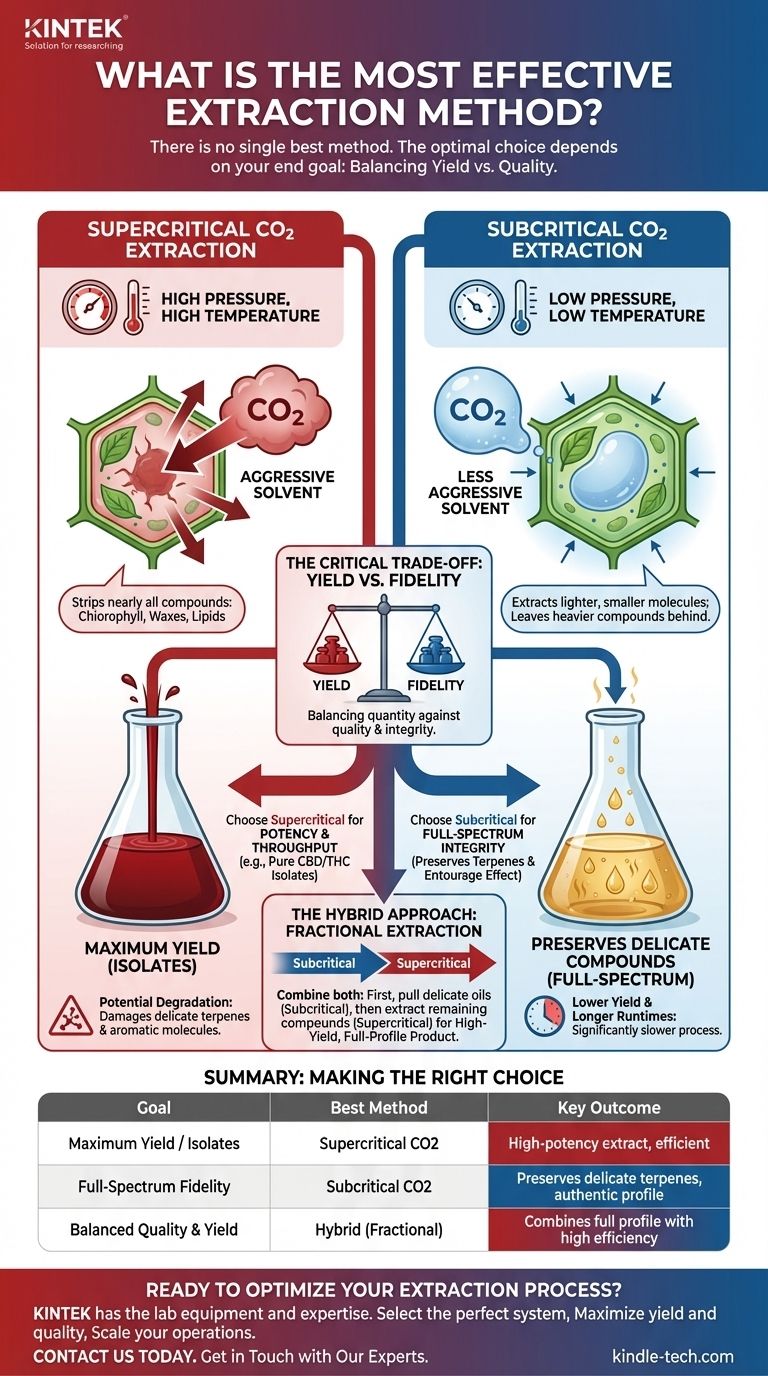
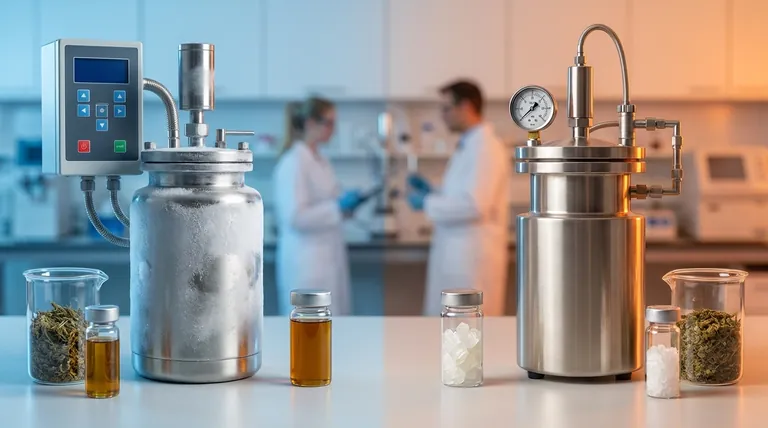
There is no single "most effective" extraction method. The optimal choice depends entirely on your end goal, as different methods excel at producing different results. The two primary CO2 extraction techniques, subcritical and supercritical, are defined by their operating temperature and pressure, which fundamentally changes how they interact with plant material.

The core trade-off in extraction is between yield and quality. Supercritical CO2 extraction maximizes yield and efficiency, making it ideal for isolates. Subcritical CO2 extraction preserves the full profile of delicate compounds, making it superior for high-fidelity, full-spectrum products.
What is the most effective extraction method? Choose the Right CO2 Process for Your Product Goal

Understanding Supercritical CO2 Extraction

Supercritical extraction uses carbon dioxide at a high temperature and high pressure. This forces the CO2 into a "supercritical" state, where it has properties of both a liquid and a gas simultaneously.

The Principle: High Pressure, High Temperature

In its supercritical state, CO2 becomes a highly effective and aggressive solvent. It can easily penetrate raw plant material and dissolve larger, heavier compounds like chlorophyll, waxes, and omega-3 and omega-6 lipids.

The Result: Maximum Yield

This method is known for its efficiency and high yields. Because of its aggressive solvent properties, it strips the plant material of nearly all its available compounds in a relatively short amount of time.

The Downside: Potential for Degradation

The high temperatures and pressures required for supercritical extraction can damage or destroy more delicate, volatile compounds. Terpenes and other aromatic molecules are particularly susceptible to degradation in this process, meaning the final extract may not reflect the full chemical profile of the original plant.

Understanding Subcritical CO2 Extraction

Subcritical extraction uses carbon dioxide at a low temperature and lower pressure. This keeps the CO2 in a liquid state, altering its solvent properties significantly compared to the supercritical method.

The Principle: Low Pressure, Low Temperature

In its liquid subcritical state, CO2 is a much less aggressive solvent. It tends to extract only the lighter, smaller molecules from the plant material, leaving the heavier compounds and waxes behind.

The Result: Preserving Delicate Compounds

This gentle process is ideal for preserving temperature-sensitive compounds. It is the preferred method for creating extracts rich in volatile terpenes and flavonoids, resulting in a product that more accurately represents the plant's original aromatic and chemical profile.

The Downside: Lower Yield and Longer Runtimes

Because subcritical extraction is less aggressive, it produces a lower overall yield compared to a supercritical run on the same material. The process is also significantly slower, requiring more time to extract the target compounds.

The Critical Trade-off: Yield vs. Fidelity

Choosing a method requires a clear understanding of your priorities. You are almost always balancing the quantity of the final product against the quality and integrity of its chemical profile.

Choose Supercritical for Potency and Throughput

If your goal is to produce a high-potency isolate (e.g., pure CBD or THC) or to maximize the sheer volume of extract from your starting material, supercritical is the more effective method. Its speed and power are unmatched for this purpose.

Choose Subcritical for Full-Spectrum Integrity

If you are creating a premium, full-spectrum or broad-spectrum product where the preservation of terpenes and the "entourage effect" is the primary goal, subcritical is the superior choice. The final product will have a more robust and nuanced aromatic profile.

The Hybrid Approach: Fractional Extraction

Many expert extractors use a combination of both methods. They first perform a subcritical run to pull out the delicate terpenes and light oils. Then, they run the same plant material through a supercritical process to extract the remaining heavier compounds. The two resulting extracts can then be combined to create a high-yield product that still contains the full, rich profile of the original plant.

Making the Right Choice for Your Goal

To select the best method, you must first define your desired outcome.

  • If your primary focus is maximum yield and creating isolates: Supercritical extraction is the most efficient and powerful method for this goal.
  • If your primary focus is preserving the full profile of delicate terpenes and flavonoids: Subcritical extraction is the only method that can reliably achieve this level of quality.
  • If your primary focus is a "best of both worlds" approach for a high-quality, high-yield product: A two-stage fractional extraction, starting subcritical and finishing supercritical, will deliver the most comprehensive results.

Ultimately, the most "effective" extraction method is the one that best serves the intention behind your final product.

Summary Table:

Goal Best Method Key Outcome
Maximum Yield / Isolates Supercritical CO2 High-potency extract, efficient
Full-Spectrum Fidelity Subcritical CO2 Preserves delicate terpenes, authentic profile
Balanced Quality & Yield Hybrid (Fractional) Combines full profile with high efficiency

Ready to Optimize Your Extraction Process?

The right equipment is crucial for achieving your target product profile. Whether you need the high-throughput power of supercritical extraction or the delicate precision of a subcritical system, KINTEK has the lab equipment and expertise to support your goals.

We help you:

  • Select the perfect system for isolates, full-spectrum, or hybrid extraction.
  • Maximize your yield and product quality with reliable, precision equipment.
  • Scale your operations with consumables and support for your laboratory needs.

Contact us today to discuss your specific application and find the most effective solution for your lab.

Get in Touch with Our Experts

Visual Guide

What is the most effective extraction method? Choose the Right CO2 Process for Your Product Goal Visual Guide

Related Products

People Also Ask

Related Products

Laboratory Test Sieves and Sieving Machines

Laboratory Test Sieves and Sieving Machines

Precision lab test sieves & sieving machines for accurate particle analysis. Stainless steel, ISO-compliant, 20μm-125mm range. Request specs now!

Benchtop Laboratory Vacuum Freeze Dryer

Benchtop Laboratory Vacuum Freeze Dryer

Benchtop laboratory freeze dryer for efficient lyophilization of biological, pharmaceutical, and food samples. Features intuitive touchscreen, high-performance refrigeration, and durable design. Preserve sample integrity—consult now!

Laboratory Sterilizer Lab Autoclave Vertical Pressure Steam Sterilizer for Liquid Crystal Display Automatic Type

Laboratory Sterilizer Lab Autoclave Vertical Pressure Steam Sterilizer for Liquid Crystal Display Automatic Type

Liquid crystal display automatic vertical sterilizer is a safe, reliable and automatic control sterilization equipment, which is composed of heating system, microcomputer control system and overheating and overvoltage protection system.

Laboratory Sterilizer Lab Autoclave Pulse Vacuum Lifting Sterilizer

Laboratory Sterilizer Lab Autoclave Pulse Vacuum Lifting Sterilizer

The pulse vacuum lifting sterilizer is a state-of-the-art equipment for efficient and precise sterilization. It uses pulsating vacuum technology, customizable cycles, and a user-friendly design for easy operation and safety.

Benchtop Laboratory Freeze Dryer for Lab Use

Benchtop Laboratory Freeze Dryer for Lab Use

Premium benchtop laboratory freeze dryer for lyophilization, preserving samples with ≤ -60°C cooling. Ideal for pharmaceuticals & research.

HFCVD Machine System Equipment for Drawing Die Nano-Diamond Coating

HFCVD Machine System Equipment for Drawing Die Nano-Diamond Coating

The nano-diamond composite coating drawing die uses cemented carbide (WC-Co) as the substrate, and uses the chemical vapor phase method ( CVD method for short ) to coat the conventional diamond and nano-diamond composite coating on the surface of the inner hole of the mold.

915MHz MPCVD Diamond Machine Microwave Plasma Chemical Vapor Deposition System Reactor

915MHz MPCVD Diamond Machine Microwave Plasma Chemical Vapor Deposition System Reactor

915MHz MPCVD Diamond Machine and its multi-crystal effective growth, the maximum area can reach 8 inches, the maximum effective growth area of single crystal can reach 5 inches. This equipment is mainly used for the production of large-size polycrystalline diamond films, the growth of long single crystal diamonds, the low-temperature growth of high-quality graphene, and other materials that require energy provided by microwave plasma for growth.

Small Vacuum Heat Treat and Tungsten Wire Sintering Furnace

Small Vacuum Heat Treat and Tungsten Wire Sintering Furnace

The small vacuum tungsten wire sintering furnace is a compact experimental vacuum furnace specially designed for universities and scientific research institutes. The furnace features a CNC welded shell and vacuum piping to ensure leak-free operation. Quick-connect electrical connections facilitate relocation and debugging, and the standard electrical control cabinet is safe and convenient to operate.

Single Punch Tablet Press Machine and Mass Production Rotary Tablet Punching Machine for TDP

Single Punch Tablet Press Machine and Mass Production Rotary Tablet Punching Machine for TDP

Rotary tablet punching machine is an automatic rotating and continuous tableting machine. It is mainly used for tablet manufacturing in the pharmaceutical industry, and is also suitable for industrial sectors such as food, chemicals, batteries, electronics, ceramics, etc. to compress granular raw materials into tablets.

Vacuum Hot Press Furnace Machine for Lamination and Heating

Vacuum Hot Press Furnace Machine for Lamination and Heating

Experience clean and precise lamination with Vacuum Lamination Press. Perfect for wafer bonding, thin-film transformations, and LCP lamination. Order now!

High Energy Vibratory Ball Mill for Lab Use

High Energy Vibratory Ball Mill for Lab Use

The high-energy vibrating ball mill is a high-energy oscillating and impacting multifunctional laboratory ball mill. The table-top type is easy to operate, small in size, comfortable and safe.

High-Energy Omnidirectional Planetary Ball Mill Milling Machine for Laboratory

High-Energy Omnidirectional Planetary Ball Mill Milling Machine for Laboratory

The KT-P4000E is a new product derived from the vertical high-energy planetary ball mill with a 360° swivel function. Experience faster, uniform, and smaller sample output results with 4 ≤1000ml ball mill jars.

High-Energy Omnidirectional Planetary Ball Mill Machine for Laboratory

High-Energy Omnidirectional Planetary Ball Mill Machine for Laboratory

The KT-P2000E is a new product derived from the vertical high-energy planetary ball mill with a 360°rotation function. The product not only has the characteristics of the vertical high-energy ball mill, but also has a unique 360°rotation function for the planetary body.

High Energy Planetary Ball Mill Milling Machine for Laboratory

High Energy Planetary Ball Mill Milling Machine for Laboratory

Experience fast and effective sample processing with the F-P2000 high-energy planetary ball mill. This versatile equipment offers precise control and excellent grinding capabilities. Perfect for laboratories, it features multiple grinding bowls for simultaneous testing and high output. Achieve optimal results with its ergonomic design, compact structure, and advanced features. Ideal for a wide range of materials, it ensures consistent particle size reduction and low maintenance.

High Energy Planetary Ball Mill Milling Machine for Laboratory

High Energy Planetary Ball Mill Milling Machine for Laboratory

The biggest feature is that the high energy planetary ball mill can not only perform fast and effective grinding, but also has good crushing ability

High Energy Vibratory Laboratory Ball Mill Double Tank Type

High Energy Vibratory Laboratory Ball Mill Double Tank Type

High-energy vibration ball mill is a small desktop laboratory grinding instrument. It uses 1700r/min high-frequency three-dimensional vibration to make the sample achieve the result of grinding or mixing.

Anti-Cracking Press Mold for Lab Use

Anti-Cracking Press Mold for Lab Use

The anti-cracking press mold is a specialized equipment designed for molding various shapes and sizes of film using high pressure and electric heating.

Graphite Vacuum Furnace IGBT Experimental Graphitization Furnace

Graphite Vacuum Furnace IGBT Experimental Graphitization Furnace

IGBT experimental graphitization furnace, a tailored solution for universities and research institutions, with high heating efficiency, user-friendliness, and precise temperature control.

Laboratory Vibratory Sieve Shaker Machine Slap Vibrating Sieve

Laboratory Vibratory Sieve Shaker Machine Slap Vibrating Sieve

KT-T200TAP is a slapping and oscillating sieving instrument for laboratory desktop use, with 300 rpm horizontal circular motion and 300 vertical slapping motions to simulate manual sieving to help sample particles pass through better.

Small Injection Molding Machine for Lab Use

Small Injection Molding Machine for Lab Use

The small injection molding machinehas fast and stable movements; good controllability and repeatability, super energy saving; the product can be automatically dropped and formed; the machine body is low, convenient for feeding, easy to maintain, and no height restrictions on the installation site.


Leave Your Message