Knowledge What gases are used in brazing? A Guide to Choosing the Right Atmosphere for Strong Joints
Author avatar

Tech Team · Kintek Solution

Updated 6 days ago

What gases are used in brazing? A Guide to Choosing the Right Atmosphere for Strong Joints


Brazing is a metal-joining process that uses a filler metal with a melting point above 450°C (842°F) but below the melting point of the base metals being joined. The process requires a controlled atmosphere to prevent oxidation and ensure a strong, clean joint. The gases used in brazing depend on the materials being joined and the desired outcome. Commonly used gases include hydrogen, nitrogen, argon, helium, and blends of these gases. Hydrogen is particularly effective in reducing metal oxides, while inert gases like argon and helium provide a protective environment. The choice of gas is critical to achieving a high-quality brazed joint.
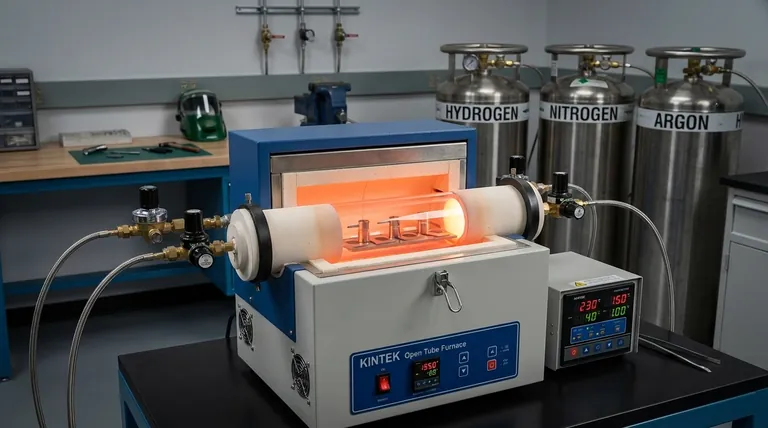
What gases are used in brazing? A Guide to Choosing the Right Atmosphere for Strong Joints

Key Points Explained:

  1. Purpose of Gases in Brazing

    • Gases are used in brazing to create a controlled atmosphere that prevents oxidation, scaling, and carbon buildup (soot).
    • Oxidation can weaken the joint and reduce the quality of the finished product.
    • A clean, bright finished product is achieved by using the appropriate gas or gas mixture.
  2. Commonly Used Gases

    • Hydrogen (H2):
      • Acts as an active agent for the reduction of metal oxides.
      • Commonly used in brazing processes to produce a clean, oxide-free surface.
      • Often used in combination with other inert gases.
    • Nitrogen (N2):
      • Displaces air/oxygen in the furnace atmosphere, preventing oxidation.
      • Particularly effective for brazing copper.
    • Argon (Ar) and Helium (He):
      • Inert gases that provide a protective atmosphere, preventing reactions with the base metals.
      • Used in brazing metals and ceramics where a non-reactive environment is essential.
    • Blends of Gases:
      • Mixtures of hydrogen and nitrogen or other inert gases are often used to tailor the atmosphere to specific brazing requirements.
  3. Specialized Atmospheres

    • Dissociated Ammonia:
      • A mixture of hydrogen and nitrogen produced by dissociating ammonia.
      • Provides a reducing atmosphere, ideal for preventing oxidation.
    • Exothermic and Endothermic Gases:
      • These are generated by burning natural gas or propane with air.
      • Used in specific brazing applications where a controlled reactive atmosphere is needed.
    • Vacuum:
      • In some cases, a vacuum is used instead of a gas atmosphere to eliminate oxidation entirely.
  4. Factors Influencing Gas Selection

    • Material Compatibility:
      • The type of base metal and filler metal being used determines the appropriate gas. For example, hydrogen is suitable for reducing oxides on steel, while nitrogen is better for copper.
    • Desired Surface Finish:
      • A bright, clean finish requires a gas that effectively reduces oxides, such as hydrogen or dissociated ammonia.
    • Process Requirements:
      • The brazing temperature, furnace design, and joint configuration influence the choice of gas.
  5. Undesirable Components in Brazing Atmospheres

    • Oxygen (O2):
      • Causes oxidation, which weakens the joint and degrades the surface finish.
    • Water Vapor (H2O):
      • Inhibits braze flow and can lead to poor joint quality, except in specific copper brazing applications where it may be beneficial.
  6. Applications of Specific Gases

    • Hydrogen:
      • Used in brazing stainless steel, nickel alloys, and other metals prone to oxidation.
    • Nitrogen:
      • Ideal for brazing copper and copper alloys.
    • Argon and Helium:
      • Used in high-temperature brazing of reactive metals like titanium and in ceramic-to-metal brazing.
  7. Safety Considerations

    • Hydrogen:
      • Highly flammable and requires careful handling and equipment designed for hydrogen use.
    • Inert Gases:
      • While non-reactive, they can displace oxygen in confined spaces, posing a suffocation risk.

In summary, the gases used in brazing are selected based on their ability to create a controlled atmosphere that prevents oxidation and ensures a strong, clean joint. Hydrogen, nitrogen, argon, helium, and their blends are the most commonly used gases, each offering unique benefits depending on the materials and process requirements. The choice of gas is critical to achieving the desired brazing outcome, and safety considerations must always be taken into account when handling these gases.

Summary Table:

Gas Type Key Properties Common Applications
Hydrogen (H2) Reduces metal oxides, ensures clean surface Stainless steel, nickel alloys
Nitrogen (N2) Displaces oxygen, prevents oxidation Copper and copper alloys
Argon (Ar) Inert, provides protective atmosphere Reactive metals (e.g., titanium), ceramic-to-metal brazing
Helium (He) Inert, high thermal conductivity High-temperature brazing of reactive metals
Blends Customizable mixtures (e.g., H2 + N2) Tailored for specific brazing requirements
Dissociated Ammonia Hydrogen + nitrogen mix, reduces oxidation Preventing oxidation in various metals
Vacuum Eliminates oxidation entirely High-precision brazing applications

Need help selecting the right gas for your brazing process? Contact our experts today for tailored solutions!

Visual Guide
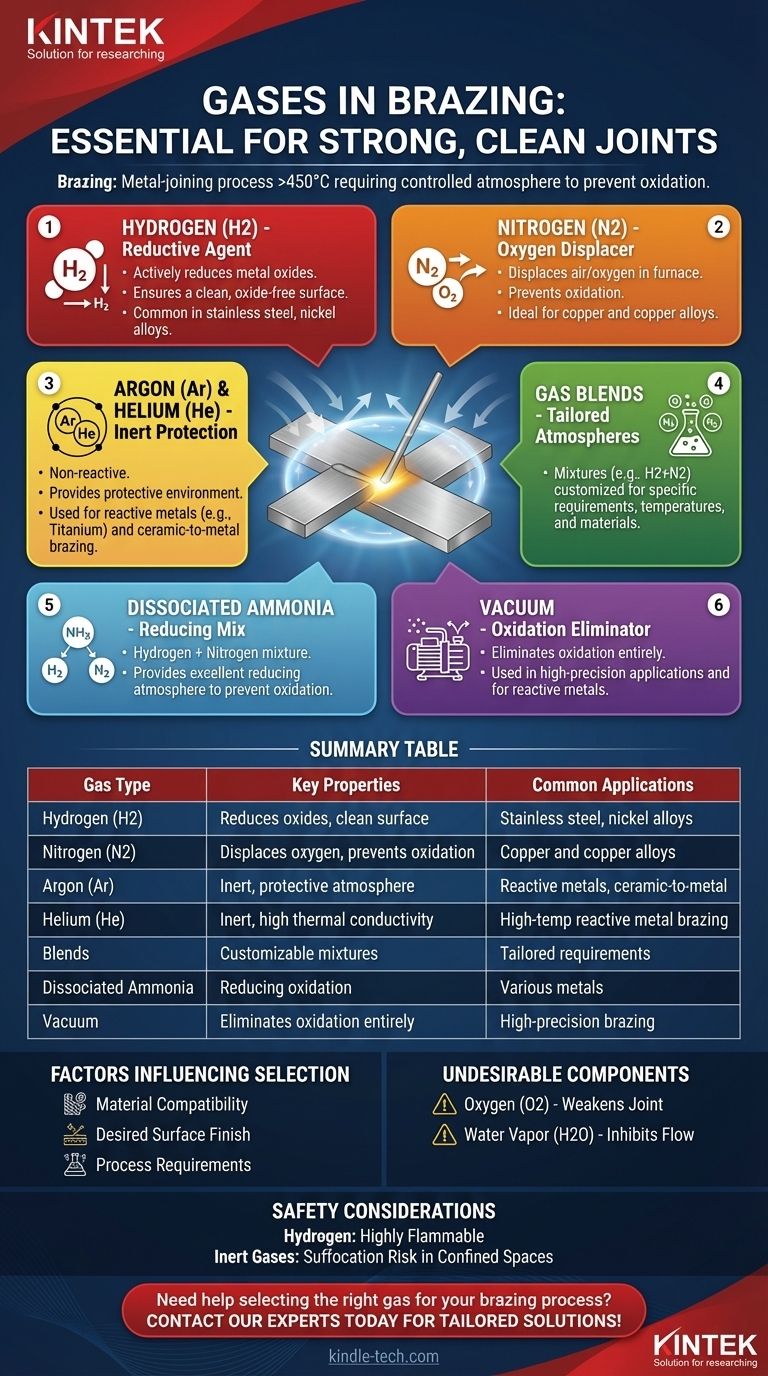
What gases are used in brazing? A Guide to Choosing the Right Atmosphere for Strong Joints Visual Guide

Related Products

People Also Ask

Related Products

1700℃ Laboratory Quartz Tube Furnace with Alumina Tube Tubular Furnace

1700℃ Laboratory Quartz Tube Furnace with Alumina Tube Tubular Furnace

Looking for a high-temperature tube furnace? Check out our 1700℃ Tube Furnace with Alumina Tube. Perfect for research and industrial applications up to 1700C.

Ultra-High Temperature Graphite Vacuum Graphitization Furnace

Ultra-High Temperature Graphite Vacuum Graphitization Furnace

The ultra-high temperature graphitization furnace utilizes medium frequency induction heating in a vacuum or inert gas environment. The induction coil generates an alternating magnetic field, inducing eddy currents in the graphite crucible, which heats up and radiates heat to the workpiece, bringing it to the desired temperature. This furnace is primarily used for graphitization and sintering of carbon materials, carbon fiber materials, and other composite materials.

Graphite Vacuum Continuous Graphitization Furnace

Graphite Vacuum Continuous Graphitization Furnace

High-temperature graphitization furnace is a professional equipment for graphitization treatment of carbon materials. It is a key equipment for the production of high-quality graphite products. It has high temperature, high efficiency and uniform heating. It is suitable for various high-temperature treatments and graphitization treatments. It is widely used in metallurgy, electronics, aerospace, etc. industry.

High Temperature Muffle Oven Furnace for Laboratory Debinding and Pre Sintering

High Temperature Muffle Oven Furnace for Laboratory Debinding and Pre Sintering

KT-MD High temperature debinding and pre-sintering furnace for ceramic materials with various molding processes. Ideal for electronic components such as MLCC and NFC.

Laboratory High Pressure Horizontal Autoclave Steam Sterilizer for Lab Use

Laboratory High Pressure Horizontal Autoclave Steam Sterilizer for Lab Use

The horizontal autoclave steam sterilizer adopts the gravity displacement method to remove the cold air in the inner chamber, so that the inner steam and cold air content is less, and the sterilization is more reliable.

Custom PTFE Teflon Parts Manufacturer for PTFE Mesh F4 Sieve

Custom PTFE Teflon Parts Manufacturer for PTFE Mesh F4 Sieve

PTFE mesh sieve is a specialized test sieve designed for particle analysis in various industries, featuring a non-metallic mesh woven from PTFE filament. This synthetic mesh is ideal for applications where metal contamination is a concern . PTFE sieves are crucial for maintaining the integrity of samples in sensitive environments, ensuring accurate and reliable results in particle size distribution analysis.

High-Purity Titanium Foil and Sheet for Industrial Applications

High-Purity Titanium Foil and Sheet for Industrial Applications

Titanium is chemically stable, with a density of 4.51g/cm3, which is higher than aluminum and lower than steel, copper, and nickel, but its specific strength ranks first among metals.

Laboratory Sterilizer Lab Autoclave Pulsating Vacuum Desktop Steam Sterilizer

Laboratory Sterilizer Lab Autoclave Pulsating Vacuum Desktop Steam Sterilizer

The pulsating vacuum desktop steam sterilizer is a compact and reliable device used for rapid sterilization of medical, pharmaceutical, and research items.

Lab-Scale Vacuum Induction Melting Furnace

Lab-Scale Vacuum Induction Melting Furnace

Get precise alloy composition with our Vacuum Induction Melting Furnace. Ideal for aerospace, nuclear energy, and electronic industries. Order now for effective smelting and casting of metals and alloys.

1400℃ Muffle Oven Furnace for Laboratory

1400℃ Muffle Oven Furnace for Laboratory

Get precise high-temperature control up to 1500℃ with KT-14M Muffle furnace. Equipped with a smart touch screen controller and advanced insulation materials.

Vacuum Sealed Continuous Working Rotary Tube Furnace Rotating Tube Furnace

Vacuum Sealed Continuous Working Rotary Tube Furnace Rotating Tube Furnace

Experience efficient material processing with our vacuum-sealed rotary tube furnace. Perfect for experiments or industrial production, equipped with optional features for controlled feeding and optimized results. Order now.

5L Chilling Circulator Cooling Water Bath Circulator for Low Temperature Constant Temperature Reaction Bath

5L Chilling Circulator Cooling Water Bath Circulator for Low Temperature Constant Temperature Reaction Bath

Maximize lab efficiency with the KinTek KCP 5L Chilling Circulator. Versatile and reliable, it provides constant chilling power up to -120℃.

Aluminum Foil Current Collector for Lithium Battery

Aluminum Foil Current Collector for Lithium Battery

The surface of aluminum foil is extremely clean and hygienic, and no bacteria or microorganisms can grow on it. It is a non-toxic, tasteless and plastic packaging material.

Electron Beam Evaporation Coating Conductive Boron Nitride Crucible BN Crucible

Electron Beam Evaporation Coating Conductive Boron Nitride Crucible BN Crucible

High-purity and smooth conductive boron nitride crucible for electron beam evaporation coating, with high temperature and thermal cycling performance.

Cylindrical Lab Electric Heating Press Mold for Laboratory Applications

Cylindrical Lab Electric Heating Press Mold for Laboratory Applications

Efficiently prepare samples with Cylindrical Lab Electric Heating Press Mold. Fast heating, high temp & easy operation. Custom sizes available. Perfect for battery, ceramic & biochemical research.

High Purity Zinc Foil for Battery Lab Applications

High Purity Zinc Foil for Battery Lab Applications

There are very few harmful impurities in the chemical composition of zinc foil, and the surface of the product is straight and smooth; it has good comprehensive properties, processability, electroplating colorability, oxidation resistance and corrosion resistance, etc.

Custom PTFE Teflon Parts Manufacturer for Culture Dish and Evaporation Dish

Custom PTFE Teflon Parts Manufacturer for Culture Dish and Evaporation Dish

The PTFE culture dish evaporating dish is a versatile laboratory tool known for its chemical resistance and high-temperature stability. PTFE, a fluoropolymer, offers exceptional non-stick properties and durability, making it ideal for various applications in research and industry, including filtration, pyrolysis, and membrane technology.

Desktop Fast High Pressure Laboratory Autoclave Sterilizer 16L 24L for Lab Use

Desktop Fast High Pressure Laboratory Autoclave Sterilizer 16L 24L for Lab Use

The desktop fast steam sterilizer is a compact and reliable device used for rapid sterilization of medical, pharmaceutical, and research items.

Custom PTFE Teflon Parts Manufacturer for Magnetic Stirring Bar

Custom PTFE Teflon Parts Manufacturer for Magnetic Stirring Bar

The PTFE magnetic stirring bar, made from high-quality PTFE, offers exceptional resistance to acids, alkalis, and organic solvents, coupled with high-temperature stability and low friction. Ideal for laboratory use, these stirring bars are compatible with standard flask ports, ensuring stability and safety during operations.

Desktop Fast Laboratory Autoclave Sterilizer 35L 50L 90L for Lab Use

Desktop Fast Laboratory Autoclave Sterilizer 35L 50L 90L for Lab Use

The desktop fast steam sterilizer is a compact and reliable device used for rapid sterilization of medical, pharmaceutical, and research items. It efficiently sterilizes surgical instruments, glassware, medicines, and resistant materials, making it suitable for various applications.


Leave Your Message