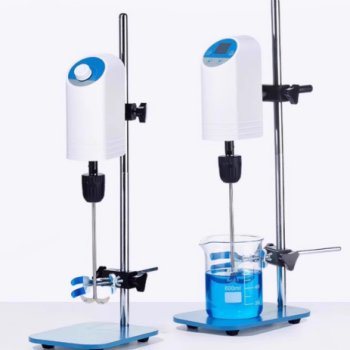
Magnetic stirring or homogenization is a critical necessity, not an optional step, in the preparation of bimetallic alloy catalysts via the colloidal method. These techniques provide the essential mechanical energy required to ensure that different metal precursors are thoroughly mixed and, crucially, reduced simultaneously within the solution. Without this consistent agitation, you cannot achieve the uniform atomic distribution required for a functional bimetallic system.
Effective agitation drives the atomic-level integration of metals. It facilitates the close molecular contact necessary to create uniform structures and unlock the synergistic effects that optimize catalytic performance.
The Mechanics of Colloidal Synthesis
Ensuring Simultaneous Reduction
In a bimetallic system, you are managing two distinct metal precursors with potentially different reduction potentials.
Stirring ensures these precursors interact with the reducing agent at the same time.
This simultaneity is vital. It prevents one metal from reducing and precipitating out before the other, which would result in separate monometallic particles rather than a cohesive alloy.
Achieving Thorough Homogeneity
The colloidal method relies on a chemically uniform environment throughout the reaction vessel.
Homogenization prevents concentration gradients from forming in the solution.
By keeping the precursors thoroughly mixed, you ensure that every part of the solution undergoes the same reaction conditions, leading to consistent particle growth.
Impact on Catalyst Structure and Performance
Formation of Uniform Structures
The physical architecture of your catalyst—whether it is a uniform alloy or a core-shell structure—is dictated by the mixing process.
Consistent agitation controls the nucleation and growth rates of the particles.
This allows the metals to arrange themselves into the specific geometric configuration intended by the synthesis design.
Enabling the Synergistic Effect
For a bimetallic catalyst to function better than the sum of its parts, the two metals must interact intimately.
Close contact at the molecular level is the prerequisite for this synergy.
Stirring forces the precursors into this proximity, allowing the electronic properties of one metal to modify the other.
Optimizing Adsorption Energy
The ultimate goal of this structural control is chemical efficiency.
The synergistic effect, driven by proper mixing, optimizes the adsorption energy of the catalyst.
According to the primary reference, this is specifically critical for optimizing the adsorption of formic acid molecules, directly influencing the catalyst's activity and efficiency.
Common Pitfalls and Trade-offs
The Risk of Phase Segregation
If the stirring speed is insufficient or the homogenization is inconsistent, the precursors will not reduce together.
This leads to phase segregation, where you obtain a mixture of two different metals rather than a single alloyed material.
Inconsistent Particle Sizes
Poor mixing often results in "hot spots" of high reactant concentration.
This causes some particles to grow much larger than others, destroying the size uniformity that is crucial for consistent catalytic performance.
Making the Right Choice for Your Goal
To ensure your bimetallic catalyst performs as designed, you must tailor your agitation strategy to your specific structural targets.
- If your primary focus is Structural Integrity: Prioritize rigorous homogenization to guarantee simultaneous reduction, ensuring the formation of a true alloy or core-shell architecture rather than separate phases.
- If your primary focus is Catalytic Efficiency: Focus on consistent mixing to maximize molecular contact, which directly optimizes adsorption energy for target molecules like formic acid.
Treat the stirring mechanism as a precise reaction variable, as vital to your success as the chemical precursors themselves.
Summary Table:
| Factor | Role in Colloidal Synthesis | Impact on Final Catalyst |
|---|---|---|
| Simultaneous Reduction | Ensures different metal precursors reduce at the same time. | Prevents phase segregation; forms cohesive alloys. |
| Homogenization | Eliminates concentration gradients and "hot spots." | Ensures consistent particle size and uniform growth. |
| Molecular Contact | Forces metal precursors into intimate proximity. | Enables synergistic effects and optimized adsorption. |
| Structural Control | Manages nucleation and particle growth rates. | Creates precise uniform or core-shell architectures. |
Elevate Your Catalyst Synthesis with KINTEK Precision
Don’t let poor agitation compromise your catalytic efficiency. KINTEK specializes in advanced laboratory equipment designed to deliver the rigorous homogenization required for superior bimetallic alloy development. Our high-performance magnetic stirrers, homogenizers, and shakers provide the mechanical precision needed to ensure simultaneous reduction and optimal atomic distribution.
From high-temperature reactors to specialized laboratory consumables, KINTEK supports your entire research workflow. Unlock the full synergistic potential of your materials—contact us today to find the perfect mixing solution for your lab!
References
- F.S. Lozano Sánchez, Nikolaos Dimitratos. Catalytic decomposition of carbon-based liquid-phase chemical hydrogen storage materials for hydrogen generation under mild conditions. DOI: 10.1007/s13203-016-0159-9
This article is also based on technical information from Kintek Solution Knowledge Base .
Related Products
- Laboratory Small Constant Temperature Heated Magnetic Stirrer Heater and Stirrer
- Custom PTFE Teflon Parts Manufacturer for Magnetic Stirring Bar
- High Performance Laboratory Stirrers for Diverse Applications
- Three-dimensional electromagnetic sieving instrument
- Custom PTFE Teflon Parts Manufacturer for PTFE Stirring Bar Recovery Rod
People Also Ask
- What role does a magnetic stirrer with heating play in ZnO nanoparticle synthesis? Precision Control for Quality Results
- What role does a constant temperature heating magnetic stirrer play in MFC-HAp synthesis? Achieve Material Homogeneity
- What is the function of a laboratory magnetic stirrer in Ni–Cr–P electrodeposition? Optimize Ion Transport & Coating
- Why is a laboratory magnetic stirrer required for benzoic acid esters? Boost Reaction Speed & Yield with High RPM
- What role does a laboratory magnetic stirrer play in TiO2 and TiO2-Ag sol preparation? Master Chemical Kinetics