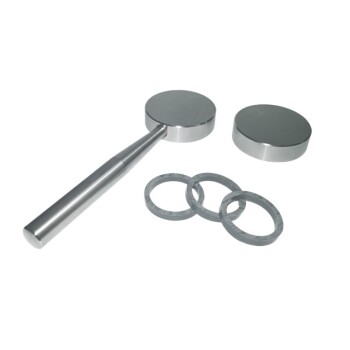
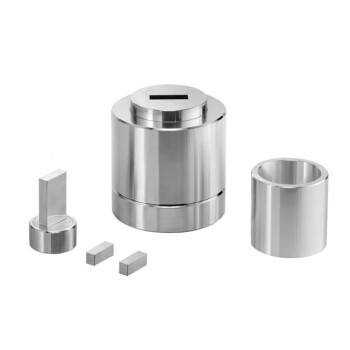
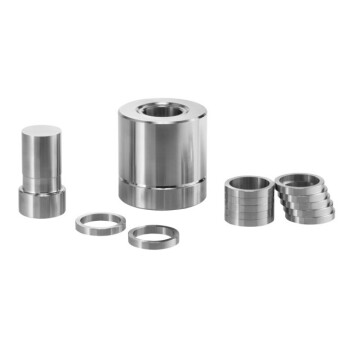
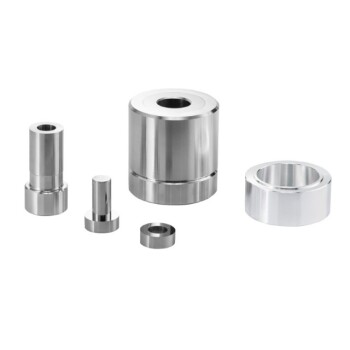
The use of a laboratory hydraulic press to pelletize Refuse-Derived Fuel (RDF) powder is a fundamental necessity for ensuring data accuracy during Thermogravimetric Analysis (TGA). By compressing the powder (e.g., 20 mg) into a defined shape (e.g., a 5 mm pellet), you drastically increase bulk density and standardize the sample's geometry. This process minimizes air voids and ensures the sample fits compactly into the TGA crucible, which is essential for reliable thermal measurements.
Core Takeaway: The necessity of pelletization lies in creating a uniform, dense sample that promotes efficient heat transfer. By eliminating air gaps and standardizing geometry, you ensure the resulting TGA curves reflect the true thermal degradation properties of the material, rather than artifacts caused by loose packing or poor contact.
The Physics of Sample Preparation
Maximizing Bulk Density
Loose RDF powder naturally contains significant volume dedicated to air gaps between particles.
Using a hydraulic press applies vertical pressure to expel this air, compressing the particles into a tight, cohesive unit.
This increased bulk density allows a sufficient mass of material to fit inside the small volume of a TGA crucible without overflowing or resting loosely.
Improving Heat Transfer Efficiency
Air is a poor conductor of heat.
When you leave voids between powder particles, these air pockets act as insulators, slowing down the transfer of heat from the furnace to the sample.
Pelletization forces particles into intimate contact, reducing thermal resistance and ensuring the sample temperature tracks the furnace temperature accurately.
Ensuring Data Integrity
Standardizing Geometry
Scientific analysis requires reproducibility.
A hydraulic press allows you to create pellets with identical dimensions and surface areas for every test run.
This consistency eliminates geometric variables, ensuring that differences in your data are due to material chemistry, not random variations in how the powder was scooped into the pan.
Capturing True Degradation Characteristics
The ultimate goal of TGA is to understand how a material degrades under heat.
Loose powder can yield "smeared" or delayed reaction curves due to uneven heating.
Compacted pellets provide a stable thermal profile, allowing the TGA curves to accurately reflect the specific temperatures at which the RDF decomposes.
Understanding the Risks of Non-Pelletized Samples
The Pitfall of "Thermal Lag"
Without the compression provided by a hydraulic press, loose powders suffer from poor contact with the crucible walls.
This results in thermal lag, where the sample is cooler than the recorded sensor temperature.
This discrepancy can cause decomposition events to appear at artificially higher temperatures, leading to incorrect conclusions about the fuel's stability.
Inconsistent Particle Contact
In loose powder, particle-to-particle contact is random and weak.
This lack of contact hampers the distribution of heat throughout the sample mass.
The hydraulic press solves this by creating a "green compact" with sufficient strength and uniformity, ensuring the entire sample reacts to thermal changes simultaneously.
Making the Right Choice for Your Goal
To get the most out of your Thermogravimetric Analysis, consider how sample preparation aligns with your objectives:
- If your primary focus is Data Accuracy: Use the hydraulic press to minimize voids and maximize thermal conductivity, preventing insulation effects from skewing your degradation temperatures.
- If your primary focus is Comparative Analysis: Rely on the press to enforce strict geometric consistency, ensuring that any variation between samples is due to the fuel composition, not the sample shape.
Standardizing your RDF samples through hydraulic pressing removes the variables of physical form, leaving you with pure, actionable thermal data.
Summary Table:
| Feature | Loose RDF Powder | Pelletized RDF (Hydraulic Press) |
|---|---|---|
| Bulk Density | Low (High air void volume) | High (Compressed, cohesive unit) |
| Heat Transfer | Poor (Air acts as insulator) | Efficient (Intimate particle contact) |
| Geometric Consistency | Random/Variable | Standardized & Reproducible |
| TGA Data Quality | Prone to thermal lag & artifacts | Accurate thermal degradation profiles |
| Sample Volume | High (Risk of crucible overflow) | Compact (Fits small TGA crucibles) |
Elevate Your Sample Preparation with KINTEK Precision
Don't let poor sample geometry compromise your analytical results. KINTEK specializes in high-performance laboratory hydraulic presses—including pellet, hot, and isostatic models—designed specifically for researchers who demand data integrity.
Our comprehensive range of laboratory equipment, from crushing and milling systems to high-temperature furnaces and pelletizing tools, empowers your lab to achieve the highest standards of accuracy in RDF testing and material science.
Ready to eliminate thermal lag and standardize your analysis?
Contact KINTEK Today for a Professional Consultation
References
- Gizem Ayas, Hakan F. Öztop. Thermal analysis of different Refuse Derived Fuels samples. DOI: 10.2298/tsci201010249a
This article is also based on technical information from Kintek Solution Knowledge Base .
Related Products
- Automatic Laboratory Hydraulic Pellet Press Machine for Lab Use
- Laboratory Manual Hydraulic Pellet Press for Lab Use
- Laboratory Manual Hydraulic Pellet Press for Lab Use
- Automatic Laboratory Hydraulic Press for XRF & KBR Pellet Press
- Laboratory Hydraulic Press Lab Pellet Press Machine for Glove Box
People Also Ask
- What is the role of a laboratory hydraulic pellet press and stainless steel molds in the fabrication of RuO2/NbC anodes?
- What role does a laboratory pellet press play in the enhancement of biomass energy products? Optimize Fuel Efficiency
- What is the purpose of using a laboratory pellet press when evaluating the electronic conductivity of carbon powders? Guide
- How does a laboratory hydraulic pellet press contribute to SiCw/2024 aluminum composite preforms? Optimize Densification
- What is the significance of applying 200 MPa of pressure with a laboratory hydraulic pellet press for composite ceramics?