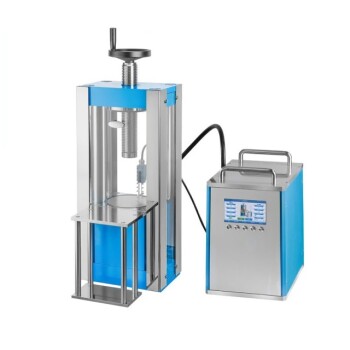
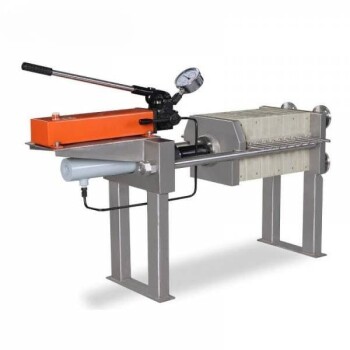
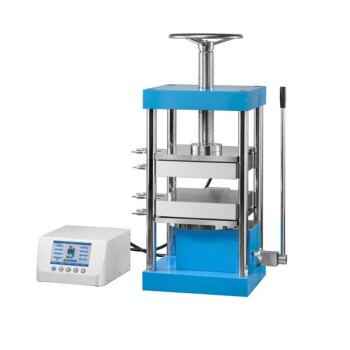
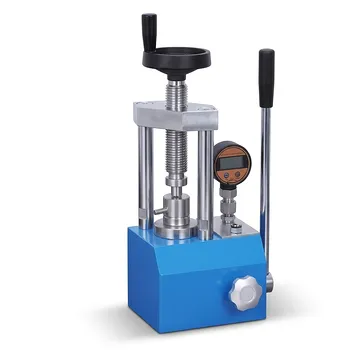
Laboratory hydraulic presses act as the critical bridge between powder synthesis and reactor evaluation. They transform loose catalyst powders into robust pellets, tablets, or disks through the application of precise, high-tonnage pressure. This physical transformation is essential for simulating industrial conditions, ensuring the material possesses the mechanical strength to withstand gas or liquid flow in fixed-bed reactors without fracturing.
Core Insight: The hydraulic press does not merely change the shape of a material; it validates its viability. By converting loose powder into a dense, mechanically stable form, the press allows researchers to decouple intrinsic chemical activity from physical failures—such as attrition, channeling, or pressure drop spikes—that would otherwise invalidate experimental data.
The Core Function: Densification and Shaping
Achieving Mechanical Integrity
The primary role of the press is to confer mechanical strength to the catalyst. Loose powders lack the structural integrity to survive the high-velocity gas or liquid flows found in industrial reactors.
Preventing Flow-Induced Fracturing
By compressing powders into pellets, the press ensures the catalyst resists physical degradation. Without this step, fragile particles would fracture under flow friction, leading to fines that clog the reactor and disrupt the process.
Minimizing Pressure Drop
A uniform catalyst bed is vital for consistent reactor performance. Pressed pellets maintain their shape, ensuring a predictable void fraction in the bed which keeps the pressure drop across the reactor minimal and consistent.
The "Pre-Pressing" Technique for Granulation
Creating the "Green Body"
In many workflows, the press is used to form an initial solid disk, often called a "green body" or "green pellet." This is an intermediate step rather than the final product.
Sizing for Fixed Beds
Once the powder is pressed into a dense disk, it is intentionally crushed and sieved. This technique produces granular particles of a specific size range (e.g., 600–800 micrometers) that retain the dense structure of the pressed disk, preventing them from blowing out of the reactor during testing.
Enhancing Chemical and Analytical Performance
Optimizing Solid-State Reactions
High-pressure compaction forces particles into intimate contact. This shortens the diffusion path for solid-state reactions, significantly improving the efficiency of doping reactions during subsequent calcination or sintering processes.
Eliminating Voids for Conductivity
For electrochemical applications, the press eliminates internal voids to create a continuous material phase. This removal of porosity is critical for accurately measuring bulk conductivity and ensuring reliable electrical performance data.
Standardizing Analytical Samples
Loose powders can cause scattering effects in analytical instruments. Pressing materials into flat, uniform pellets provides a standardized surface for characterization techniques like XRF (X-ray Fluorescence), ensuring data accuracy.
Understanding the Trade-offs
The Density vs. Porosity Balance
While high pressure increases mechanical strength, it also reduces porosity. Over-compressing a catalyst can collapse the internal pore structure required for reactants to access active sites, potentially stifling catalytic activity.
Uniformity Risks
If the pressure is not applied uniformly or if the mold is filled unevenly, the resulting pellets may have density gradients. This can lead to inconsistent mechanical strength, causing some pellets to survive the reactor environment while others crumble.
Making the Right Choice for Your Goal
When utilizing a hydraulic press for catalyst preparation, your target application dictates your pressure strategy.
- If your primary focus is Industrial Simulation: Prioritize mechanical strength and consistent pellet size to ensure the bed pressure drop mimics real-world conditions.
- If your primary focus is Electrical Characterization: Apply higher pressures to eliminate voids and maximize particle-to-particle contact for accurate conductivity readings.
- If your primary focus is Standardized Analysis (XRF/SEM): Focus on surface flatness and uniformity to eliminate scattering effects and ensure reproducible data.
Ultimately, the laboratory hydraulic press transforms a theoretically active chemical powder into a physically viable industrial product.
Summary Table:
| Application Stage | Primary Function of Hydraulic Press | Key Benefit |
|---|---|---|
| Granulation | Creating 'green bodies' for crushing/sieving | Controlled particle size for fixed-bed reactors |
| Mechanical Testing | Densification into tablets or disks | Prevents fracturing and flow-induced attrition |
| Analytical Prep | Standardizing sample surface for XRF/SEM | Eliminates scattering and ensures data accuracy |
| Characterization | Removing internal voids and porosity | Maximizes contact for bulk conductivity measurements |
Elevate Your Material Research with KINTEK Precision
Transitioning from powder synthesis to industrial validation requires tools that guarantee mechanical integrity. KINTEK specializes in high-performance laboratory hydraulic presses (manual, electric, and isostatic) designed specifically for the rigorous demands of catalyst preparation and pelletizing.
Our comprehensive laboratory portfolio includes:
- Hydraulic Presses & Pellet Dies for consistent sample preparation.
- High-Temperature Muffle & Tube Furnaces for precise calcination and sintering.
- Crushing, Milling & Sieving Systems to achieve the perfect granular size.
- Advanced Reactors & Autoclaves for post-pressing catalytic evaluation.
Don't let physical failure invalidate your chemical research. Partner with KINTEK to ensure your catalysts withstand the pressure.
Contact Our Technical Experts Today
References
- Md. Eaqub Ali, Sharifah Bee Abd Hamid. Heterogeneous Metal Catalysts for Oxidation Reactions. DOI: 10.1155/2014/192038
This article is also based on technical information from Kintek Solution Knowledge Base .
Related Products
- Laboratory Hydraulic Press Lab Pellet Press Machine for Glove Box
- Laboratory Hydraulic Press Split Electric Lab Pellet Press
- Laboratory Hydraulic Press Lab Pellet Press for Button Battery
- Automatic Laboratory Hydraulic Press for XRF & KBR Pellet Press
- Automatic Laboratory Hydraulic Pellet Press Machine for Lab Use
People Also Ask
- What is the function of a laboratory hydraulic press in W-Cu composites? Control Porosity and Material Ratio
- What is the role of a laboratory hydraulic press in the initial stages of Li6PS5Cl preparation? Key to Green Pellets
- What role does a laboratory hydraulic press play in triboelectric testing? Achieve Precision Alloy Sample Prep
- How can a laboratory hydraulic press be applied to chitosan for wastewater treatment? Optimize Pores & Strength
- How do a precision laboratory hydraulic press and specialized molds contribute to the fabrication of spherical ceramic samples? Achieving High-Density Material Precision