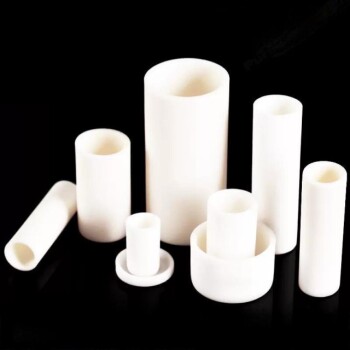
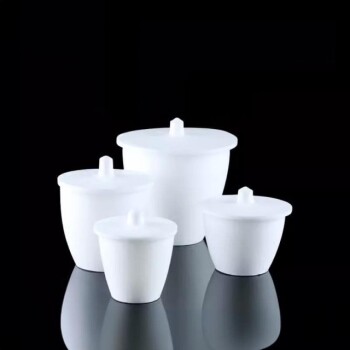
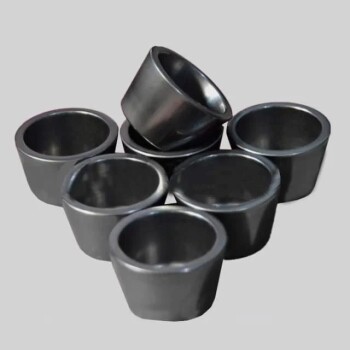
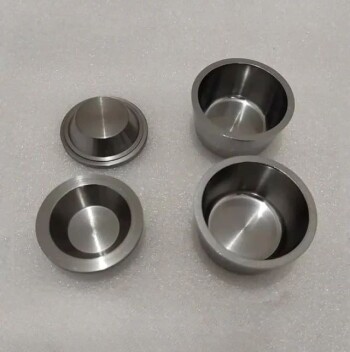
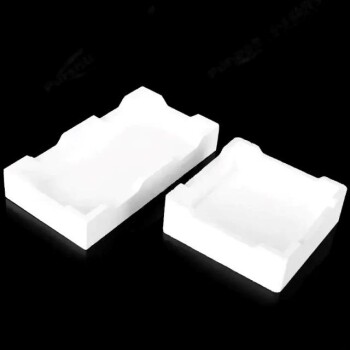
The necessity of using ceramic crucibles for holding 2,4,6-trichlorophenyl methacrylate (TClPhMA) copolymers in Thermogravimetric Analysis (TGA) stems directly from their chemical inertness and high-temperature resistance.
These crucibles prevent reaction with the copolymer or its decomposition byproducts at temperatures exceeding 600 °C, ensuring that recorded mass changes result solely from the sample's thermal behavior rather than environmental interference.
Core Takeaway To obtain accurate TGA data, the sample holder must be an "invisible" participant in the experiment. Ceramic crucibles provide a neutral environment that isolates the mass loss of the TClPhMA copolymer, ensuring that chemical reactions or thermal instability of the container do not skew the results.
Ensuring Data Integrity Through Chemical Inertness
Preventing Sample-Crucible Interaction
The primary danger in TGA is a "ghost reaction" where the sample reacts with its container.
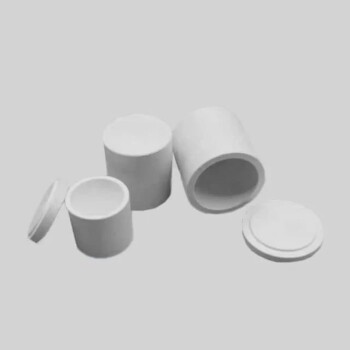
Ceramic crucibles (typically alumina or porcelain) are chemically inert. They do not react with 2,4,6-trichlorophenyl methacrylate (TClPhMA) or the volatile products generated during its decomposition.
Protecting Against Corrosive Byproducts
TClPhMA contains chlorine, which can release corrosive byproducts upon decomposition.
While metal crucibles might degrade or catalyze reactions with halogenated compounds, ceramic withstands these aggressive conditions. This ensures the chemical composition of the crucible does not alter the decomposition pathway of the sample.
Isolating the Mass Change Signal
The goal of TGA is to measure mass change with extreme precision.
By using a non-reactive ceramic holder, you guarantee that any weight loss recorded by the weighing system is strictly due to the thermal decomposition of the polymer. This remains true whether you are operating under oxidative (air) or inert (argon) atmospheres.
Thermal Stability and Experimental Precision
Withstanding Extreme Temperatures
TGA experiments frequently push materials to their thermal limits.
Ceramic crucibles maintain their structural integrity and mass stability at temperatures of 600 °C and above, with some capable of handling up to 800 °C. They do not melt, soften, or off-gas, which is critical for establishing a stable baseline.
Facilitating Accurate Kinetics
Beyond just holding the sample, the crucible acts as a heat conduit.
Alumina crucibles offer excellent thermal conductivity. This ensures heat is transferred rapidly and uniformly to the interior of the sample during programmed temperature ramps.
Uniform heating is essential for deriving accurate kinetic data regarding the pyrolysis or decomposition reaction.
Understanding the Trade-offs
Brittleness and Handling
While chemically superior for this application, ceramic crucibles are fragile.
Unlike metal pans, ceramic can crack or shatter if dropped or subjected to extreme thermal shock (rapid cooling). Careful handling is required during loading and unloading.
Cleaning and Reusability
Ceramic surfaces are generally easy to clean, but incomplete combustion can leave residue.
If the TClPhMA sample melts and fuses to the ceramic before decomposing, it can be difficult to remove the residue completely without damaging the crucible surface. This can impact the baseline for subsequent experiments.
Making the Right Choice for Your Goal
To ensure your TGA data is valid and defensible, consider the following regarding your experimental setup:
- If your primary focus is Chemical Specificity: Use ceramic crucibles to prevent chlorine-based interactions between the TClPhMA copolymer and the container.
- If your primary focus is Kinetic Accuracy: Rely on ceramic (alumina) to ensure uniform heat transfer, preventing thermal gradients that could skew reaction rate calculations.
- If your primary focus is High-Temperature Analysis: Choose ceramic for any protocol exceeding 600 °C to eliminate baseline drift caused by crucible degradation.
Ultimately, using ceramic crucibles for TClPhMA eliminates experimental noise, leaving you with pure, unadulterated thermal data.
Summary Table:
| Feature | Ceramic Crucible Benefit for TGA | Impact on TClPhMA Analysis |
|---|---|---|
| Chemical Inertness | No reaction with halogenated byproducts | Prevents sample-container "ghost reactions" |
| Thermal Stability | Stable mass at temperatures >600°C | Eliminates baseline drift and noise |
| Corrosion Resistance | Withstands chlorine-based decomposition | Protects the integrity of the weighing system |
| Heat Conductivity | Uniform and rapid heat transfer | Ensures accurate decomposition kinetics |
| Atmospheric Neutrality | Stable in both oxidative and inert gases | Facilitates versatile experimental protocols |
Elevate Your Thermal Analysis with KINTEK Precision
Don't let container interference compromise your TGA results. KINTEK provides high-quality ceramic crucibles and laboratory consumables specifically designed for sensitive applications like TClPhMA copolymer analysis.
Our extensive portfolio supports advanced research with:
- Thermal Management: High-temperature furnaces (muffle, vacuum, CVD) and precise cooling solutions.
- Sample Preparation: Professional crushing, milling, and hydraulic press systems (pellet, isostatic).
- Specialized Labware: Durable ceramics, crucibles, PTFE products, and electrochemical cells.
Whether you are analyzing polymer kinetics or developing new materials, KINTEK offers the tools to ensure your data is pure and defensible.
Contact us today to find the perfect crucible for your lab!
References
- Gökhan Demirci, Barbara Gawdzik. Copolymerization and thermal study of the new methacrylate derivative of 2,4,6-trichlorophenol. DOI: 10.1007/s10973-016-5672-7
This article is also based on technical information from Kintek Solution Knowledge Base .
Related Products
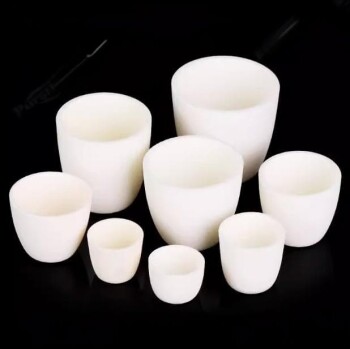
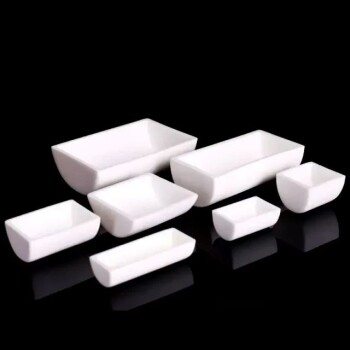
- Arc-Shaped Alumina Ceramic Crucible High Temperature Resistant for Engineering Advanced Fine Ceramics
- Alumina Al2O3 Ceramic Crucible Semicircle Boat with Lid for Engineering Advanced Fine Ceramics
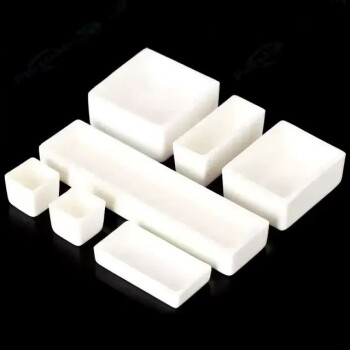
- Engineering Advanced Fine Alumina Al2O3 Ceramic Crucible for Laboratory Muffle Furnace
- Boron Nitride (BN) Crucible for Phosphorous Powder Sintered
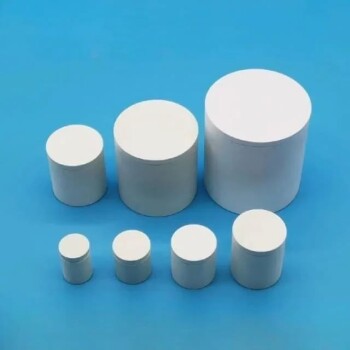
- Engineering Advanced Fine Ceramics Alumina Al2O3 Crucible With Lid Cylindrical Laboratory Crucible
People Also Ask
- Why Use Alumina Crucibles & Powder Burial for NaSICON? Ensure Phase Purity and Prevent Elemental Volatilization
- What is the primary purpose of using alumina crucibles for LLTO ceramics? Optimize Your High-Temperature Sintering
- Why are alumina crucibles and mother powder essential for LATP sintering? Optimize Your Solid Electrolyte Performance
- Why are high-purity alumina crucibles used for liquid lead corrosion experiments? Ensure Data Accuracy at 550°C
- Primary considerations for choosing alumina crucibles and quartz tubes in indium intercalation: Ensure Material Purity