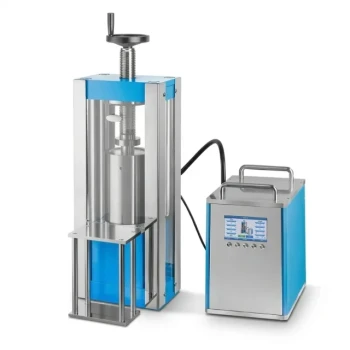
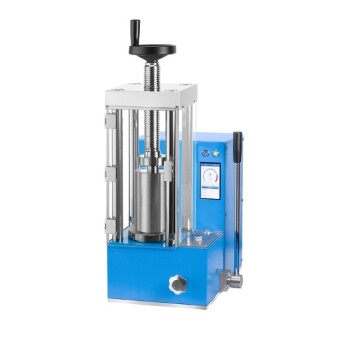
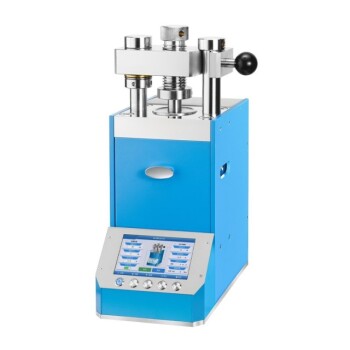
The primary objective of using a laboratory hydraulic press in this context is to force a tight, solid-solid contact interface between the composite electrode and the solid electrolyte layer. Because these components are rigid, high-pressure cold pressing is required to mechanically consolidate them into a unified structure, ensuring the battery functions as intended.
Core Takeaway Solid-state batteries lack liquid electrolytes to naturally fill gaps between components. Therefore, significant mechanical pressure is the only way to minimize microscopic voids, drastically reduce interfacial contact resistance, and enable smooth lithium-ion transport.
The Challenge of the Solid-Solid Interface
In traditional batteries, liquid electrolytes naturally wet the electrode surfaces, creating perfect contact. All-solid-state batteries do not have this luxury.
Overcoming Material Rigidity
The composite electrode (often graphite/silicon) and the solid electrolyte layer are rigid solids. Left alone, they would merely sit on top of one another, creating a poor interface.
The Role of High Pressure
To overcome this rigidity, a laboratory hydraulic press applies high-pressure cold pressing—for example, reaching levels around 480 MPa.
This intense pressure forces the materials against each other, mechanically interlocking the surfaces to create a cohesive boundary.
Eliminating Microscopic Voids
Without sufficient pressure, the interface between the electrode and electrolyte remains plagued by microscopic voids.
The hydraulic press consolidates the structure, closing these gaps to ensure the active battery components are in effective physical contact.
The Physics of Performance Improvement
The application of pressure is not just about structural integrity; it is directly tied to the electrochemical performance of the battery.
Reducing Interfacial Contact Resistance
The primary adversary in solid-state assembly is resistance.
By establishing a tight interface, the hydraulic press significantly reduces interfacial contact resistance. This ensures that energy is not lost as heat or impedance at the boundary between layers.
Enabling Ion Transport
For the battery to function, lithium ions must move between solid particles.
High-pressure consolidation establishes smooth pathways for this movement. It facilitates efficient ion transport across the solid-solid interface, which is fundamental to the battery's overall performance.
Understanding the Constraints
While high pressure is necessary, it introduces specific engineering constraints that differ from liquid-based battery manufacturing.
The Necessity of Mechanical Intervention
Unlike liquid systems that are chemically forgiving regarding contact, solid-state systems are mechanically demanding.
The process relies entirely on physical force to mimic the conductivity continuity that liquids provide naturally. If the pressure is insufficient, the contact resistance will remain too high for the battery to operate efficiently.
Consolidation vs. Operation
It is important to distinguish between assembly and operation.
The hydraulic press is used to consolidate the monolithic structure during manufacturing. However, supplementary data suggests that continuous stacking pressure may also be required in prototypes to maintain this contact over time, highlighting that the "solid" interface is dynamic and requires constant maintenance.
Making the Right Choice for Your Goal
When utilizing a laboratory hydraulic press for solid-state assembly, your specific parameters should align with your research objectives.
- If your primary focus is Assembly Integrity: Ensure your press can achieve high pressures (e.g., 480 MPa) to fully consolidate the graphite/silicon and electrolyte layers into a monolithic structure.
- If your primary focus is Electrochemical Performance: Prioritize pressure uniformity to minimize microscopic voids, as this is the direct lever for reducing interfacial resistance and maximizing ion transport.
High-pressure cold pressing is the fundamental bridge that transforms separate solid components into a functional, high-performance energy storage unit.
Summary Table:
| Feature | High-Pressure Cold Pressing Benefit |
|---|---|
| Interface Type | Establishes critical solid-solid contact |
| Pressure Range | Typically reaches up to 480 MPa |
| Structural Goal | Consolidation into a monolithic structure |
| Electrochemical Impact | Reduces resistance & enables ion transport |
| Material Challenge | Overcomes rigidity of electrodes & electrolytes |
Maximize Your Battery Research Precision with KINTEK
Transitioning to all-solid-state technology requires more than just pressure; it requires uniformity and reliability. KINTEK specializes in advanced laboratory equipment, offering high-performance manual, electric, and isostatic hydraulic presses designed to eliminate microscopic voids and optimize ion transport in your energy storage prototypes.
Beyond assembly, our portfolio supports every stage of your workflow with high-temperature furnaces (CVD/PECVD), planetary ball mills for material crushing, and specialized electrolytic cells. Partner with KINTEK to benefit from equipment that ensures your materials meet the rigorous mechanical demands of modern solid-state research.
Ready to elevate your lab's performance? Contact us today to find the perfect pressing solution!
Related Products
- Electric Split Lab Cold Isostatic Press CIP Machine for Cold Isostatic Pressing
- Ball Press Mold for Lab
- Manual High Temperature Heated Hydraulic Press Machine with Heated Plates for Lab
- Automatic High Temperature Heated Hydraulic Press Machine with Heated Plates for Lab
- Automatic Heated Hydraulic Press Machine with Heated Plates for Laboratory Hot Press
People Also Ask
- How is isostatic pressing equipment utilized to integrate lithium metal anodes during solid-state battery assembly?
- How does isostatic pressing equipment enhance lithium metal anode contact? Optimize Your Solid-State Battery Assembly
- What is the meaning of isostatic pressing? Achieve Uniform Density in Complex Parts
- What is isostatic pressing method for ceramics? Achieve Uniform Density for Complex Parts
- What role does cold isostatic pressing play in the formation of feed rods for single crystal growth? Ensure Stability.