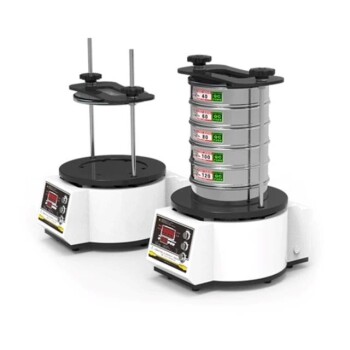
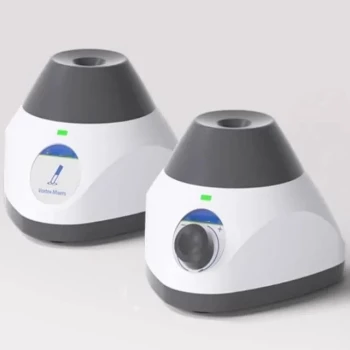
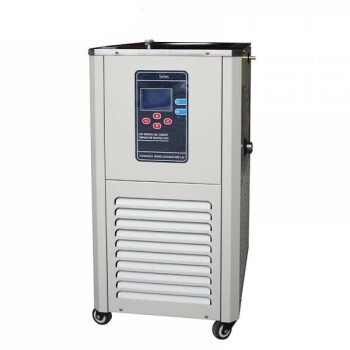
The operating mechanism of a shaking reactor relies on high-frequency mechanical oscillation to drive chemical changes through physical instability. Instead of relying solely on heat, the reactor induces quasi-periodic kinetic instability modes, known as Faraday waves, within the solid particles inside the vessel.
The core advantage of this mechanism is the conversion of mechanical energy into chemical potential. By generating high-energy collisions that lower the apparent activation energy, the reactor enables the reduction of iodine and titanium dioxide at significantly lower temperatures than traditional thermodynamics would dictate.
The Physical Mechanism: From Oscillation to Impact
Inducing Kinetic Instability
The process begins with the reactor applying rapid, high-frequency oscillations to the container. This movement disrupts the static state of the solid particles within.
Generating Faraday Waves
This disruption creates a specific type of instability known as Faraday waves. These waves represent a quasi-periodic mode of motion that propagates through the granular material.
Promoting High-Energy Collisions
The primary function of these waves is to force the solid particles to interact aggressively. The instability ensures that particles undergo continuous, high-energy collisions with one another.
The Chemical Consequence: Mechanochemistry
Lowering Activation Energy
The continuous input of mechanical energy alters the energy landscape of the reaction. It effectively lowers the apparent activation energy required for the chemical reduction to occur.
Facilitating Mechanochemical Reactions
Because the activation barrier is lowered mechanically rather than thermally, the process facilitates mechanochemical reactions. The physical impact drives the chemical transformation directly.
Enabling Low-Temperature Processing
This mechanism allows reactions to proceed efficiently at lower thermodynamic temperatures. The mechanical energy serves as a substitute for the high thermal energy usually required to drive these reduction paths.
Application in Iodine Reduction
The Reactants
In the specific context of iodine reduction paths, this mechanism is applied to mixtures of iodine and titanium dioxide.
The Product
The high-energy collisions drive the reaction between these materials to form titanium iodide intermediates.
Understanding the Trade-offs
Mechanical Energy Dependency
The system relies entirely on the continuous input of mechanical energy to sustain the reaction. If the oscillation stops, the "apparent" reduction in activation energy vanishes immediately.
Particle Integrity
The very mechanism that drives the reaction—high-energy collisions—relies on the physical interaction of solids. This implies a process that is inherently abrasive and dependent on the physical properties of the solid particles involved.
Making the Right Choice for Your Goal
This technology bridges the gap between physical mechanics and chemical synthesis.
- If your primary focus is energy efficiency: This mechanism allows you to bypass high thermal requirements by substituting heat with mechanical oscillation.
- If your primary focus is reaction feasibility: This approach enables the synthesis of intermediates like titanium iodide that might be difficult to stabilize or form under purely thermal conditions.
By leveraging kinetic instability, the shaking reactor transforms mechanical force into a precise chemical tool.
Summary Table:
| Feature | Mechanism Detail | Impact on Process |
|---|---|---|
| Energy Source | High-frequency mechanical oscillation | Substitutes thermal energy with mechanical force |
| Physical Phenomenon | Generation of Faraday waves | Induces kinetic instability in solid particles |
| Particle Interaction | High-energy collisions | Lowers apparent activation energy |
| Key Outcome | Mechanochemical reaction | Enables low-temperature synthesis of titanium iodide |
| Requirement | Continuous mechanical input | Reaction ceases if oscillation stops |
Maximize Your Lab’s Synthesis Potential with KINTEK
Are you looking to bridge the gap between physical mechanics and chemical efficiency? KINTEK specializes in advanced laboratory equipment designed for the most demanding research applications. Whether you are exploring iodine reduction paths or high-pressure synthesis, our portfolio of high-temperature high-pressure reactors, autoclaves, and crushing and milling systems provides the precision you need.
From pellet and isostatic hydraulic presses to specialized PTFE and ceramic consumables, we empower researchers to achieve superior results at lower temperatures. Contact us today to find the perfect shaking reactor solution for your laboratory!
References
- Mrutyunjay Panigrahi, Takashi Nakamura. An Overview of Production of Titanium and an Attempt to Titanium Production with Ferro-Titanium. DOI: 10.1515/htmp.2010.29.5-6.495
This article is also based on technical information from Kintek Solution Knowledge Base .
Related Products
- Shaking Incubators for Diverse Laboratory Applications
- Customizable Laboratory High Temperature High Pressure Reactors for Diverse Scientific Applications
- Laboratory Wet Three-Dimensional Vibratory Sieve Shaker Machine
- Laboratory Vibratory Sieve Shaker Machine Slap Vibrating Sieve
- Customizable High Pressure Reactors for Advanced Scientific and Industrial Applications
People Also Ask
- What physical conditions does a shaking incubator provide for bioethanol fermentation? Optimize Yeast Productivity
- Why is the mechanical agitation provided by a shaking incubator necessary for the enzymatic hydrolysis of biomass?
- What critical reaction conditions does a shaking incubator provide? Optimize Cassava Cellulose Enzymatic Hydrolysis
- What are the primary functions of a shaking incubator? Optimize Biomass Fenton Pretreatment Efficiency
- What function does a laboratory shaking incubator serve for halophilic archaea? Optimize Your Seed Cultivation Today