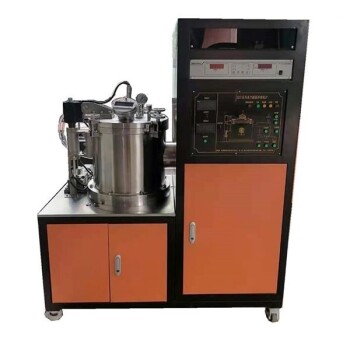
The primary function of a high-frequency induction melting furnace in preparing copper-nickel (CuNi) alloys is to ensure atomic-level homogeneity through electromagnetic stirring while rapidly melting the base metals. Unlike standard furnaces that simply apply heat, this equipment utilizes electromagnetic induction to generate high temperatures for rapid melting. Simultaneously, it induces currents within the molten metal that actively mix the copper and nickel components, preventing separation and ensuring a uniform composition.
Core Takeaway While rapid heating is a functional necessity, the defining advantage of high-frequency induction melting for CuNi alloys is the electromagnetic stirring effect. This intrinsic feature guarantees that the alloy is mixed uniformly at the atomic scale, eliminating compositional segregation that would render experimental deformation data invalid.
The Mechanism of Uniformity
Electromagnetic Stirring
The most critical aspect of this process is not merely the heat, but the motion. As the furnace generates the currents required to melt the metal, it simultaneously creates a stirring effect within the melt.
This is not a mechanical paddle; it is a force generated by the induction field itself. This force ensures that the copper and nickel are continuously circulated, preventing the heavier or denser elements from settling or separating.
Atomic-Scale Mixing
For research-grade alloys, macroscopic mixing is insufficient. The induction process facilitates mixing at the atomic scale.
This ensures that whether you are creating CuNi5 or CuNi25, the ratio of copper to nickel is consistent throughout the entire bulk material, rather than varying from the center to the edge of the ingot.
Preventing Compositional Segregation
Without adequate stirring, alloys can suffer from compositional segregation. This occurs when the constituent elements separate during the liquid phase or solidification.
By maintaining constant movement within the melt until the moment of casting, the high-frequency induction furnace effectively prevents these deviations. This ensures the final material is a true solid solution.
Why This Matters for CuNi Research
Reliable Deformation Data
The primary reason for using this specific furnace type is to support accurate scientific investigation. Researchers often use CuNi alloys to study deformation mechanisms.
If the alloy has segregated spots (areas with too much copper or too much nickel), the mechanical response to stress will vary unpredictably across the sample.
Eliminating Experimental Variables
To determine how specific compositions (like CuNi5 versus CuNi25) perform, the variable must be the composition itself, not the quality of the mix.
High-frequency induction melting removes "poor mixing" as a variable, ensuring that any data recorded regarding mechanical performance is a result of the intended alloy design, not a manufacturing defect.
Understanding the Trade-offs
Atmosphere Control
While high-frequency induction excels at mixing, the melting environment is critical. If not paired with a vacuum or inert gas atmosphere, the high temperatures can lead to oxidation of the metal.
Standard induction furnaces in open air may require flux or cover gases to protect the melt, whereas specialized vacuum induction variants (mentioned in broader metallurgical contexts) are used when absolute purity from gases is required.
Material Selectivity
This method is highly effective for conductive metals like copper and nickel. However, it relies entirely on the material's ability to couple with the magnetic field. It is less effective for non-conductive materials or materials with very poor magnetic coupling unless a conductive crucible (susceptor) is used to transfer heat indirectly.
Making the Right Choice for Your Goal
When selecting a furnace for alloy preparation, align the equipment capabilities with your specific output requirements.
- If your primary focus is basic melting: A standard resistance furnace may suffice, but you risk inconsistent alloy distribution.
- If your primary focus is experimental validity: You must use high-frequency induction to guarantee the atomic-level homogeneity required for publishable data on deformation mechanisms.
The high-frequency induction furnace is the standard for CuNi preparation because it treats mixing as a fundamental part of the melting process, not an afterthought.
Summary Table:
| Feature | High-Frequency Induction Furnace | Standard Resistance Furnace |
|---|---|---|
| Mixing Mechanism | Inherent Electromagnetic Stirring | Passive (Relies on Diffusion) |
| Heating Speed | Rapid (High Efficiency) | Slower |
| Compositional Quality | Atomic-Level Homogeneity | Potential for Segregation |
| Primary Use Case | Precision Alloys & Research | General Metal Melting |
| Experimental Validity | High (Consistent Mechanical Data) | Low (Variable Properties) |
Elevate Your Material Research with KINTEK Precision
Ensure the integrity of your experimental data with KINTEK’s advanced metallurgical solutions. As specialists in laboratory equipment, we provide high-performance induction melting furnaces, vacuum systems, and crushing and milling equipment tailored for researchers and manufacturers. Whether you are developing CuNi alloys or advanced composites, our team offers the technical expertise to help you achieve perfect homogeneity and purity.
Ready to optimize your alloy preparation? Contact KINTEK today for a consultation and explore our full range of high-temperature furnaces, hydraulic presses, and essential consumables.
References
- Stefan J. Eder, Carsten Gachot. Effect of Temperature on the Deformation Behavior of Copper Nickel Alloys under Sliding. DOI: 10.3390/ma14010060
This article is also based on technical information from Kintek Solution Knowledge Base .
Related Products
- Lab-Scale Vacuum Induction Melting Furnace
- Vacuum Arc Induction Melting Furnace
- Vacuum Heat Treat Furnace and Levitation Induction Melting Furnace
- Non Consumable Vacuum Arc Induction Melting Furnace
- 600T Vacuum Induction Hot Press Furnace for Heat Treat and Sintering
People Also Ask
- How do vacuum induction or arc melting furnaces facilitate the synthesis of U-Al-C MAX phases? Precision Heat & Purity
- What types of metals are typically processed in a vacuum induction melting furnace? High-Purity Alloys for Critical Applications
- What is the primary function of a vacuum induction melting furnace in Ni-Mo-Cr-Fe master alloy prep? Ensure High Purity
- Why use VIM for rare earth steel? Essential Precision for Melting Reactive Lanthanum and Cerium
- What are the key components inside the vacuum chamber of a vacuum induction melting furnace? A Guide to the Core Melting Assembly