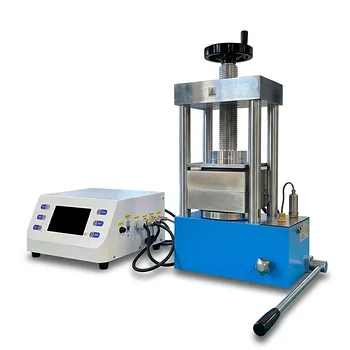
The primary function of a laboratory hydraulic press in this context is to compress loose, high-purity titanium dioxide (TiO2) nanopowder into a solid, disc-shaped form known as a "green body." By applying significant force, the press increases the density of the powder to define specific diameters and thicknesses, preparing the material for the next stage of synthesis.
The press serves as the bridge between raw nanomaterials and solid ceramics, converting loose powder into a cohesive shape. Its main role is to provide sufficient mechanical strength to ensure the target maintains its structure prior to high-temperature sintering.
The Mechanics of Target Preparation
Compacting High-Purity Nanopowder
The process begins with high-purity TiO2 nanopowder, which is naturally loose and difficult to handle.
The hydraulic press exerts a specific high pressure—typically around 1500 kg/cm²—to force these particles together.
Forming the Green Body
The result of this compression is a "green body."
This is a technical term for a ceramic object that has been shaped but not yet fired. The press ensures this body achieves a uniform disc shape with precise dimensional control over both diameter and thickness.
Achieving Structural Integrity
Maximizing Particle Packing
The application of high pressure ensures that the powder particles are tightly packed.
Eliminating voids between particles is essential for the quality of the final target. A higher packing density leads to a more uniform material structure.
Establishing Initial Mechanical Strength
Before the target undergoes heat treatment, it must be strong enough to be moved and handled without crumbling.
The hydraulic press provides this initial mechanical strength. It creates a physical bond between particles that is robust enough to maintain the disc's shape outside of the mold.
The Role in the Sintering Workflow
A Foundation for Sintering
The press does not create the final, hard ceramic target; rather, it establishes a solid physical foundation.
This step is a prerequisite for the subsequent high-temperature sintering process.
Ensuring Successful Densification
Sintering relies on the particles being in close contact to fuse correctly.
By pre-densifying the material in the press, you ensure the sintering process is efficient and results in a high-quality target suitable for Pulsed Laser Deposition (PLD).
Critical Considerations and Limitations
The Nature of "Green" Strength
It is vital to understand that the strength provided by the press is strictly mechanical, not chemical.
While the green body is solid, it remains relatively fragile compared to a sintered ceramic and must be handled with care to avoid micro-cracks.
Pressure Uniformity
The effectiveness of the green body depends entirely on the consistent application of pressure.
If the 1500 kg/cm² (or similar required force) is not applied evenly, the green body may suffer from density gradients, leading to defects during the sintering phase.
Making the Right Choice for Your Goal
To ensure high-quality TiO2 targets for PLD, focusing on the pressing parameters is essential.
- If your primary focus is structural integrity: Ensure you apply sufficient pressure (e.g., 1500 kg/cm²) to achieve the tight particle packing required for a robust green body.
- If your primary focus is dimensional precision: Verify that your mold and hydraulic press settings are calibrated to produce the exact diameter and thickness required for your PLD system.
The laboratory hydraulic press is the critical tool that transforms raw nanopowder into a viable, handleable component ready for thermal processing.
Summary Table:
| Feature | Description |
|---|---|
| Primary Role | Compresses loose TiO2 nanopowder into a solid "green body" |
| Target Form | Disc-shaped pellet with defined diameter and thickness |
| Typical Pressure | Approximately 1500 kg/cm² for optimal particle packing |
| Key Outcome | Maximizes mechanical strength and density before sintering |
| Critical Goal | Eliminates voids to ensure uniform densification during heat treatment |
Elevate Your Material Research with KINTEK Precision
Achieving the perfect TiO2 target for Pulsed Laser Deposition starts with uniform density and structural integrity. KINTEK specializes in high-performance laboratory equipment, providing the advanced hydraulic presses (pellet, hot, and isostatic) and precision molds you need to create flawless green bodies.
Our comprehensive range supports every stage of your workflow, from crushing and milling systems to high-temperature furnaces for sintering and high-pressure reactors for material synthesis. Whether you are developing advanced ceramics or conducting cutting-edge battery research, KINTEK delivers the durability and precision your lab demands.
Ready to optimize your target fabrication? Contact our experts today to find the perfect pressing solution!
References
- M. J. Kadhim, N. H. Obaeed. Investigation Nano coating for Corrosion Protection of Petroleum Pipeline Steel Type A106 Grade B; Theoretical and Practical Study in Iraqi Petroleum Sector. DOI: 10.30684/etj.35.10a.11
This article is also based on technical information from Kintek Solution Knowledge Base .
Related Products
- Hydraulic Diaphragm Lab Filter Press for Laboratory Filtration
- Laboratory Hydraulic Press Split Electric Lab Pellet Press
- Laboratory Manual Hydraulic Pellet Press for Lab Use
- Automatic Laboratory Hydraulic Pellet Press Machine for Lab Use
- Laboratory Hydraulic Pellet Press for XRF KBR FTIR Lab Applications
People Also Ask
- What are the advantages and disadvantages of presses? A Guide to Lab Filter Presses for R&D
- How is a laboratory hydraulic press used in the preparation of modified biochar samples for FTIR analysis? Expert Guide
- What are the safety precautions for filter press? Essential Steps to Prevent High-Pressure Hazards
- What is the capacity of a filter press? A Guide to Volumetric & Throughput Metrics
- What is an example of a hydraulic press? Discover the Power of Laboratory Sample Preparation