The laboratory press serves as the critical bridge between raw powder mixtures and a structured ceramic form. It utilizes high-precision pressure to compact coal gangue, clay, and additives into "green bodies," establishing the structural integrity and particle density required for successful sintering.
The primary function of a laboratory press in this process is the die-pressing and compaction of raw powder mixtures into standardized green bodies. By applying precise axial pressure, the press eliminates internal voids and facilitates particle bonding, creating a stable geometric foundation for the final porous ceramic product.
Transforming Raw Materials into Structural "Green Bodies"
The Mechanics of Die-Pressing
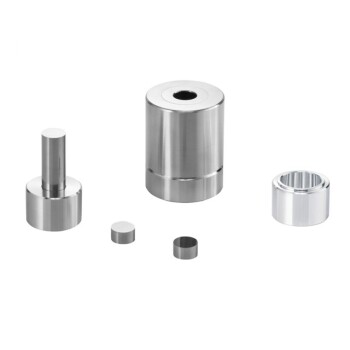
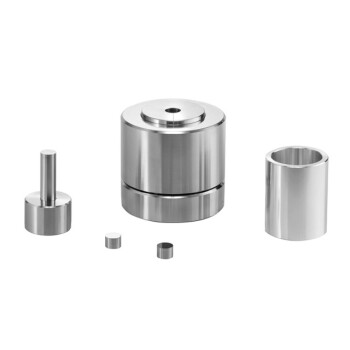
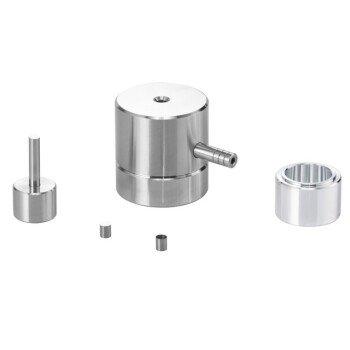
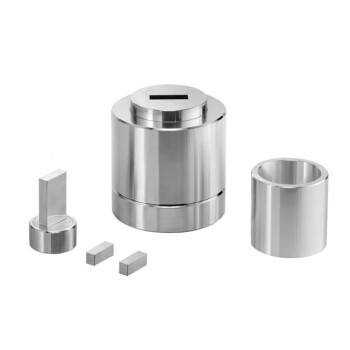
The press applies uniaxial pressure to a uniform mixture of coal gangue, clay, and additive powders held within a precision mold. This mechanical force pre-presses loose material into specific shapes, such as cylindrical pellets or rectangular specimens, often referred to as green bodies.
Achieving Particle Consolidation
High-pressure forming significantly increases the initial packing density of the material. By forcing the powder particles together, the press initiates particle rearrangement and enhances intermolecular forces, which are necessary to hold the shape together before it is fired.
Preliminary Air Expulsion
During the compression cycle, the press assists in the preliminary expulsion of air trapped between the loose powder particles. This reduction in internal gas pockets is essential for creating a uniform internal structure and preventing bloating or cracking during the heating stage.
Establishing the Foundations of Material Quality
Elimination of Internal Defects
Precise control of the applied pressure ensures the tight packing of particles, which directly reduces internal flaws and structural inconsistencies. A well-compacted green body is less likely to develop macro-pores or fractures that could compromise the ceramic's final performance.
Structural Integrity for Downstream Processing
The press provides the green body with sufficient mechanical strength to be handled, measured, or moved to the kiln. This establishes a stable physical form that can withstand the stresses of drying and the early stages of the sintering process.
Simulation of Industrial Standards
In a laboratory setting, the press allows researchers to apply specific unit pressures (often ranging from 8 MPa to 120 MPa) to simulate industrial manufacturing conditions. This enables the accurate evaluation of how different additive concentrations affect the density and shrinkage of the coal gangue-based ceramic.
Understanding the Trade-offs
Pressure Sensitivity and Cracking
While high pressure increases density, exceeding the material's limit can cause lamination or pressure cracking. If the air is not expelled gradually or if the pressure is released too quickly, the stored elastic energy can cause the green body to fail.
Uniformity Limitations in Uniaxial Pressing
Uniaxial pressing in a laboratory press can sometimes lead to density gradients within the sample. The friction between the powder and the mold walls may result in the top of the sample being denser than the center, which can cause uneven warping during the sintering phase.
How to Apply This to Your Ceramic Development
When utilizing a laboratory press for coal gangue-based porous ceramics, your pressure settings should align with your specific material objectives:
- If your primary focus is maximizing structural strength: Utilize higher compaction pressures (e.g., 100-120 MPa) to ensure maximum particle contact and minimize the large voids that lead to structural failure.
- If your primary focus is optimizing permeability and porosity: Use a lower, carefully controlled specific unit pressure (e.g., 8-20 MPa) to maintain the intended pore network while still providing enough strength for handling.
- If your primary focus is industrial scalability: Calibrate the laboratory press to match the exact MPa of your intended production equipment to ensure your shrinkage and density data remain relevant at scale.
Proper compaction via the laboratory press is the essential first step in ensuring a high-quality, durable porous ceramic structure.
Summary Table:
| Function | Key Benefit | Impact on Final Product |
|---|---|---|
| Die-Pressing | Shapes raw powder into "green bodies" | Provides a stable geometric foundation |
| Consolidation | Enhances particle bonding & density | Reduces internal flaws and defects |
| Air Expulsion | Removes trapped gas pockets | Prevents bloating and cracking during sintering |
| Mechanical Strength | Improves handling durability | Ensures stability during drying and firing |
| Simulation | Replicates industrial unit pressures | Enables accurate scalability of research data |
Elevate Your Material Research with KINTEK Precision
Achieving the perfect balance of porosity and strength in coal gangue-based ceramics requires uncompromising precision. KINTEK specializes in high-performance laboratory equipment, including manual and automatic hydraulic presses (pellet, hot, and isostatic) designed to deliver the exact axial pressure needed for superior green body formation.
Our comprehensive portfolio supports your entire workflow—from crushing and milling systems for raw material preparation to high-temperature muffle and tube furnaces for the final sintering stage. Whether you are optimizing permeability or maximizing structural strength, KINTEK provides the reliability and control essential for industrial-grade results.
Contact us today to find the ideal pressing solution for your research needs!
References
- Yansen Jia, Yongzhen Wang. Preparation of Coal Gangue-Based Porous Ceramics and Its Application on Pb2+ Cycling Adsorption. DOI: 10.3390/su151511879
This article is also based on technical information from Kintek Solution Knowledge Base .
Related Products
- Carbide Lab Press Mold for Laboratory Applications
- Assemble Lab Cylindrical Press Mold
- Square Lab Press Mold for Laboratory Applications
- Cylindrical Press Mold for Lab Applications
- Assemble Square Lab Press Mold for Laboratory Applications
People Also Ask
- How to use a press mold? Master the Art of Creating Consistent Ceramic Forms
- What is the press mould method? A Guide to Consistent, Detailed Ceramic Forms
- What is the function of press molds during the preparation of SiCf/Ti-43Al-9V composites? Achieve Structural Precision
- What is a press mold used for? Achieve Repeatable Precision and Efficiency
- What is the purpose of specialized pressure devices in sulfide solid-state batteries? Ensure Chemo-Mechanical Stability