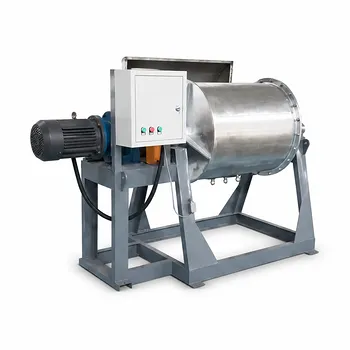
The primary function of a planetary ball mill in the preparation of Oxide Dispersion Strengthened (ODS) ferritic steel is to perform high-energy mechanical alloying. Through high-speed collisions and intense shear forces, the equipment drives the atomic-level forced mixing of metallic elements (such as Fe, Cr, W, and Ti) with oxide nanoparticles. This process creates a uniform solid solution and ensures the strengthening phases are evenly distributed throughout the matrix.
By generating intense mechanical energy, the planetary ball mill forces incompatible materials to combine. It embeds nanoscale oxide particles into the metal matrix to create a homogenous alloy, a critical step that dictates the material's final strength and stability.
The Mechanism of Mechanical Alloying
Generating High-Energy Impact
The planetary ball mill operates by rotating the grinding jar and the supporting disc in opposite directions.
This planetary motion generates high centrifugal forces, causing the grinding balls to impact the powder mixture at high speeds. This kinetic energy is the driving force that allows the mill to alter the microstructure of the steel powder.
The Cycle of Cold Welding and Fracturing
At the microscopic level, the process subjects the powder to a continuous cycle of cold welding and fracturing.
As the grinding balls collide, the metallic powder particles are flattened and welded together, trapping the oxide nanoparticles (such as Yttria or Zirconia) inside. Immediately after, shear forces fracture these composite particles.
Achieving Atomic-Level Mixing
Repeated fracturing and re-welding leads to a forced solid solution.
Unlike standard mixing, which only blends particles superficially, this process enables the diffusion of alloying elements at the atomic level. It transforms the initial mixture of distinct powders into a single-phase alloy with a refined microstructure.
Critical Objectives in ODS Steel Preparation
Breaking Down Agglomeration
Nanoparticles, such as oxide strengthening phases, have a strong tendency to clump together due to electrostatic attraction.
The planetary ball mill utilizes high-speed rotational energy to break these agglomerates. This ensures that the nano-scale oxides are chemically bonded to and embedded within the micron-sized metallic base powders, rather than sitting loosely on the surface.
Ensuring Uniform Dispersion
The defining characteristic of ODS steel is the uniform distribution of its strengthening phase.
Without the high-energy input of the ball mill, the oxides would remain segregated. The milling process ensures these particles are dispersed evenly throughout the matrix, which is the foundation for the material's structural integrity.
Enhancing High-Temperature Stability
The ultimate goal of this preparation is to improve the finished steel's performance in extreme environments.
By achieving a supersaturated solid solution and uniform dispersion, the milled powder yields a material with significantly enhanced creep strength and microstructural stability when exposed to high temperatures or radiation.
Understanding the Trade-offs
Processing Time and Energy
Mechanical alloying is an energy-intensive process that can require significant time to achieve the necessary saturation.
The process relies on repetitive deformation; rushing this stage can lead to an inhomogeneous distribution of oxides, which compromises the mechanical properties of the final product.
Contamination Risks
Because the process relies on high-friction grinding, there is a risk of contamination from the milling media (the balls and jar).
Operators must select the correct grinding media materials to minimize impurities that could degrade the purity of the ferritic steel powder.
Making the Right Choice for Your Goal
Whether you are optimizing for additive manufacturing or traditional sintering, understanding the role of the ball mill is essential for process control.
- If your primary focus is Microstructural Homogeneity: Ensure the milling duration is sufficient to achieve a complete solid solution, preventing the segregation of oxide particles.
- If your primary focus is Powder Flowability (e.g., for 3D Printing): Monitor the process to ensure the embedding of nanoparticles effectively reduces agglomeration, allowing the powder to pass through feeding systems.
The planetary ball mill is not just a mixer; it is a reactor that uses mechanical force to engineer the atomic structure of ODS steel for superior performance.
Summary Table:
| Process Component | Role in ODS Steel Preparation |
|---|---|
| Primary Function | High-energy mechanical alloying and atomic-level forced mixing |
| Key Mechanism | Repetitive cycle of cold welding and fracturing of particles |
| Energy Source | High centrifugal forces from opposite rotation of jar and disc |
| Core Objective | Breaking nanoparticle agglomeration and ensuring uniform dispersion |
| Final Benefit | Enhanced creep strength and high-temperature microstructural stability |
Elevate your material science research with KINTEK’s industry-leading precision equipment. From high-energy planetary ball mills and crushing and milling systems to high-temperature furnaces (muffle, vacuum, CVD) and isostatic hydraulic presses, we provide the specialized tools necessary for advanced ODS steel preparation and additive manufacturing. Our comprehensive range of laboratory equipment and consumables, including high-purity ceramics and crucibles, is designed to minimize contamination and maximize consistency. Optimize your alloy development—contact KINTEK today for expert solutions!
References
- Agata Strojny‐Nędza, Marcin Chmielewski. Effect of Nitrogen Atmosphere Annealing of Alloyed Powders on the Microstructure and Properties of ODS Ferritic Steels. DOI: 10.3390/ma17081743
This article is also based on technical information from Kintek Solution Knowledge Base .
Related Products
- High Energy Planetary Ball Mill for Laboratory Horizontal Tank Type Milling Machine
- Laboratory Planetary Ball Mill Rotating Ball Milling Machine
- High-Energy Omnidirectional Planetary Ball Mill Milling Machine for Laboratory
- High Energy Planetary Ball Mill Milling Machine for Laboratory
- Laboratory Horizontal Planetary Ball Mill Milling Machine
People Also Ask
- What is the role of a planetary ball mill in sulfide-based solid-state batteries? Engineer High-Performance Cathodes
- What are the parameters of a planetary ball mill? Master Speed, Time, and Media for Perfect Grinding
- What is the function of a planetary ball mill for nanostructured eutectic steel? Essential Prep for High-Strength Alloys
- What role does a planetary ball mill play in the preparation of NASICON-type solid electrolytes like LATP and LAGP?
- What is the function of a planetary ball mill in solid-state electrolyte prep? Milling vs. SDS Methods Explained