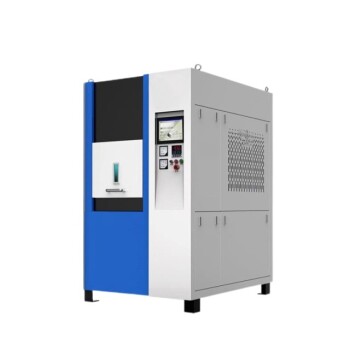
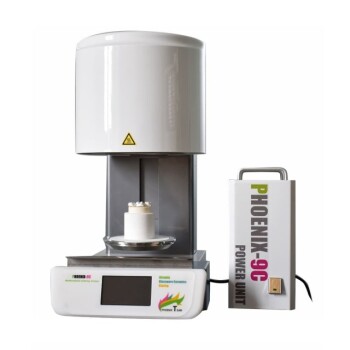
The primary function of a sintering furnace in the production of gradient functional materials is to provide a precise, high-temperature environment that facilitates densification through atomic diffusion. By heating pre-formed powder "green bodies," the furnace enables different material layers to bond and integrate without melting, creating a unified structure with distinct, transitioning properties.
Sintering acts as the bridge between separate powder layers and a solid, functional part. It utilizes atomic diffusion to create a smooth transition of properties between different materials, effectively reducing thermal stress and ensuring structural integrity.
The Mechanics of Gradient Sintering
Facilitating Atomic Diffusion
The furnace heats the material to a point just below its melting point.
At this specific temperature, particles within the powder layers gain enough energy to move and bond. This process, known as atomic diffusion, causes the particles to weld together, transforming the loose powder into a solid mass.
Densification of Green Bodies
Before entering the furnace, the raw material exists as a "green body"—a pressed but fragile form.
The furnace drives the densification process, eliminating voids between particles. This results in a compact, high-strength component that retains the complex geometry shaped during the initial pressing stage.
Layer-to-Layer Integration
In gradient functional materials, distinct layers of different compositions must become one.
The sintering furnace allows these layers to diffuse into one another at their boundaries. This creates a cohesive bond between dissimilar materials, such as metals and ceramics, which is essential for the material's advanced functionality.
Why This Matters for Gradient Materials
Enabling Smooth Transitions
The defining characteristic of a gradient material is the lack of a sharp interface between layers.
Sintering ensures a smooth transition of properties across the component. Rather than an abrupt change that could lead to separation, the material properties shift gradually from one layer to the next.
Reduction of Thermal Stress
One of the most critical roles of the sintering process in this context is stress management.
By processing at relatively lower temperatures compared to full melting, and by creating gradual transitions, the furnace significantly reduces thermal stress. This prevents cracking and delamination that often occur when joining materials with different thermal expansion rates.
Precision at Every Scale
The sintering process is highly adaptable regarding scale.
It allows for the fabrication of stepped gradient structures with varying layer thicknesses. The furnace can effectively process transitions ranging from the nanometer scale up to millimeters, offering immense design flexibility.
Understanding the Trade-offs
Temperature Control is Critical
Sintering requires maintaining temperatures strictly below the melting point of the main component.
If the temperature is too high, the material may liquefy, destroying the gradient structure. If it is too low, atomic diffusion will not occur, resulting in a weak, porous part.
Material Compatibility
While sintering avoids solid-liquid phase changes, it still requires chemical compatibility between layers.
The diffusion rates of the different powders must be aligned. If one layer sinters significantly faster than its neighbor, it can lead to warping or internal stresses that the furnace cannot correct.
Porosity Management
Sintering increases strength, but it does not always result in 100% density.
Depending on the time and temperature, some porosity may remain. While this is useful for applications like filters, it can be a detriment in parts requiring high fatigue strength.
Making the Right Choice for Your Goal
To maximize the effectiveness of your sintering process, align your furnace parameters with your specific material objectives:
- If your primary focus is structural integrity: Prioritize higher sintering temperatures (within limits) and longer dwell times to maximize densification and particle welding.
- If your primary focus is complex gradient transitions: Focus on precise temperature zoning to manage the diffusion rates between dissimilar material layers, minimizing residual stress.
The sintering furnace is not just a heater; it is the environment where loose potential is transformed into engineered performance through the precise control of atomic diffusion.
Summary Table:
| Feature | Role in Gradient Material Production |
|---|---|
| Core Process | Facilitates atomic diffusion to bond powder particles without liquefaction. |
| Structural Goal | Transforms fragile 'green bodies' into dense, high-strength solid components. |
| Interface Quality | Eliminates sharp boundaries by creating smooth transitions between layers. |
| Stress Management | Minimizes thermal stress and prevents delamination between dissimilar materials. |
| Precision Control | Maintains temperatures strictly below melting points to preserve gradient geometry. |
Elevate Your Material Research with KINTEK Precision
Unlock the full potential of your powder metallurgy and gradient material projects with KINTEK’s advanced thermal solutions. Our comprehensive range of high-temperature furnaces (muffle, tube, vacuum, and atmosphere) and crushing and milling systems are engineered to provide the exact temperature zoning and particle consistency required for flawless atomic diffusion.
Whether you are developing complex metal-ceramic transitions or high-strength industrial components, KINTEK offers the specialized laboratory equipment—from high-pressure reactors to isostatic hydraulic presses—to ensure your structural integrity and performance goals are met.
Ready to optimize your sintering process? Contact us today to find the perfect solution for your lab!
References
- Islam M. El-Galy, Mahmoud H. Ahmed. Functionally graded materials classifications and development trends from industrial point of view. DOI: 10.1007/s42452-019-1413-4
This article is also based on technical information from Kintek Solution Knowledge Base .
Related Products
- Vacuum Heat Treat and Sintering Furnace with 9MPa Air Pressure
- Spark Plasma Sintering Furnace SPS Furnace
- Vacuum Heat Treat and Molybdenum Wire Sintering Furnace for Vacuum Sintering
- Small Vacuum Heat Treat and Tungsten Wire Sintering Furnace
- Dental Porcelain Zirconia Sintering Ceramic Vacuum Press Furnace
People Also Ask
- What is the process of pressure sintering? Achieve Superior Density and Strength for High-Performance Parts
- What is the effect of pressure during sintering? Achieve Higher Density and Finer Microstructures Faster
- Why must green bodies produced via binder jetting undergo treatment in a vacuum sintering furnace?
- What is a vacuum sintering furnace? Unlock Purity and Performance in Advanced Materials
- How does the vacuum environment impact sintering of diamond-copper composites? Protect Against Thermal Damage