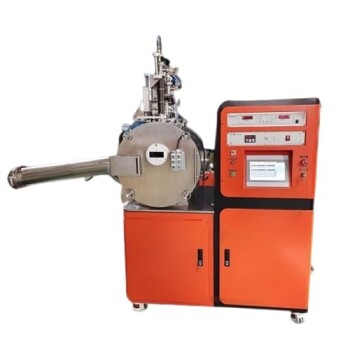
The primary function of a vacuum induction furnace in the preparation of High-Strength Low-Alloy (HSLA) steel is to create a high-purity vacuum environment for melting ingots. By strictly isolating the molten metal from the atmosphere, the furnace eliminates reactive gases like oxygen and nitrogen. This process is essential for minimizing non-metallic inclusions and ensuring the precise chemical composition required for high-performance applications.
Core Takeaway The vacuum induction furnace is not merely a heating device; it is a purification tool. Its critical value lies in preventing atmospheric contamination during the melting phase, thereby guaranteeing the material purity and compositional accuracy necessary for reliable microstructural analysis and subsequent heat treatment.
The Mechanism of Purification
Eliminating Atmospheric Contamination
The fundamental role of this equipment is to remove air from the melting chamber. Standard atmospheric melting exposes molten steel to oxygen and nitrogen.
In a vacuum induction furnace, these gases are effectively evacuated. This prevents them from reacting with the molten pool, which is the primary cause of material degradation in high-performance alloys.
Reduction of Non-Metallic Inclusions
When oxygen reacts with molten steel, it creates oxides—microscopic non-metallic particles trapped inside the metal. These are known as inclusions.
The vacuum environment drastically reduces the formation of these inclusions. Fewer inclusions mean the steel maintains higher structural integrity and fewer potential failure points.
Degassing and Cleanliness
Beyond preventing new contaminants, the vacuum process actively degasses the material. It helps remove volatile impurities already present in the raw materials.
This results in an exceptionally clean ingot. A clean baseline is required to study how the steel evolves during later processing steps.
Precision in Chemical Composition
Protecting Active Elements
HSLA steels often rely on precise additions of alloying elements to achieve their strength. In the presence of air, active elements can oxidize and burn off before they mix into the steel.
The vacuum environment ensures that these alloying elements remain in the melt rather than turning into slag. This guarantees that the final chemical makeup matches the intended design exactly.
Preventing Brittle Compound Formation
While the primary focus is purity, the exclusion of nitrogen is equally critical. High nitrogen levels can lead to the formation of brittle nitrides (such as aluminum or boron nitrides).
By keeping nitrogen out, the furnace prevents these brittle phases from forming. This is essential for maintaining the ductility and toughness expected of HSLA steel.
Understanding the Risks of Atmospheric Exposure
The Cost of Impurity
If HSLA steel is prepared without a vacuum environment, the "deep need" for reliability is compromised. The presence of oxygen and nitrogen introduces variables that are difficult to control.
Impact on Future Processing
The primary reference highlights that this purity is critical for "subsequent heat treatment and microstructural evolution research."
If the initial melting is flawed by inclusions or incorrect chemistry, all downstream data—such as how the steel responds to heat or stress—becomes unreliable. The vacuum furnace ensures the starting material is a "known quantity."
Making the Right Choice for Your Goal
To ensure your HSLA steel meets the necessary standards, align your preparation method with your specific research or production objectives.
- If your primary focus is material integrity: Prioritize vacuum induction melting to minimize non-metallic inclusions that act as stress concentration points.
- If your primary focus is research accuracy: Use this furnace to establish a chemically precise baseline, ensuring that observed microstructural changes are due to your experimental variables, not random impurities.
- If your primary focus is alloy complexity: Rely on the vacuum environment to protect reactive alloying elements from oxidation, ensuring they contribute fully to the steel's mechanical properties.
Ultimately, the vacuum induction furnace acts as the gatekeeper of quality, transforming raw potential into a predictable, high-performance engineering material.
Summary Table:
| Feature | Primary Function in HSLA Steel Production |
|---|---|
| Atmospheric Isolation | Eliminates oxygen and nitrogen to prevent oxidation and brittle nitride formation. |
| Purification Mechanism | Actively degasses volatile impurities and minimizes non-metallic inclusions. |
| Composition Control | Protects reactive alloying elements from oxidation, ensuring precise chemical makeup. |
| Material Integrity | Creates a clean, predictable baseline for reliable microstructural and heat treatment research. |
Elevate Your Alloy Research with KINTEK Precision
Ensure the integrity of your high-strength low-alloy steels with KINTEK’s advanced vacuum induction melting systems. Our high-temperature furnaces provide the ultra-pure environments necessary to eliminate contamination and guarantee compositional accuracy. Beyond induction melting, KINTEK specializes in a comprehensive range of laboratory equipment including high-temperature reactors, autoclaves, crushing and milling systems, and hydraulic presses designed for demanding material science applications.
Ready to transform your material quality? Contact KINTEK today for expert solutions!
References
- Ning Li, Chengzhi Zhao. Effect of Dynamic Recrystallization on the Transformed Ferrite Microstructures in HSLA Steel. DOI: 10.3390/met10060817
This article is also based on technical information from Kintek Solution Knowledge Base .
Related Products
- 600T Vacuum Induction Hot Press Furnace for Heat Treat and Sintering
- Lab-Scale Vacuum Induction Melting Furnace
- Non Consumable Vacuum Arc Induction Melting Furnace
- Vacuum Heat Treat Furnace and Levitation Induction Melting Furnace
- Vacuum Arc Induction Melting Furnace
People Also Ask
- What role does an induction vacuum hot pressing furnace play in sintering? Achieve 98% Density in Carbide Blocks
- What advantages does a vacuum hot press furnace provide for LSLBO ceramic electrolytes? Achieve 94% Relative Density
- What role does a Vacuum Hot Press (VHP) furnace play in the densification of austenitic stainless steel 316 composites?
- What role does mechanical pressure play during the vacuum diffusion bonding of tungsten and copper? Keys to Solid Bonding
- What are the advantages of a vacuum hot press furnace for W-50%Cu? Achieve 99.6% Density at Lower Temperatures