Knowledge What is the primary function of a vacuum induction furnace in the preparation of silicon-containing T91 steel?
Author avatar

Tech Team · Kintek Solution

Updated 2 days ago

What is the primary function of a vacuum induction furnace in the preparation of silicon-containing T91 steel?


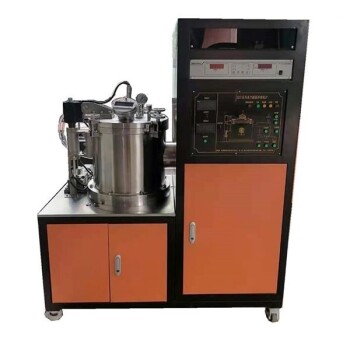
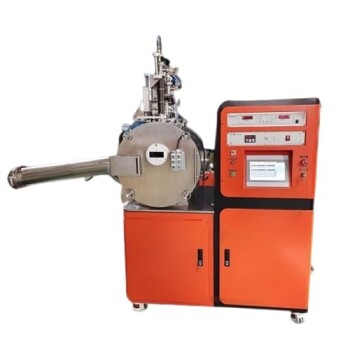
The primary function of a vacuum induction furnace in the preparation of silicon-containing T91 steel is to melt ingots within a strictly controlled vacuum environment to ensure chemical precision. By isolating the melt from the atmosphere, the furnace allows for the exact regulation of the material's composition while preventing the unintended oxidation of critical alloying elements.

The core value of this process lies in stability. By eliminating atmospheric oxygen, the vacuum induction furnace protects reactive elements like silicon and chromium from oxidizing, ensuring that exact concentration targets (such as 0.5, 1.3, and 2.0 wt.%) are achieved for accurate experimental analysis.

Achieving Chemical Precision

Controlling the Environment

The preparation of specialized alloys requires more than just high heat; it requires a pristine environment.

A vacuum induction furnace provides a strictly controlled setting that isolates the molten steel from external contaminants.

Regulating Alloy Composition

The primary objective during the melting process is maintaining the integrity of the chemical recipe.

The vacuum setup allows metallurgists to precisely regulate the composition of the T91 steel, ensuring the final product matches the intended theoretical design.

Targeting Specific Concentrations

In experimental studies, even minor deviations in elemental weight percentages can skew results.

This furnace technology is critical for hitting exact targets, such as specific silicon concentrations of 0.5 wt.%, 1.3 wt.%, and 2.0 wt.%, which are necessary for reliable material characterization.

Preventing Material Degradation

The Risk of Oxidation

High-temperature melting in an open atmosphere poses a significant risk to reactive elements.

Alloying elements such as silicon and chromium are particularly susceptible to oxidation, which effectively burns them out of the mixture before the steel solidifies.

Preserving Critical Elements

If these elements oxidize, the final steel will lack the specific properties required for the study.

The vacuum induction furnace prevents this loss, ensuring that the silicon and chromium added to the melt remain in the final ingot rather than turning into slag or oxides.

Understanding the Trade-offs

Operational Complexity

While vacuum induction offers superior control, it introduces significant operational complexity.

Unlike open-air melting, this process requires maintaining a rigorous vacuum seal, which demands specialized equipment and careful monitoring.

Batch Processing Limits

The necessity of a controlled vacuum environment often limits the volume of material that can be processed at once.

This method prioritizes quality and precision over high-volume throughput, making it ideal for experimental ingots but potentially slower for mass production.

Making the Right Choice for Your Goal

To ensure your material preparation yields valid experimental data, consider the following regarding the use of vacuum induction:

  • If your primary focus is preventing elemental loss: Rely on vacuum induction to stop silicon and chromium from oxidizing during the melt.
  • If your primary focus is experimental accuracy: Use this method to guarantee that your actual silicon concentrations match your target weights (e.g., 0.5 wt.% or 2.0 wt.%).

The vacuum induction furnace is the definitive tool for converting a precise chemical formula into a physical reality without environmental interference.

Summary Table:

Feature Benefit in T91 Steel Preparation
Vacuum Environment Prevents oxidation of reactive elements like Si and Cr
Composition Control Ensures precise weight percentages (0.5, 1.3, 2.0 wt.%)
Atmospheric Isolation Eliminates external contaminants for material purity
Induction Heating Provides uniform melting and efficient alloying

Elevate Your Material Research with KINTEK Precision

Precision in the lab translates to reliability in the field. KINTEK specializes in advanced laboratory equipment designed for the most demanding metallurgical applications. Our induction melting systems provide the rigorous vacuum control necessary to eliminate atmospheric contamination and secure exact chemical compositions for T91 steel and other complex alloys.

From high-temperature furnaces (muffle, tube, and vacuum) to our specialized high-temperature high-pressure reactors and crushing systems, KINTEK provides the tools researchers need for flawless material characterization.

Ready to ensure your experimental accuracy? Contact our laboratory specialists today to discover how our melting and alloy preparation solutions can support your next breakthrough.

References

  1. Ji Li, Gang Yang. Effect of Silicon on Dynamic/Static Corrosion Resistance of T91 in Lead–Bismuth Eutectic at 550 °C. DOI: 10.3390/ma15082862

This article is also based on technical information from Kintek Solution Knowledge Base .

Related Products

People Also Ask

Related Products

Molybdenum Vacuum Heat Treat Furnace

Molybdenum Vacuum Heat Treat Furnace

Discover the benefits of a high-configuration molybdenum vacuum furnace with heat shield insulation. Ideal for high-purity, vacuum environments like sapphire crystal growth and heat treatment.

2200 ℃ Graphite Vacuum Heat Treat Furnace

2200 ℃ Graphite Vacuum Heat Treat Furnace

Discover the power of the KT-VG Graphite Vacuum Furnace - with a maximum working temperature of 2200℃, it's perfect for vacuum sintering of various materials. Learn more now.

2200 ℃ Tungsten Vacuum Heat Treat and Sintering Furnace

2200 ℃ Tungsten Vacuum Heat Treat and Sintering Furnace

Experience the ultimate refractory metal furnace with our Tungsten vacuum furnace. Capable of reaching 2200℃, perfect for sintering advanced ceramics and refractory metals. Order now for high-quality results.

1400℃ Controlled Atmosphere Furnace with Nitrogen and Inert Atmosphere

1400℃ Controlled Atmosphere Furnace with Nitrogen and Inert Atmosphere

Achieve precise heat treatment with KT-14A controlled atmosphere furnace. Vacuum sealed with a smart controller, it's ideal for lab and industrial use up to 1400℃.

Ultra-High Temperature Graphite Vacuum Graphitization Furnace

Ultra-High Temperature Graphite Vacuum Graphitization Furnace

The ultra-high temperature graphitization furnace utilizes medium frequency induction heating in a vacuum or inert gas environment. The induction coil generates an alternating magnetic field, inducing eddy currents in the graphite crucible, which heats up and radiates heat to the workpiece, bringing it to the desired temperature. This furnace is primarily used for graphitization and sintering of carbon materials, carbon fiber materials, and other composite materials.

Vacuum Heat Treat and Molybdenum Wire Sintering Furnace for Vacuum Sintering

Vacuum Heat Treat and Molybdenum Wire Sintering Furnace for Vacuum Sintering

A vacuum molybdenum wire sintering furnace is a vertical or bedroom structure, which is suitable for withdrawal, brazing, sintering and degassing of metal materials under high vacuum and high temperature conditions. It is also suitable for dehydroxylation treatment of quartz materials.

Vacuum Heat Treat Sintering Brazing Furnace

Vacuum Heat Treat Sintering Brazing Furnace

A vacuum brazing furnace is a type of industrial furnace used for brazing, a metalworking process that joins two pieces of metal using a filler metal that melts at a lower temperature than the base metals. Vacuum brazing furnaces are typically used for high-quality applications where a strong, clean joint is required.

Vacuum Heat Treat Furnace with Ceramic Fiber Liner

Vacuum Heat Treat Furnace with Ceramic Fiber Liner

Vacuum furnace with polycrystalline ceramic fiber insulation liner for excellent heat insulation and uniform temperature field. Choose from 1200℃ or 1700℃ max. working temperature with high vacuum performance and precise temperature control.

Graphite Vacuum Furnace Bottom Discharge Graphitization Furnace for Carbon Materials

Graphite Vacuum Furnace Bottom Discharge Graphitization Furnace for Carbon Materials

Bottom-out graphitization furnace for carbon materials, ultra-high temperature furnace up to 3100°C, suitable for graphitization and sintering of carbon rods and carbon blocks. Vertical design, bottom discharging, convenient feeding and discharging, high temperature uniformity, low energy consumption, good stability, hydraulic lifting system, convenient loading and unloading.

Horizontal High Temperature Graphite Vacuum Graphitization Furnace

Horizontal High Temperature Graphite Vacuum Graphitization Furnace

Horizontal Graphitization Furnace: This type of furnace is designed with the heating elements placed horizontally, allowing for uniform heating of the sample. It's well-suited for graphitizing large or bulky samples that require precise temperature control and uniformity.

1800℃ Muffle Oven Furnace for Laboratory

1800℃ Muffle Oven Furnace for Laboratory

KT-18 muffle furnace with Japan Al2O3 polycrystalline fibe and Silicon Molybdenum heating element, up to 1900℃, PID temperature control and 7" smart touch screen. Compact design, low heat loss, and high energy efficiency. Safety interlock system and versatile functions.

1200℃ Split Tube Furnace with Quartz Tube Laboratory Tubular Furnace

1200℃ Split Tube Furnace with Quartz Tube Laboratory Tubular Furnace

KT-TF12 split tube furnace: high-purity insulation, embedded heating wire coils, and max. 1200C. Widely used for new materials and chemical vapour deposition.

1700℃ Muffle Oven Furnace for Laboratory

1700℃ Muffle Oven Furnace for Laboratory

Get superior heat control with our 1700℃ Muffle Furnace. Equipped with intelligent temperature microprocessor, TFT touch screen controller & advanced insulation materials for precise heating up to 1700C. Order now!

Vertical High Temperature Graphite Vacuum Graphitization Furnace

Vertical High Temperature Graphite Vacuum Graphitization Furnace

Vertical high temperature graphitization furnace for carbonization and graphitization of carbon materials up to 3100℃.Suitable for shaped graphitization of carbon fiber filaments and other materials sintered in a carbon environment.Applications in metallurgy, electronics, and aerospace for producing high-quality graphite products like electrodes and crucibles.

Laboratory Muffle Oven Furnace Bottom Lifting Muffle Furnace

Laboratory Muffle Oven Furnace Bottom Lifting Muffle Furnace

Efficiently produce batches with excellent temperature uniformity using our Bottom Lifting Furnace. Features two electric lifting stages and advanced temperature control up to 1600℃.

1400℃ Muffle Oven Furnace for Laboratory

1400℃ Muffle Oven Furnace for Laboratory

Get precise high-temperature control up to 1500℃ with KT-14M Muffle furnace. Equipped with a smart touch screen controller and advanced insulation materials.

600T Vacuum Induction Hot Press Furnace for Heat Treat and Sintering

600T Vacuum Induction Hot Press Furnace for Heat Treat and Sintering

Discover the 600T Vacuum Induction Hot Press Furnace, designed for high-temperature sintering experiments in vacuum or protected atmospheres. Its precise temperature and pressure control, adjustable working pressure, and advanced safety features make it ideal for nonmetal materials, carbon composites, ceramics, and metal powders.

Small Vacuum Heat Treat and Tungsten Wire Sintering Furnace

Small Vacuum Heat Treat and Tungsten Wire Sintering Furnace

The small vacuum tungsten wire sintering furnace is a compact experimental vacuum furnace specially designed for universities and scientific research institutes. The furnace features a CNC welded shell and vacuum piping to ensure leak-free operation. Quick-connect electrical connections facilitate relocation and debugging, and the standard electrical control cabinet is safe and convenient to operate.

Laboratory Vacuum Tilt Rotary Tube Furnace Rotating Tube Furnace

Laboratory Vacuum Tilt Rotary Tube Furnace Rotating Tube Furnace

Discover the versatility of Laboratory Rotary Furnace: Ideal for calcination, drying, sintering, and high-temperature reactions. Adjustable rotating and tilting functions for optimal heating. Suitable for vacuum and controlled atmosphere environments. Learn more now!

Graphite Vacuum Continuous Graphitization Furnace

Graphite Vacuum Continuous Graphitization Furnace

High-temperature graphitization furnace is a professional equipment for graphitization treatment of carbon materials. It is a key equipment for the production of high-quality graphite products. It has high temperature, high efficiency and uniform heating. It is suitable for various high-temperature treatments and graphitization treatments. It is widely used in metallurgy, electronics, aerospace, etc. industry.


Leave Your Message