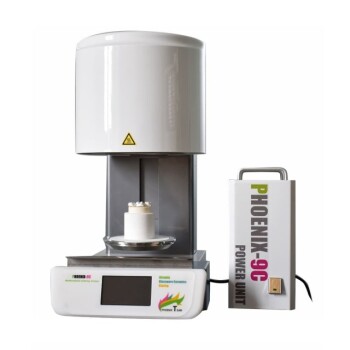
The primary function of an atmosphere sintering furnace is to provide a controlled reduction environment that facilitates the bonding of metal powder particles at high temperatures. Specifically, in the preparation of P434L stainless steel supports, the furnace heats tape-cast samples to approximately 1350°C to achieve a targeted porosity of 40% while preventing any unintended oxidation that would compromise the material's integrity.
Core Takeaway: The atmosphere sintering furnace acts as a precision thermal reactor that manages chemical reactions and particle fusion to transform fragile green bodies into mechanically sound, porous stainless steel structures.
The Role of Controlled Atmospheres in Sintering
Preventing Material Degradation
For stainless steels like P434L, exposure to oxygen at high temperatures causes rapid oxidation, which can ruin the material's surface and internal structure. The furnace excludes oxygen by introducing high-purity inert gases or reducing mixtures, ensuring the stainless steel remains chemically stable during the process.
The Impact of Reduction Environments
Primary fabrication processes utilize a specific mixture of 2% H2 and 98% Ar. This hydrogen component acts as a reducing agent, removing any residual oxides from the surface of the metal powders to ensure clean, high-strength contact points between particles.
Elimination of Contaminants
Atmosphere regulation is also essential for removing pressing lubricants and binders used during the initial forming stages. By controlling the gas flow and temperature, the furnace ensures these additives are "burned off" or evacuated before the final sintering stage begins.
Achieving Structural Integrity and Targeted Porosity
Formation of Sintering Necks
The furnace facilitates solid-state sintering, where atoms diffuse across particle boundaries to form "sintering necks." These necks act as bridges that bond the powder particles together, providing the support with its final mechanical strength and dimensional accuracy.
Solid-State Transformation vs. Melting
A critical function of the furnace is maintaining temperatures strictly below the melting point of P434L stainless steel. The goal is to shape the material and induce crystallization without liquefying it, which would cause the internal pore structure to collapse.
Precise Porosity Management
By tightly controlling the thermal cycle and the duration of the heat soak, the furnace allows engineers to hit a specific 40% porosity target. This balance is vital for creating a support that is permeable enough for filtration or electrochemical use while remaining structurally robust.
Understanding the Trade-offs
Porosity vs. Mechanical Strength
There is an inherent trade-off between the density of a part and its permeability. Increasing the sintering temperature or time enhances atomic diffusion, which improves mechanical strength but simultaneously reduces porosity as the voids between particles are filled.
Atmosphere Purity and Cost
Maintaining a strictly controlled reduction environment requires continuous gas flow and precise monitoring. High-purity argon and hydrogen mixtures increase operational costs, but any lapse in atmosphere quality can lead to embrittlement or structural failure of the P434L support.
Applying Furnace Parameters to Your Project
When preparing porous P434L supports, your furnace settings must align with the intended application of the final product.
- If your primary focus is Maximum Permeability: Prioritize lower sintering temperatures or shorter dwell times to prevent excessive densification and maintain the 40% porosity target.
- If your primary focus is Structural Durability: Utilize a slightly higher hydrogen concentration and longer thermal soaking to maximize the size and strength of the sintering necks between particles.
The successful preparation of porous P434L supports relies entirely on the furnace’s ability to balance thermal bonding with a protective, non-oxidizing chemical environment.
Summary Table:
| Parameter/Function | Specification for P434L | Impact on Material Quality |
|---|---|---|
| Primary Temperature | ~1350°C (Below melting point) | Induces crystallization & solid-state sintering |
| Gas Atmosphere | 2% H2 + 98% Ar Mixture | Prevents oxidation; removes surface oxides |
| Porosity Target | 40% | Balances permeability with mechanical strength |
| Binder Removal | Thermal debinding stage | Eliminates contaminants and lubricants |
| Structural Goal | Sintering Neck Formation | Ensures atomic diffusion for bonding |
Achieve Unmatched Precision in Your Material Sintering
Precision and atmosphere control are the keys to successful P434L stainless steel fabrication. KINTEK specializes in advanced laboratory equipment designed to meet the rigorous demands of material science. Our comprehensive range of atmosphere, vacuum, and tube furnaces provides the stable, non-oxidizing environments necessary for achieving targeted porosity and structural integrity.
Whether you need high-temperature furnaces, high-pressure reactors, or specialized PTFE and ceramic consumables, KINTEK delivers the reliability your research deserves.
Ready to elevate your lab's performance? Contact our experts today to find the perfect sintering solution for your specific application!
References
- Fengyu Shen, Michael C. Tucker. Oxidation of porous stainless steel supports for metal-supported solid oxide electrolysis cells. DOI: 10.1016/j.ijhydene.2022.11.235
This article is also based on technical information from Kintek Solution Knowledge Base .
Related Products
- Mesh belt controlled atmosphere furnace
- Controlled Nitrogen Inert Hydrogen Atmosphere Furnace
- 1200℃ Controlled Atmosphere Furnace Nitrogen Inert Atmosphere Furnace
- 1700℃ Controlled Atmosphere Furnace Nitrogen Inert Atmosphere Furnace
- 1400℃ Controlled Atmosphere Furnace with Nitrogen and Inert Atmosphere
People Also Ask
- What are some of the reasons why a controlled atmosphere furnace is desirable in sintering? Achieve Superior Sintering Results
- What role does a controlled atmosphere furnace with argon gas flow play in the production of reduced graphene oxide (rGO)?
- Why is a furnace equipped with a controlled atmosphere necessary for the preparation of active metal catalysts?
- How does a mesh belt furnace work? Achieve High-Volume, Repeatable Heat Treatment
- What is the process of a mesh belt furnace? Achieve Consistent, High-Volume Heat Treatment