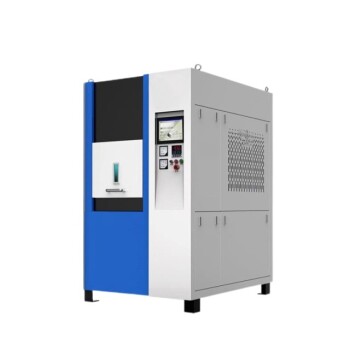
The primary function of an induction melting furnace in developing heat-resistant Cr-Ni steel is to achieve high-temperature homogeneity through electromagnetic stirring. This equipment uses electromagnetic induction to generate the intense heat required to completely melt refractory alloying elements—such as chromium, nickel, molybdenum, and niobium—while simultaneously mixing the molten bath to ensure a uniform chemical composition throughout the iron matrix.
Core Insight: In R&D, melting is not just about liquefaction; it is about consistency. The induction furnace's defining value is its ability to reduce macrosegregation, ensuring that every cubic millimeter of the cast billet represents the exact alloy formulation intended for study.
The Mechanism of Alloy Homogenization
Melting High-Melting-Point Elements
Heat-resistant steels rely on specific alloying elements to survive extreme environments. Elements like molybdenum (Mo) and niobium (Nb) have very high melting points compared to base iron.
The induction furnace generates sufficient localized heat to rapidly dissolve these stubborn elements. This ensures they are fully integrated into the solution rather than remaining as undissolved inclusions, which would compromise the steel's heat resistance.
The Power of Electromagnetic Stirring
A distinct advantage of induction technology is the electromagnetic stirring effect. As the magnetic field induces currents to heat the metal, it also creates physical movement within the molten bath.
This continuous circulation prevents heavier elements from settling and lighter elements from floating. It aggressively counters macrosegregation, ensuring that the chemical distribution of Cr and Ni remains uniform from the bottom of the crucible to the top.
Establishing Material Purity
For research purposes, the baseline material must be free of variables that could skew test results. Induction melting provides a relatively clean environment compared to fossil-fuel-fired furnaces.
By minimizing the introduction of external gases and non-metallic inclusions, the furnace helps create a "clean" master material. This high degree of purity establishes a reliable foundation for subsequent forging, rolling, and mechanical testing.
Understanding the Trade-offs
Raw Material Sensitivity
While induction furnaces are excellent for melting, their ability to refine (chemically alter) the steel is different from an electric arc furnace. The quality of the output is highly dependent on the quality of the scrap steel and pig iron used as the charge. If the raw materials contain high levels of impurities like phosphorus or sulfur, the induction process alone may not fully remove them without specific fluxing strategies.
Oxidation Risks
Standard induction melting occurs in the open atmosphere. While it is cleaner than combustion heating, the molten steel is still exposed to oxygen and nitrogen.
For alloys requiring ultra-low gas content or precise control over reactive elements (like aluminum or titanium additions), a standard induction furnace may allow oxidation. In these high-stakes R&D scenarios, a Vacuum Induction Melting (VIM) furnace is often preferred to completely inhibit oxidation reactions.
Making the Right Choice for Your Goal
To maximize the effectiveness of your R&D process, match the furnace operation to your specific metallurgical targets.
- If your primary focus is alloy consistency: Rely on the electromagnetic stirring effect to mix heavy elements like Tungsten or Molybdenum thoroughly before casting.
- If your primary focus is purity and gas control: Consider upgrading to a vacuum environment to prevent the loss of reactive elements and minimize oxide inclusions.
- If your primary focus is rapid prototyping: Utilize the rapid heating capabilities of standard induction to produce multiple test billets quickly, provided your raw charge materials are pre-cleaned and high quality.
The induction melting furnace is the gatekeeper of your alloy's potential, transforming raw calculations into a physically uniform reality.
Summary Table:
| Feature | Role in Cr-Ni Steel R&D | Key Benefit |
|---|---|---|
| Electromagnetic Stirring | Continuous bath circulation | Prevents macrosegregation of heavy elements like Mo and Nb |
| High-Temp Melting | Dissolution of refractory elements | Ensures full integration of alloying elements without inclusions |
| Atmosphere Control | Clean heating environment | Reduces non-metallic inclusions compared to combustion furnaces |
| Rapid Prototyping | Fast heating and melting cycles | Accelerates development of multiple alloy test billets |
Elevate Your Metallurgical Research with KINTEK
Precise alloy formulation requires equipment that guarantees chemical consistency. At KINTEK, we specialize in high-performance induction melting furnaces and vacuum induction melting (VIM) systems designed to eliminate macrosegregation and ensure material purity.
Whether you are developing heat-resistant Cr-Ni steels or advanced aerospace alloys, our comprehensive portfolio includes:
- Melting & Casting: Induction melting furnaces, vacuum furnaces, and induction melting systems.
- Sample Prep: Crushing and milling systems, hydraulic pellet presses, and sieving equipment.
- Thermal Processing: Muffle, tube, and rotary furnaces for heat treatment.
Ready to transform your raw alloy calculations into high-quality physical realities? Contact our laboratory specialists today to discover how KINTEK's precision engineering can optimize your R&D workflow.
References
- В. Г. Мищенко, D. M. Tonkonoh. Developing the optimal chemical composition of heat-resistant Cr-Ni steel for aerospace equipment. DOI: 10.15587/1729-4061.2023.288224
This article is also based on technical information from Kintek Solution Knowledge Base .
Related Products
- Lab-Scale Vacuum Induction Melting Furnace
- Vacuum Heat Treat Furnace and Levitation Induction Melting Furnace
- Non Consumable Vacuum Arc Induction Melting Furnace
- Vacuum Arc Induction Melting Furnace
- 600T Vacuum Induction Hot Press Furnace for Heat Treat and Sintering
People Also Ask
- How do vacuum induction or arc melting furnaces facilitate the synthesis of U-Al-C MAX phases? Precision Heat & Purity
- What types of metals are typically processed in a vacuum induction melting furnace? High-Purity Alloys for Critical Applications
- What is the primary function of a vacuum induction melting furnace in Ni-Mo-Cr-Fe master alloy prep? Ensure High Purity
- Why use VIM for rare earth steel? Essential Precision for Melting Reactive Lanthanum and Cerium
- What are the key components inside the vacuum chamber of a vacuum induction melting furnace? A Guide to the Core Melting Assembly