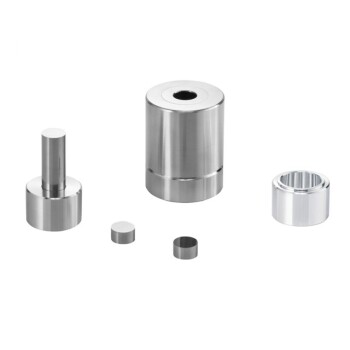
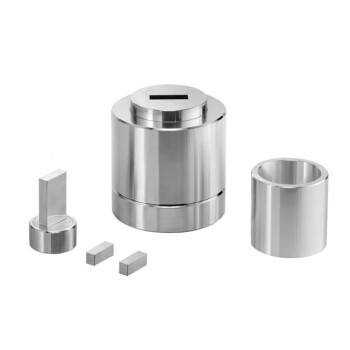
The primary function of a laboratory hydraulic press in this context is to apply extreme static pressure to high-melting-point carbide powders, compressing them into cohesive "green bodies" with a strictly defined porosity. This mechanical consolidation is necessary to overcome the inherent hardness of carbide particles, ensuring the sample achieves the uniform initial density gradient required for valid high-energy load and shock wave research.
The press transforms loose, hard powder into a stable, porous solid. By controlling this initial density and structure, researchers establish a reliable baseline for studying how materials behave during explosive compaction and shock wave experiments.
The Mechanics of Sample Preparation
Overcoming Particle Hardness
Carbide powders are characterized by extreme hardness and high melting points. Standard compaction methods are often insufficient to force these particles to cohere.
The hydraulic press exerts immense static pressure—often reaching 200 MPa—to physically force these resistant particles together. This force overcomes the material's natural resistance to packing, interlocking the particles without the need for heat at this stage.
Creating the "Green Body"
The immediate output of the press is a "green body." This is a compacted object that holds its shape but has not yet been sintered or fired.
Achieving sufficient green strength is critical. The sample must be robust enough to be handled, measured, and moved to testing apparatuses without crumbling or losing its structural integrity.
Precision Porosity Control
The objective is rarely to compress the material to solid density immediately. Instead, the press is used to target a pre-defined porosity, such as an open porosity of approximately 30 percent.
This specific void structure creates capillary channels. In later processing stages, these channels allow for the smooth infiltration of other materials, such as molten silicon, into the carbide matrix.
The Criticality for High-Energy Research
Ensuring Uniform Density Gradients
For high-energy load research, the internal structure of the sample must be consistent. If the density varies randomly across the sample, the experimental data will be flawed.
The hydraulic press ensures a uniform initial density gradient. This uniformity allows researchers to accurately isolate variables when studying how shock waves propagate through the material.
Modeling Explosive Compaction
The preparation phase mirrors the physics of the experiment itself. By creating a controlled static environment, researchers prepare the material for the dynamic chaos of explosive compaction.
This allows for a clear cause-and-effect analysis. Any changes observed after the high-energy load is applied can be attributed to the experiment, rather than pre-existing inconsistencies in the sample preparation.
Understanding the Trade-offs
Pressure vs. Integrity
Applying too much pressure can crush individual particles or seal off necessary capillary channels, preventing proper infiltration later. Applying too little pressure results in a weak green body that falls apart before testing.
Uniformity vs. Geometry
While hydraulic presses are excellent for creating uniform density in simple shapes (like disks or cylinders), achieving that same uniformity in complex geometries is challenging. Stress gradients can form during pressing, leading to "density variations" that may affect shock wave data.
Making the Right Choice for Your Goal
When configuring your hydraulic press parameters, align your settings with your specific research outcomes:
- If your primary focus is Shock Wave Propagation: Prioritize pressure uniformity to ensure a consistent density gradient, minimizing noise in your wave data.
- If your primary focus is Infiltration/Sintering: Target a specific pressure (e.g., 200 MPa) to achieve the necessary ~30% open porosity for capillary action.
Success in high-energy research begins with the mechanical precision applied during the static pressing phase.
Summary Table:
| Feature | Function in Carbide Sample Preparation |
|---|---|
| Pressure Application | Exerts up to 200 MPa to overcome particle hardness and ensure interlocking. |
| Consolidation | Transforms loose powders into stable, cohesive "green bodies" for handling. |
| Porosity Control | Achieves targeted open porosity (e.g., 30%) for future infiltration/sintering. |
| Density Gradient | Ensures uniform initial density to provide a reliable baseline for shock wave data. |
| Structural Integrity | Provides sufficient green strength to prevent crumbling during transport/testing. |
Elevate Your Materials Research with KINTEK
Precision is the foundation of high-energy research. At KINTEK, we specialize in advanced laboratory equipment designed to meet the rigorous demands of material science. Our comprehensive range of hydraulic presses (pellet, hot, and isostatic) and crushing systems ensures your carbide samples achieve the exact density and porosity required for valid experimental outcomes.
From high-temperature furnaces and autoclaves to specialized battery research tools, KINTEK provides the high-performance solutions your lab needs to thrive. Don't compromise on your sample integrity—contact us today to find the perfect equipment for your research goals!
References
- К. К. Маевский. Numerical modeling of carbides behavior under high-energy liading. DOI: 10.21883/tp.2022.01.52536.200-21
This article is also based on technical information from Kintek Solution Knowledge Base .
Related Products
- Carbide Lab Press Mold for Laboratory Applications
- Laboratory Hydraulic Press Split Electric Lab Pellet Press
- Automatic Laboratory Hydraulic Pellet Press Machine for Lab Use
- Laboratory Hydraulic Press Lab Pellet Press for Button Battery
- Laboratory Manual Hydraulic Pellet Press for Lab Use
People Also Ask
- How to use a press mold? Master the Art of Creating Consistent Ceramic Forms
- What is the press mould method? A Guide to Consistent, Detailed Ceramic Forms
- What is the function of press molds during the preparation of SiCf/Ti-43Al-9V composites? Achieve Structural Precision
- What is a press mold used for? Achieve Repeatable Precision and Efficiency
- What is the purpose of specialized pressure devices in sulfide solid-state batteries? Ensure Chemo-Mechanical Stability