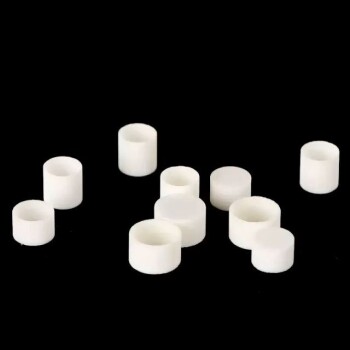
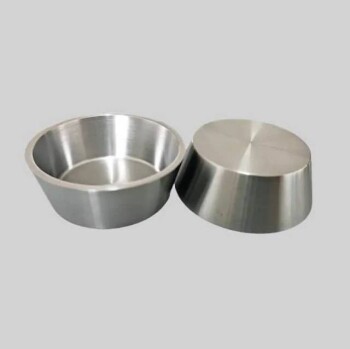
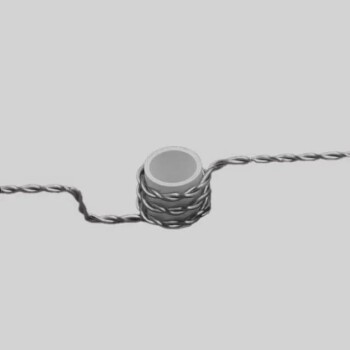
Nickel crucibles function as chemically inert reaction vessels essential for the solid-state synthesis of anti-perovskite Li2OHCl solid electrolytes. Their primary role is to safely contain highly corrosive lithium precursors, specifically LiOH and LiCl, without degrading or contaminating the mixture during high-temperature processing.
The use of nickel is dictated by its exceptional chemical stability; it prevents side reactions between the vessel and the raw materials at 400°C, ensuring the final synthesized powder meets the high purity standards required for solid electrolytes.
The Challenge of Lithium Precursors
Handling Corrosive Raw Materials
The synthesis of Li2OHCl relies on specific precursors: lithium hydroxide (LiOH) and lithium chloride (LiCl).
These lithium salts are chemically aggressive. They are known to corrode many standard laboratory materials, particularly when subjected to heat.
The Risk of Side Reactions
If the reaction vessel interacts with these precursors, side reactions occur immediately.
This interaction not only damages the crucible but also leaches contaminants into the synthesis mixture.
For solid electrolytes, where ionic conductivity is highly sensitive to impurities, such contamination is unacceptable.
Why Nickel is the Critical Solution
Superior Chemical Stability
Nickel crucibles are selected specifically for their resistance to chemical attack.
They act as a stable barrier against the corrosive nature of LiOH and LiCl.
This stability holds firm even under the rigorous thermal conditions required for the synthesis.
Withstanding High Temperatures
The solid-state reaction to form anti-perovskite Li2OHCl requires heating the mixture to 400°C.
At this temperature, many other metals or ceramics might soften, crack, or become reactive.
Nickel maintains its structural and chemical integrity throughout this heating cycle.
Guaranteeing Product Purity
The ultimate function of the nickel crucible is the preservation of purity.
By preventing the vessel material from entering the reaction chain, nickel ensures the final powder is composed solely of the intended chemical phase.
This results in a high-quality electrolyte powder free from foreign elements.
Understanding the Trade-offs
Material Compatibility Limits
While nickel is the superior choice for this specific reaction, it is not universally inert.
It is highly effective for LiOH and LiCl at 400°C, but one must always verify compatibility if introducing new additives or significantly higher temperatures.
The Cost of Substitution
A common pitfall in solid-state synthesis is attempting to use standard alumina or silica glassware for lithium-heavy reactions.
These materials will almost certainly react with the lithium salts, ruining the sample and potentially destroying the vessel.
There is rarely a viable "lower cost" substitute for nickel when processing these specific precursors.
Making the Right Choice for Your Project
Selecting the correct crucible is not a minor detail; it is a fundamental parameters of your experimental design.
- If your primary focus is Phase Purity: Rely on nickel crucibles to eliminate the variable of vessel-leached contamination.
- If your primary focus is Process Safety: Use nickel to ensure the containment vessel does not degrade or fail during the 400°C heat treatment.
The nickel crucible provides the foundational stability necessary to successfully synthesize high-performance Li2OHCl solid electrolytes.
Summary Table:
| Feature | Nickel Crucible Performance in Li2OHCl Synthesis |
|---|---|
| Primary Function | Chemically inert reaction vessel for corrosive precursors |
| Target Materials | Lithium Hydroxide (LiOH) and Lithium Chloride (LiCl) |
| Temperature Resistance | Stable at required 400°C synthesis temperature |
| Key Benefit | Prevents side reactions and ensures high ionic conductivity |
| Material Advantage | Superior resistance compared to alumina or silica glassware |
Elevate Your Solid-State Synthesis with KINTEK
Precision in material synthesis starts with the right equipment. KINTEK specializes in providing high-performance laboratory solutions tailored for advanced battery research and materials science. Whether you are synthesizing anti-perovskite electrolytes or exploring new chemical phases, our premium nickel crucibles, high-temperature furnaces (muffle, vacuum, and tube), and specialized ceramics ensure zero contamination and maximum process safety.
From high-pressure reactors to crushing and milling systems, KINTEK provides the tools necessary to maintain the integrity of your lithium-based precursors.
Ready to optimize your lab's performance? Contact KINTEK today to discover how our comprehensive range of crucibles and thermal processing equipment can enhance your research outcomes.
Related Products
- Electron Beam Evaporation Coating Conductive Boron Nitride Crucible BN Crucible
- Electron Beam Evaporation Coating Tungsten Crucible and Molybdenum Crucible for High Temperature Applications
- Electron Beam Evaporation Coating Gold Plating Tungsten Molybdenum Crucible for Evaporation
- Boron Nitride (BN) Crucible for Phosphorous Powder Sintered
- High Purity Pure Graphite Crucible for Electron Beam Evaporation
People Also Ask
- Why use Boron Nitride (BN) crucibles in metal infiltration? Ensure sample purity and non-wetting performance.
- Why are Boron Nitride (BN) or Alumina crucibles preferred for Na-flux GaN growth? Optimize Your Crystal Yield
- What is the container that holds the metal source material called in e-beam evaporation? Ensure Purity and Quality in Your Thin-Film Deposition
- What is the process of e-beam coating? Achieve High-Purity, Precise Thin Films for Your Lab
- What materials are used in electron beam evaporation? Master High-Purity Thin Film Deposition