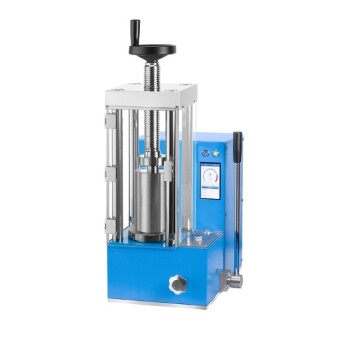
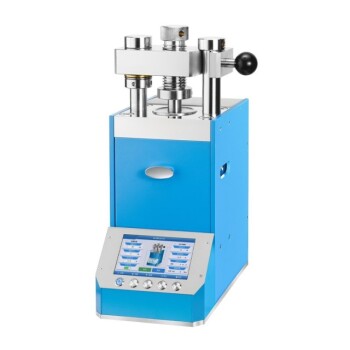
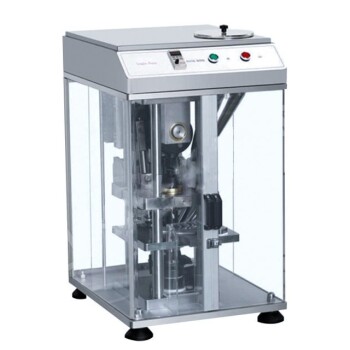
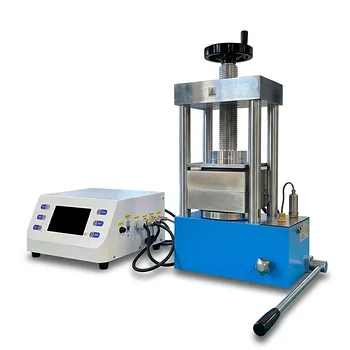
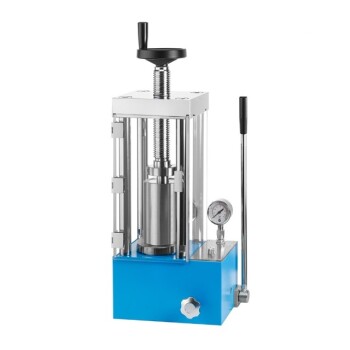
The primary purpose of using a laboratory hydraulic press for cold pressing aluminum matrix composite powders is to transform loose, mixed particles into a cohesive "green body" with a specific shape and structural integrity. This pre-forming step is essential for expelling trapped air, optimizing initial particle packing, and creating a stable solid that can be safely handled and loaded into molds for subsequent vacuum hot pressing and sintering.
Core Takeaway Cold pressing is the foundational bridge between loose raw materials and a finished composite. By applying mechanical pressure to create a "green body," you eliminate air voids and establish the necessary geometry and handling strength required for successful high-temperature sintering.
The Mechanics of Green Body Formation
Establishing Structural Integrity
The immediate goal of the hydraulic press is to compact loose powder into a defined shape, such as a cylinder or disc. By applying high axial pressure, the press forces particles to rearrange and mechanically interlock, particularly with ductile components like aluminum. This creates a "green compact" with sufficient strength to be picked up, moved, and loaded into sintering equipment without crumbling.
Optimizing Particle Packing
Before heat is ever applied, the hydraulic press initiates the densification process. The pressure overcomes the mechanical friction between particles, reducing the void space and increasing the packing density of the alloy powders. This ensures that the components are in tight physical contact, which is a prerequisite for effective diffusion and grain bonding during later stages.
Preparing for the Sintering Phase
Essential Air Removal
Loose powders naturally trap significant amounts of air, which can lead to defects or oxidation in the final product. Cold pressing expels the majority of this air from between the particles. Removing this air early is critical for preventing internal porosity and ensuring the uniformity of the final composite structure.
Reducing Volume Shrinkage
Sintering loose powder results in massive volume changes that are difficult to control. By pre-densifying the material into a green body, you significantly reduce volume shrinkage during the hot pressing stage. This leads to better dimensional accuracy and reduces the risk of the final product warping or cracking.
Understanding the Limitations
Density Gradients
While cold pressing is effective for shaping, it introduces the risk of density variations. Friction between the powder and the die walls can cause the edges of the green body to be denser than the center. If not managed, this gradient can lead to non-uniform properties in the final aluminum matrix composite.
The Limits of Green Strength
It is vital to remember that a green body relies solely on mechanical interlocking, not chemical bonding. While it is stable enough for handling, it remains fragile compared to a sintered part. Attempting to machine or apply significant stress to a green body before sintering will result in fracture.
Making the Right Choice for Your Goal
To maximize the effectiveness of your cold pressing stage, align your process with your specific objectives:
- If your primary focus is Handling Efficiency: Prioritize achieving a specific pressure threshold (e.g., sufficient MPa) that ensures the green body creates strong mechanical interlocks, allowing for easy transfer to the sintering furnace.
- If your primary focus is Final Density: Focus on the duration and uniformity of the press to maximize air expulsion and particle rearrangement, minimizing the work required during the vacuum hot pressing stage.
A well-executed cold pressing step is the single most important factor in ensuring your raw powder mixture evolves into a defect-free, high-performance composite.
Summary Table:
| Stage | Primary Function | Impact on Quality |
|---|---|---|
| Particle Packing | Mechanical interlocking of powder | Increases initial density and structural integrity |
| Air Removal | Expulsion of trapped air voids | Minimizes internal porosity and oxidation risks |
| Pre-forming | Creation of a defined 'green body' | Ensures handling strength and dimensional accuracy |
| Volume Control | Pre-densification | Reduces shrinkage and warping during sintering |
Elevate Your Material Research with KINTEK Precision
Precision in the 'green body' phase is the foundation of high-performance composite engineering. KINTEK specializes in providing the advanced laboratory equipment you need to achieve superior material density and structural integrity. From our robust hydraulic presses (pellet, hot, and isostatic) for flawless powder compaction to our cutting-edge vacuum hot pressing systems and high-temperature furnaces, we offer the complete toolset for aluminum matrix composite innovation.
Whether you are refining battery research, developing aerospace alloys, or optimizing sintering workflows, KINTEK’s expertise in high-pressure systems and thermal processing ensures your lab delivers repeatable, defect-free results. Contact KINTEK today to find the perfect pressing solution for your application.
Related Products
- Round Bidirectional Press Mold for Lab
- Laboratory Hydraulic Press Split Electric Lab Pellet Press
- Ball Press Mold for Lab
- Laboratory Hydraulic Press Lab Pellet Press Machine for Glove Box
- Automatic Laboratory Hydraulic Press for XRF & KBR Pellet Press
People Also Ask
- How to use a press mold? Master the Art of Creating Consistent Ceramic Forms
- What is the press mould method? A Guide to Consistent, Detailed Ceramic Forms
- What is the function of press molds during the preparation of SiCf/Ti-43Al-9V composites? Achieve Structural Precision
- What is a press mold used for? Achieve Repeatable Precision and Efficiency
- What is the purpose of specialized pressure devices in sulfide solid-state batteries? Ensure Chemo-Mechanical Stability