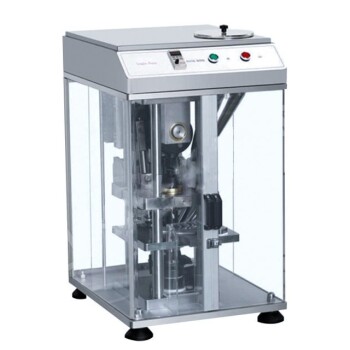
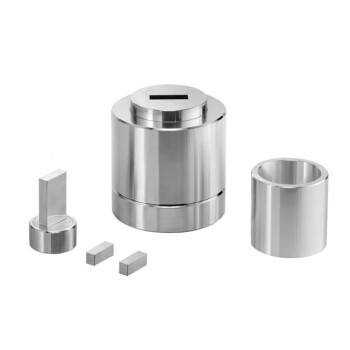
The primary purpose of using a laboratory hydraulic press for pre-pressing is to expel entrapped air and establish initial particle contact. By applying mechanical pressure to loose powder within a mold, you transform it into a cohesive "green compact" that possesses initial density and sufficient structural strength for handling.
Core Takeaway Pre-pressing is a critical preparatory step that maximizes the efficiency of the subsequent vacuum hot pressing sintering process. By removing air voids and creating a stable, denser foundation, you minimize shrinkage and prevent deformation in the final product.
The Mechanics of Pre-Pressing
Air Expulsion and Initial Densification
Loose powder contains a significant amount of air in the spaces between particles.
Expelling this air is the most immediate function of the hydraulic press.
This process forces particles closer together, resulting in initial densification even before heat is applied.
Creation of the "Green Compact"
Pre-pressing transforms loose, unmanageable powder into a formed solid known as a green compact or green body.
This compact achieves a specific green strength, allowing it to be safely removed from the mold.
This facilitates the transfer and loading of the sample into the hot pressing equipment without the material crumbling.
Enhancing the Sintering Process
Improving Process Efficiency
The quality of the pre-pressed body directly dictates the success of the hot pressing stage.
A well-compacted green body allows for tighter contact between particles, which greatly improves the efficiency of solid-state reactions.
This leads to a higher density in the final sintered product, such as cemented carbide.
Minimizing Shrinkage and Deformation
Because a significant volume of air is removed during cold pre-pressing, the volume change during the hot phase is reduced.
This reduction in shrinkage volume is vital for maintaining dimensional accuracy.
It helps prevent structural defects and deformation that can occur if the powder bed settles unevenly during high-temperature treatment.
Common Pitfalls to Avoid
The Risk of Uneven Loading
While pre-pressing aids uniformity, uneven loading of the powder into the mold prior to pressing can still cause issues.
If the initial powder distribution is not flat, the resulting green body will have density gradients.
This often leads to warping or cracking during the final sintering phase despite the pre-press step.
Pressure Management
Applying pressure is not simply about using maximum force; it requires precise control.
Excessive or insufficient pressure can alter the pore size distribution unpredictably.
For applications like ceramic membranes, failure to control this pressure compromises the porosity and stability of the final support structure.
Making the Right Choice for Your Goal
To maximize the utility of your laboratory hydraulic press, align your pre-pressing strategy with your final material requirements:
- If your primary focus is Maximum Density: Prioritize high-pressure air expulsion to ensure the tightest possible particle arrangement before heating.
- If your primary focus is Dimensional Precision: Focus on the uniformity of the green compact to minimize volume shrinkage and prevent warping during sintering.
A successful sintering run begins with a meticulously consolidated green body.
Summary Table:
| Feature | Function in Pre-Pressing | Impact on Hot Pressing Sintering |
|---|---|---|
| Air Expulsion | Removes entrapped air from loose powder | Minimizes shrinkage and prevents structural voids |
| Green Compact | Creates a cohesive solid body | Ensures structural strength for handling and loading |
| Densification | Increases initial particle contact | Improves reaction efficiency and final product density |
| Volume Control | Establishes a stable initial shape | Enhances dimensional accuracy and reduces warping |
Elevate Your Material Research with KINTEK Precision
Maximize the quality of your sintered products by starting with the perfect green compact. KINTEK specializes in advanced laboratory solutions, offering high-performance hydraulic presses (pellet, hot, and isostatic) designed for precise powder consolidation.
Whether you are working on advanced ceramics, cemented carbides, or battery research, our comprehensive range of high-temperature furnaces, crushing and milling systems, and high-pressure reactors provides the reliability your lab needs to succeed.
Ready to optimize your sintering process? Contact our experts today to find the ideal equipment for your specific application and ensure superior dimensional accuracy and density in every sample.
Related Products
- 30T 40T Split Automatic Heated Hydraulic Press Machine with Heated Plates for Laboratory Hot Press
- 24T 30T 60T Heated Hydraulic Press Machine with Heated Plates for Laboratory Hot Press
- Laboratory Hydraulic Press Lab Pellet Press Machine for Glove Box
- Laboratory Hydraulic Press Split Electric Lab Pellet Press
- Automatic Laboratory Hydraulic Pellet Press Machine for Lab Use
People Also Ask
- What are the advantages of using a laboratory hydraulic press for hot pressing? Achieve Peak Nano-Composite Density
- What are the core advantages of using a laboratory hot press to produce Bi2Se3? Achieve 93% Density & High Conductivity
- Why is a laboratory hydraulic hot press essential for high-density, additive-free Silicon Carbide? Unlock Pure SiC.
- How does a laboratory hydraulic hot press ensure the quality of PHBV/natural fiber composites? Expert Guide
- What is the function of a laboratory hydraulic hot press in the assembly of solid-state photoelectrochemical cells?