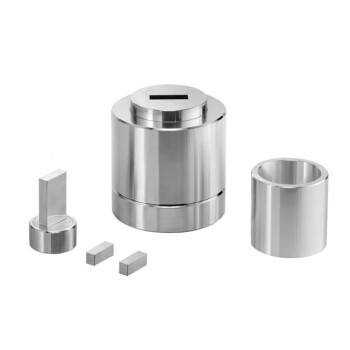
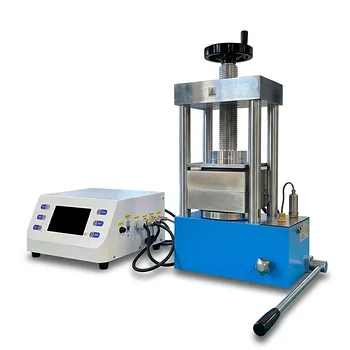
In the context of supercritical gasification research, a laboratory hydraulic press serves as the fundamental tool for standardizing sample geometry and density. It functions by applying precise pressure to convert loose powdered or fibrous biomass into uniform "green bodies" or pellets, eliminating physical variations that could otherwise distort experimental data.
The hydraulic press acts as a control mechanism for physical variables. By creating samples with identical surface areas and internal densities, researchers can ensure that observed changes in reaction kinetics are due to chemical processes, not inconsistent heat transfer caused by irregular sample shapes.
The Science of Sample Standardization
Creating Uniform Density
Raw biomass materials naturally exist in irregular states, such as loose powders or fibers. A laboratory hydraulic press compresses these materials into pellets with a specific, uniform density. This mechanical uniformity is critical for simulating the physical properties of the material in a controlled environment.
Ensuring Structural Consistency
By applying precise pressure, the press ensures the internal structure of the sample is homogenous. This eliminates voids or density gradients within the "green body." Without this step, internal inconsistencies could lead to uneven reactions during the gasification process.
Controlling Geometric Dimensions
The press allows researchers to dictate the exact shape and size of the test material. By regularizing these shapes, you strictly control the surface area exposed to the supercritical environment. This control provides a consistent baseline for all subsequent quantitative studies.
Why Precision Matters for Gasification Data
Reproducible Heating Rates
In supercritical gasification, the rate at which a material heats up drives the reaction. Samples with irregular shapes heat unevenly, introducing noise into the data. Pressed samples ensure that heating rates are consistent across multiple experimental runs.
Accurate Reaction Kinetics
To calculate reaction kinetics accurately, variables must be isolated. If the sample geometry varies, the reaction rate varies. The hydraulic press eliminates this variable, ensuring that the kinetic data reflects the true chemical behavior of the biomass, rather than its physical irregularities.
Understanding the Trade-offs
Idealization vs. Reality
While a hydraulic press creates the perfect sample for studying kinetics, it creates an idealized material. Real-world industrial feedstocks are rarely as uniform as laboratory-pressed pellets. Researchers must acknowledge that while pressed samples offer excellent reproducibility for theoretical modeling, they may not perfectly mimic the chaotic physical state of raw feedstock used in large-scale operations.
Making the Right Choice for Your Research
To maximize the utility of your laboratory hydraulic press, tailor your approach to your specific research goals:
- If your primary focus is fundamental reaction kinetics: Prioritize extreme precision in pressure application to ensure every sample has the exact same surface-area-to-volume ratio.
- If your primary focus is simulating industrial conditions: Adjust the pressure settings to produce pellets with densities that closely mirror commercial fuel pellets, rather than achieving maximum theoretical density.
By rigorously controlling the physical state of your model materials, you transform qualitative observations into robust, quantitative scientific data.
Summary Table:
| Feature | Role in Research | Impact on Results |
|---|---|---|
| Density Control | Compresses loose biomass into uniform green bodies. | Eliminates voids and ensures consistent internal structure. |
| Geometric Precision | Standardizes sample shape and dimensions. | Provides a fixed surface-area-to-volume ratio for heating. |
| Pressure Consistency | Applies exact force for reproducible samples. | Enables accurate calculation of reaction kinetics and data. |
| Sample Idealization | Creates standardized "model" materials. | Reduces experimental noise from physical irregularities. |
Elevate Your Research Precision with KINTEK
Achieve unmatched consistency in your supercritical gasification studies with KINTEK’s high-performance laboratory hydraulic presses. Whether you require pellet, hot, or isostatic presses, our equipment is engineered to deliver the precise pressure needed for uniform sample density and structural integrity.
Beyond sample preparation, KINTEK offers a comprehensive suite of tools for advanced research, including:
- High-Temperature & High-Pressure Reactors and Autoclaves
- Muffle, Tube, and Vacuum Furnaces
- Crushing and Milling Systems
- Ceramic and PTFE Consumables
Ensure your kinetic data reflects true chemical behavior, not physical variables. Contact KINTEK today to find the perfect solution for your lab!
References
- Onursal Yakaboylu, Wiebren de Jong. Supercritical Water Gasification of Biomass: A Literature and Technology Overview. DOI: 10.3390/en8020859
This article is also based on technical information from Kintek Solution Knowledge Base .
Related Products
- Automatic Laboratory Hydraulic Pellet Press Machine for Lab Use
- Laboratory Manual Hydraulic Pellet Press for Lab Use
- Laboratory Hydraulic Press Split Electric Lab Pellet Press
- Heated Hydraulic Press Machine with Integrated Manual Heated Plates for Lab Use
- Assemble Square Lab Press Mold for Laboratory Applications
People Also Ask
- What is the role of a laboratory hydraulic pellet press and stainless steel molds in the fabrication of RuO2/NbC anodes?
- What role does a laboratory pellet press play in the enhancement of biomass energy products? Optimize Fuel Efficiency
- What is the purpose of using a laboratory pellet press when evaluating the electronic conductivity of carbon powders? Guide
- How does a laboratory hydraulic pellet press contribute to SiCw/2024 aluminum composite preforms? Optimize Densification
- What is the significance of applying 200 MPa of pressure with a laboratory hydraulic pellet press for composite ceramics?