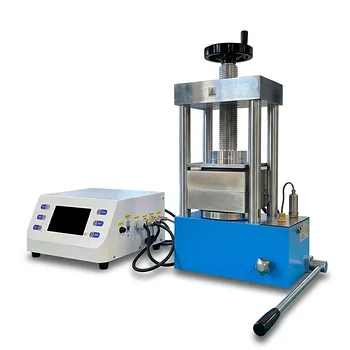
The primary function of a bench-top laboratory hydraulic press in this context is to transform loose Prosopis juliflora pod powder into a solid, perfectly flat pellet suitable for X-ray fluorescence (XRF) analysis. By applying high pressure—specifically around 22 tons—the machine compacts a mixture of sample powder and binder to eliminate physical irregularities that would otherwise distort the analytical results.
Core Takeaway: The hydraulic press serves as a stabilization tool that eliminates voids and porosity in the sample. By converting loose powder into a dense pellet, it minimizes X-ray scattering and maximizes the signal-to-noise ratio, ensuring that quantitative elemental analysis is accurate and reproducible.
Transforming Biological Matter into Analytical Samples
Compacting the Matrix
To prepare Prosopis juliflora for analysis, the pod powder is first mixed with a binder material. The hydraulic press then subjects this mixture to immense force, often reaching 22 tons of pressure. This mechanical force is necessary to bind the organic particles together into a cohesive form.
Achieving High Density
The result of this process is a smooth and dense pellet. Unlike loose powder, which contains air gaps and varying densities, a pressed pellet offers a uniform matrix. This uniformity is the foundation for consistent chemical analysis.
Why Compression Improvements Data Accuracy
Eliminating Voids and Porosity
Loose powders contain microscopic voids between particles. These voids create inconsistencies in how X-rays penetrate the sample. The hydraulic press forces particles together, effectively eliminating these voids and ensuring the X-ray beam encounters solid material rather than air pockets.
Reducing X-Ray Scattering
When X-rays hit an irregular surface or a porous material, they scatter unpredictably. This scattering interferes with the detector's ability to read the specific energy emissions of the elements present. A pressed, flat surface significantly reduces this scattering, allowing for a direct and clear interaction between the beam and the sample.
Boosting Signal-to-Noise Ratio
By stabilizing the sample surface and density, the press enhances the clarity of the results. The characteristic fluorescence signals become more stable, leading to a higher signal-to-noise ratio. This allows the spectrometer to detect trace elements with much greater precision.
Critical Considerations and Trade-offs
The Requirement of Binders
Pressure alone is often insufficient for biological samples like Prosopis juliflora. A binder is strictly necessary to act as a glue; without it, the pellet may crumble or exhibit surface cracks, which would reintroduce the scattering errors the press is meant to solve.
Pressure Consistency
While high pressure is required, the application must be consistent across all samples. Variations in pressure can lead to variations in pellet density. If density varies between samples, the relative data generated by the XRF spectrometer may become skewed, making comparisons between different Prosopis juliflora samples invalid.
Making the Right Choice for Your Goal
- If your primary focus is quantitative accuracy: Ensure you apply sufficient pressure (e.g., 22 tons) to create a perfectly mirror-like surface that minimizes X-ray scattering.
- If your primary focus is sample integrity: Verify the binder ratio is correct before pressing to prevent the pellet from expanding or cracking after removal from the die.
The hydraulic press is not just a molding tool; it is the critical step that standardizes your sample physics to ensure your chemical data is true to reality.
Summary Table:
| Feature | Role in XRF Sample Preparation | Impact on Analytical Results |
|---|---|---|
| Pressure Application | Compresses powder at ~22 tons | Eliminates voids and atmospheric porosity |
| Pellet Density | Creates a uniform, solid matrix | Minimizes X-ray scattering for clearer signals |
| Surface Finish | Produces a perfectly flat, smooth surface | Maximizes signal-to-noise ratio for precision |
| Consistency | Ensures uniform sample thickness | Guarantees reproducible quantitative data |
Elevate Your Analytical Precision with KINTEK
At KINTEK, we understand that the quality of your XRF data begins with the integrity of your sample. Our precision-engineered bench-top hydraulic presses (available in pellet, hot, and isostatic models) are designed to deliver the consistent pressure required to transform raw biological matter like Prosopis juliflora into high-density, analytical-grade pellets.
Beyond sample preparation, KINTEK specializes in a comprehensive range of laboratory solutions, including high-temperature furnaces (muffle, vacuum, CVD), crushing and milling systems, and high-pressure reactors. Whether you are performing elemental analysis or advanced material research, our tools provide the stability and reliability your lab demands.
Ready to achieve superior results? Contact KINTEK today to find the perfect press or consumable for your specific application!
References
- G. Gayathri, Kiran Babu Uppuluri. The comprehensive characterization of Prosopis juliflora pods as a potential bioenergy feedstock. DOI: 10.1038/s41598-022-22482-9
This article is also based on technical information from Kintek Solution Knowledge Base .
Related Products
- Heated Hydraulic Press Machine with Integrated Manual Heated Plates for Lab Use
- Automatic High Temperature Heated Hydraulic Press Machine with Heated Plates for Lab
- Laboratory Hydraulic Press Lab Pellet Press Machine for Glove Box
- Automatic Heated Hydraulic Press Machine with Heated Plates for Laboratory Hot Press 25T 30T 50T
- Laboratory Hydraulic Press Split Electric Lab Pellet Press
People Also Ask
- Why is a heated laboratory hydraulic press necessary for composite laminates? Achieve Void-Free Structural Integrity
- What role does a heated hydraulic press play in Cold Sintering (CSP)? Enhancing LATP-Halide Densification
- What technical conditions does a heated hydraulic press provide for PEO batteries? Optimize Solid-State Interfaces
- Why is the heating function of a laboratory hydraulic press essential for MEA assembly in DEFC? Optimize Cell Bonding
- What are heated hydraulic presses used for? Molding Composites, Vulcanizing Rubber, and More