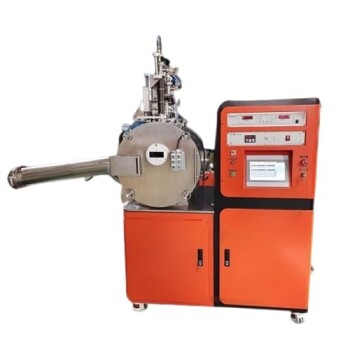
The primary purpose of utilizing a vacuum induction furnace for Alumina-Forming Austenitic (AFA) steel is to preserve the integrity of reactive alloying elements. This equipment creates a strictly controlled vacuum environment that prevents the oxidative loss of aluminum (Al) and chromium (Cr) while employing electromagnetic stirring to guarantee a uniform and clean alloy matrix.
The core value of this process lies in its ability to simultaneously protect active elements from degradation and mechanically homogenize the melt, ensuring the final material meets precise design specifications for heat resistance.
Protecting Critical Alloying Elements
Preventing Oxidative Loss
AFA steel relies heavily on specific active elements, particularly aluminum and chromium, to provide heat resistance.
These elements have a high affinity for oxygen; without a vacuum, they would react with the atmosphere to form oxides (slag) rather than integrating into the steel.
The vacuum induction furnace eliminates atmospheric oxygen, ensuring these critical elements remain metallic and effective within the alloy.
Controlling Volatilization
Beyond oxidation, high temperatures can cause volatile elements to evaporate.
While the primary goal is preventing oxidation, the controlled environment also helps manage the vapor pressure of elements like chromium.
By maintaining precise pressure levels (often using inert gas backfill like argon), the furnace suppresses the evaporation of these elements to maintain the correct chemical ratios.
Achieving Structural Integrity
Electromagnetic Induction Stirring
A unique advantage of induction furnaces is the inherent electromagnetic stirring effect.
This force actively agitates the molten metal, ensuring that lighter elements like aluminum are thoroughly mixed with heavier elements like iron and nickel.
This prevents segregation and ensures high compositional homogeneity throughout the ingot.
Reducing Gas and Inclusions
The vacuum environment promotes the removal of dissolved gases, such as nitrogen and hydrogen, from the molten metal.
Simultaneously, the process significantly reduces the presence of non-metallic inclusions.
This results in a "clean" matrix, which is essential for preventing brittleness and ensuring the mechanical stability of the steel at high temperatures.
Understanding the Trade-offs
Management of Vapor Pressure
While the vacuum protects against oxidation, an excessively deep vacuum can inadvertently strip volatile elements from the melt.
Operators must carefully balance the vacuum level, often introducing a partial pressure of argon to prevent the evaporation of chromium or manganese.
Process Complexity
Vacuum induction melting is significantly more complex and costly than standard air melting.
It requires rigorous control systems to monitor temperature and pressure, as slight deviations can lead to composition drift or incomplete degassing.
Making the Right Choice for Your Goal
To maximize the quality of your AFA steel, tailor your process parameters to your specific metallurgical priorities:
- If your primary focus is Compositional Accuracy: Prioritize the use of inert gas partial pressure (argon) to suppress the evaporation of chromium while preventing oxidation.
- If your primary focus is Material Purity: Maximize the time spent under vacuum with active induction stirring to degas the melt and float out non-metallic inclusions.
The vacuum induction furnace is the definitive tool for converting raw ingredients into a high-performance, heat-resistant alloy without compromising its chemical identity.
Summary Table:
| Feature | Benefit for AFA Steel Production |
|---|---|
| Vacuum Environment | Prevents oxidative loss of reactive elements like Al and Cr |
| Induction Stirring | Ensures uniform distribution of elements and prevents segregation |
| Degassing | Removes dissolved gases (H, N) to reduce brittleness |
| Inclusion Control | Produces a clean alloy matrix for superior mechanical stability |
| Pressure Management | Uses argon backfill to suppress evaporation of volatile elements |
Elevate Your Material Research with KINTEK Precision
Producing high-performance Alumina-Forming Austenitic (AFA) steel requires the absolute control of a professional-grade vacuum environment. At KINTEK, we specialize in providing advanced vacuum induction melting systems and induction melting furnaces designed to protect your reactive alloying elements and ensure a clean, homogeneous matrix.
Whether you are refining heat-resistant alloys or exploring new material frontiers, KINTEK offers a comprehensive range of laboratory equipment including high-temperature furnaces, crushing and milling systems, and hydraulic presses. Our solutions are tailored for researchers and manufacturers who cannot compromise on material purity.
Ready to optimize your alloy production? Contact our technical experts today to discover how KINTEK’s induction melting solutions can bring precision and reliability to your laboratory.
References
- Nan Dong, Peide Han. Composition Optimum Design and Strengthening and Toughening Mechanisms of New Alumina-Forming Austenitic Heat-Resistant Steels. DOI: 10.3390/met9090921
This article is also based on technical information from Kintek Solution Knowledge Base .
Related Products
- Vacuum Induction Melting Spinning System Arc Melting Furnace
- Non Consumable Vacuum Arc Induction Melting Furnace
- Lab-Scale Vacuum Induction Melting Furnace
- Vacuum Arc Induction Melting Furnace
- Vacuum Heat Treat Furnace and Levitation Induction Melting Furnace
People Also Ask
- What are the advantages of a vacuum induction melting furnace? Achieve High-Purity Alloys with Precision VIM
- Why use VIM for rare earth steel? Essential Precision for Melting Reactive Lanthanum and Cerium
- What is the primary function of a vacuum induction melting furnace in Ni-Mo-Cr-Fe master alloy prep? Ensure High Purity
- What is the function of a vacuum induction melting furnace? Essential Guide for High-Purity FeCrAl Alloy Production
- What types of metals are typically processed in a vacuum induction melting furnace? High-Purity Alloys for Critical Applications