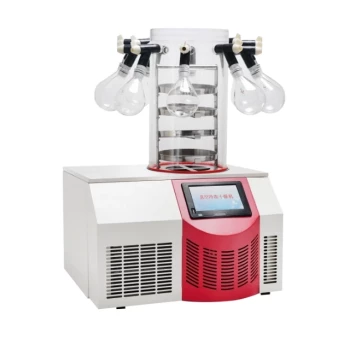
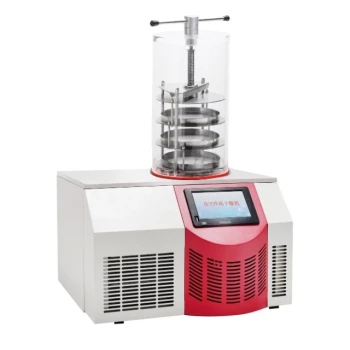
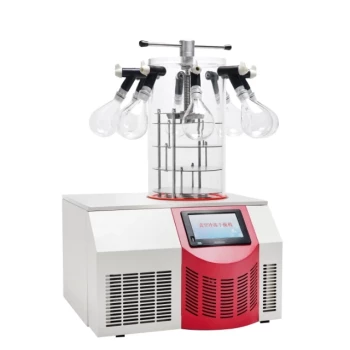
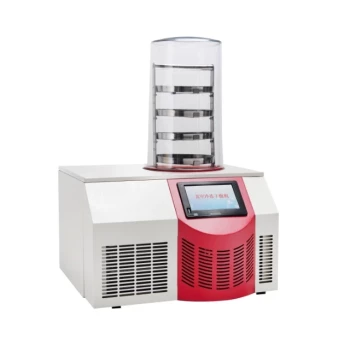
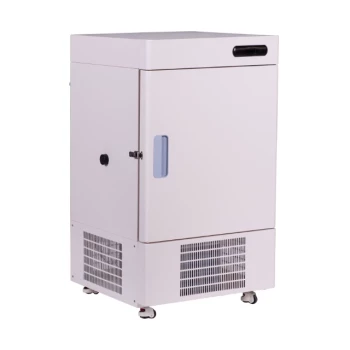
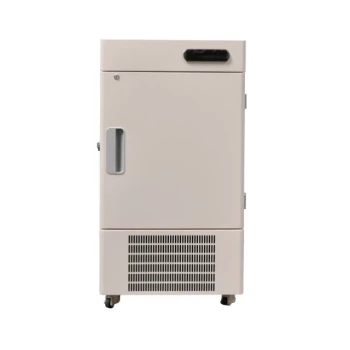
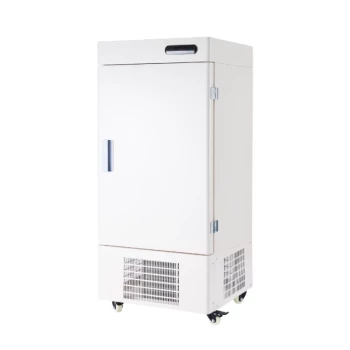
The primary role of a freeze dryer in this context is to remove the solvent from 3D-printed CNT@ZnO structures without damaging their delicate architecture. By processing the ink at low temperatures (around -50°C), the freeze dryer facilitates the direct sublimation of water from a solid state to a gas. This prevents the structural collapse that would otherwise occur due to liquid surface tension during conventional drying.
Conventional drying methods frequently destroy fine architectures due to the capillary forces of evaporating liquids. Freeze drying circumvents this by bypassing the liquid phase entirely, preserving the vertically aligned microwalls and microchannels necessary for subsequent lithium metal alloy injection.
The Mechanism of Structural Preservation
Eliminating Surface Tension
The most critical function of the freeze dryer is the avoidance of the liquid phase. In standard drying, as liquid water evaporates, surface tension creates powerful capillary forces.
These forces are strong enough to pull down and collapse the microscopic features of the 3D-printed ink. Freeze drying eliminates this risk completely.
Facilitating Direct Sublimation
The freeze dryer operates by freezing the water within the ink structure, typically at temperatures as low as -50°C.
Once frozen, the machine lowers the pressure, allowing the ice to convert directly into water vapor. This process, known as sublimation, removes the solvent while the structure remains rigid and supported by the ice lattice until the very end.
Achieving the Target Architecture
Maintaining Vertical Alignment
The ultimate goal of this process is to create a template with specific geometric properties. The freeze dryer ensures that the vertically aligned microwalls remain standing and distinct.
Without this specific drying technique, these walls would likely fold or merge, ruining the vertical alignment required for the material's function.
Preserving Microchannels for Injection
The removal of ice leaves behind precise voids, resulting in a network of open microchannels.
This porous framework is not an accident; it is the ideal structure required to hold the next material in the process. The preserved channels allow for the effective injection of lithium metal alloys.
Critical Process Considerations
Strict Temperature Control
The success of this method relies entirely on maintaining the temperature well below the freezing point of the solvent.
If the temperature fluctuates and allows even partial melting, the solid-state protection is lost. This would immediately reintroduce surface tension and lead to structural failure.
Solvent Compatibility
The reference specifically highlights the sublimation of water.
This indicates that the freeze drying process is specifically tuned to the thermodynamic properties of the aqueous solvent used in the 3D-printing ink.
Implications for Material Fabrication
To ensure high-quality CNT@ZnO templates, consider the following based on your specific fabrication goals:
- If your primary focus is structural fidelity: Prioritize the stability of the low-temperature environment (-50°C) to ensure the solvent sublimates without ever entering the liquid phase.
- If your primary focus is application readiness: Verify that the freeze drying cycle is complete to ensure fully open microchannels, which are critical for the successful infiltration of lithium metal alloys.
Freeze drying is not merely a drying step; it is the definitive process that locks in the functional geometry of the template.
Summary Table:
| Feature | Role of Freeze Drying (Sublimation) | Conventional Drying (Evaporation) |
|---|---|---|
| Mechanism | Direct solid-to-gas transition | Liquid-to-gas transition |
| Structural Impact | Preserves vertical microwalls and channels | Often causes collapse due to surface tension |
| Key Outcome | Maintains rigid, porous 3D framework | Loss of vertical alignment and microchannels |
| Operating Temp | Typically -50°C (low temperature) | High temperatures |
| Resulting Porosity | Open channels for lithium alloy injection | Closed or fused structural voids |
Elevate Your Material Research with KINTEK Precision
Achieving perfect structural fidelity in CNT@ZnO templates and other advanced materials requires uncompromising thermal control. KINTEK specializes in high-performance laboratory solutions tailored for cutting-edge nanotechnology and battery research. From our advanced freeze dryers and cold traps that prevent structural collapse to our comprehensive range of high-temperature furnaces and lithium battery research tools, we provide the equipment necessary to lock in your material's functional geometry.
Why choose KINTEK?
- Unmatched Precision: Maintain critical temperatures (like -50°C) for sensitive sublimation processes.
- Diverse Portfolio: Everything from high-pressure reactors and crushing systems to specialized ceramics and crucibles.
- Industry Expertise: Supporting researchers in developing the next generation of energy storage and 3D-printed architectures.
Ready to optimize your fabrication workflow? Contact us today to find the perfect solution for your lab!
Related Products
- High Performance Laboratory Freeze Dryer
- High Performance Laboratory Freeze Dryer for Research and Development
- Benchtop Laboratory Freeze Dryer for Lab Use
- Benchtop Laboratory Vacuum Freeze Dryer
- 108L Vertical Ultra Low Temperature ULT Freezer
People Also Ask
- What role does a laboratory freeze dryer play in the synthesis of graphene-based electrocatalysts? Preserve 3D Structures
- What are the technical advantages of using a laboratory freeze dryer for porous carbon precursors? Preserve 3D Networks
- What types of liquid samples can be processed using a laboratory freeze dryer? Preserve Your Sensitive Materials
- How do laboratory freeze dryers support scientific research? Preserve Sample Integrity for Reproducible Results
- Why is a laboratory freeze dryer preferred over traditional heating? Preserve Biochar Structure & Maximize Porosity