Knowledge What is the principle of vibrating sieve? Achieve Precise Particle Separation with Mechanical Vibration
Author avatar

Tech Team · Kintek Solution

Updated 6 days ago

What is the principle of vibrating sieve? Achieve Precise Particle Separation with Mechanical Vibration


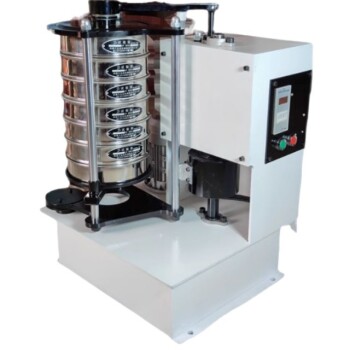
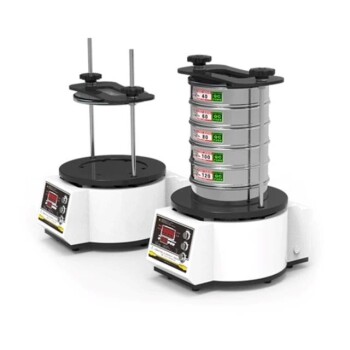
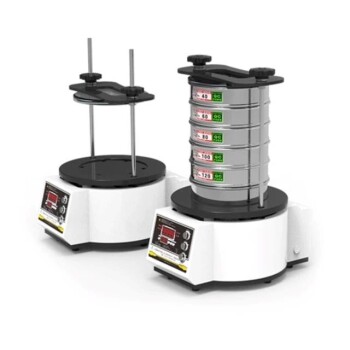
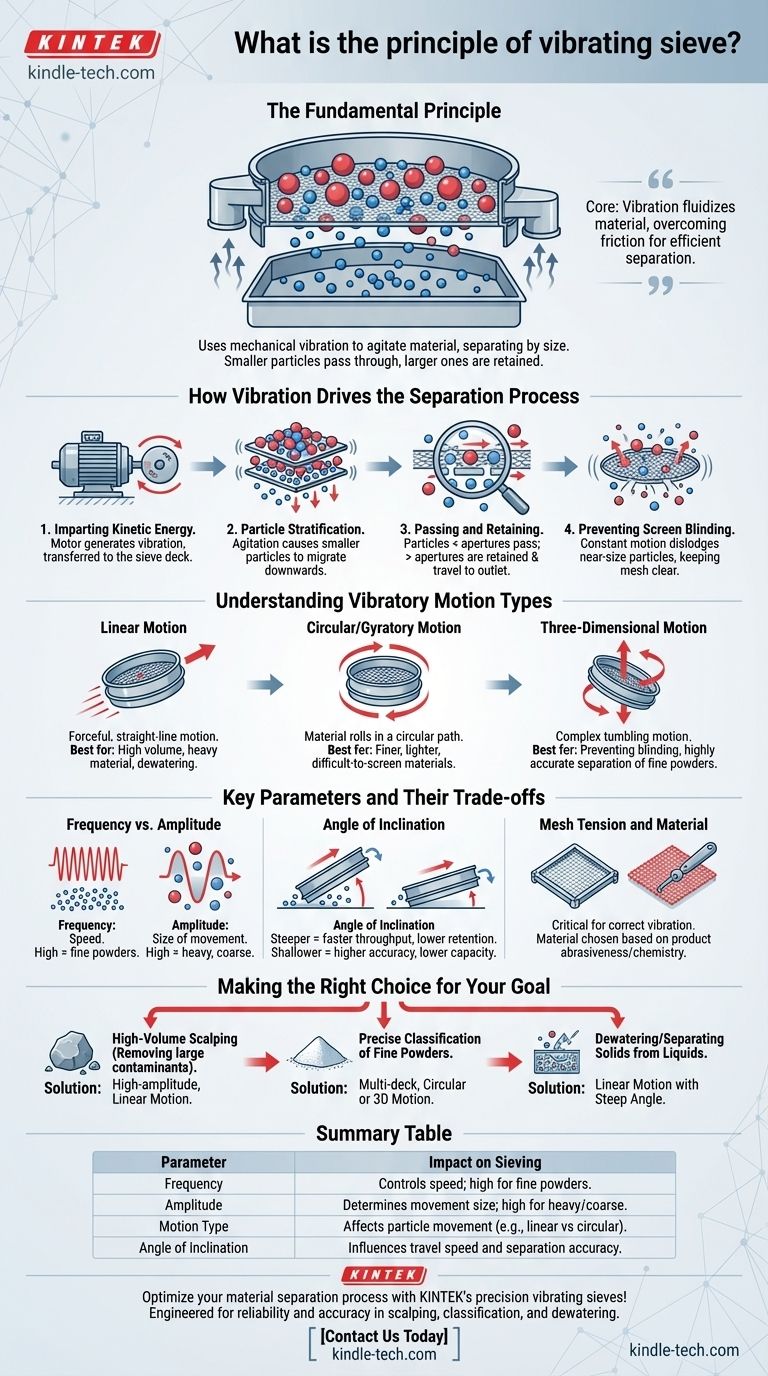
The fundamental principle of a vibrating sieve is to use mechanical vibration to agitate a bed of material on a screen or mesh. This motion causes smaller particles to fall through the screen's openings while retaining the larger particles on top, achieving a physical separation based purely on size.

At its core, a vibrating sieve works by overcoming inter-particle friction and cohesion. The vibration fluidizes the material, giving each particle the opportunity to find an opening in the screen, which dramatically increases the efficiency and accuracy of the separation process.

What is the principle of vibrating sieve? Achieve Precise Particle Separation with Mechanical Vibration

How Vibration Drives the Separation Process

A vibrating sieve, also known as a vibrating screen, relies on a carefully controlled motion generated by an electric motor. This motion is the engine of the entire separation process.

Imparting Kinetic Energy

An electric motor, typically connected to an eccentric weight or an electromagnetic exciter, generates the vibration. This energy is transferred directly to the sieve deck, which holds the screen mesh.

Particle Stratification

The vibration causes the entire bed of material to move. This agitation makes smaller particles migrate downwards through the larger ones, a process known as stratification. This ensures the finest particles reach the screen surface efficiently.

Passing and Retaining

Once at the screen surface, particles smaller than the mesh openings (apertures) pass through. Particles larger than the openings are retained and travel across the screen surface toward an outlet, effectively separating the material into two or more size fractions.

Preventing Screen Blinding

Without vibration, a screen can quickly clog or "blind," as particles get stuck in the apertures. The constant, vigorous motion of a vibrating sieve dislodges these near-size particles, keeping the mesh clear and ensuring continuous, effective operation.

Understanding Vibratory Motion Types

The specific type of motion has a significant impact on separation efficiency for different materials. The two most common types are linear and circular.

Linear Motion

A linear or straight-line motion forcefully throws the material forward and upward. This is highly effective for moving large volumes of heavy, coarse material and for dewatering applications.

Circular or Gyratory Motion

This motion causes material to roll across the screen surface in a circular path. It keeps particles on the screen for a longer duration, providing more opportunities for them to pass through the mesh. This is ideal for finer, lighter, or difficult-to-screen materials.

Three-Dimensional Motion

Some advanced sieves combine vertical and horizontal movements to create a complex, three-dimensional "tumbling" motion. This is the most effective method for preventing blinding and achieving highly accurate separation of fine, low-density powders.

Key Parameters and Their Trade-offs

Optimizing a vibrating sieve involves balancing several key operational parameters. Adjusting one will invariably affect the others.

Frequency vs. Amplitude

Frequency is the speed of vibration, while amplitude is the size of the movement (stroke). High amplitude is needed to move heavy, coarse materials, while high frequency with low amplitude is better for fluidizing and separating very fine powders.

Angle of Inclination

The angle of the sieve deck controls how quickly material travels across it. A steeper angle increases throughput but reduces retention time, which can lower separation accuracy. A shallower angle increases accuracy but can reduce capacity.

Mesh Tension and Material

The screen mesh itself is critical. It must be properly tensioned to vibrate correctly and prevent premature failure. The material of the mesh (e.g., stainless steel, polyurethane) is chosen based on the abrasiveness and chemical properties of the product being screened.

Making the Right Choice for Your Goal

The ideal setup depends entirely on your material and desired outcome.

  • If your primary focus is high-volume scalping (removing large contaminants): A high-amplitude, linear motion sieve is the most efficient choice.
  • If your primary focus is precise classification of fine powders: A multi-deck sieve with a circular or three-dimensional motion will provide the necessary accuracy.
  • If your primary focus is dewatering or separating solids from liquids: A linear motion screen with a steep angle of inclination will work best.

By controlling the type, frequency, and amplitude of vibration, you can tailor the sieving process to achieve precise and reliable material separation for virtually any application.

Summary Table:

Parameter Impact on Sieving
Frequency Controls speed of vibration; high frequency is better for fine powders.
Amplitude Determines size of movement; high amplitude moves heavy, coarse materials.
Motion Type Affects particle movement (e.g., linear for high volume, circular for fine powders).
Angle of Inclination Influences material travel speed and separation accuracy.

Optimize your material separation process with KINTEK's precision vibrating sieves! Whether you're scalping large contaminants, classifying fine powders, or dewatering solids, our lab equipment is engineered for reliability and accuracy. Contact us today to find the perfect sieve for your laboratory needs and enhance your efficiency with tailored solutions from KINTEK.

Visual Guide
What is the principle of vibrating sieve? Achieve Precise Particle Separation with Mechanical Vibration Visual Guide

Related Products

People Also Ask

Related Products

Three-dimensional electromagnetic sieving instrument

Three-dimensional electromagnetic sieving instrument

KT-VT150 is a desktop sample processing instrument for both sieving and grinding. Grinding and sieving can be used both dry and wet. The vibration amplitude is 5mm and the vibration frequency is 3000-3600 times/min.

Laboratory Vibratory Sieve Shaker Machine Slap Vibrating Sieve

Laboratory Vibratory Sieve Shaker Machine Slap Vibrating Sieve

KT-T200TAP is a slapping and oscillating sieving instrument for laboratory desktop use, with 300 rpm horizontal circular motion and 300 vertical slapping motions to simulate manual sieving to help sample particles pass through better.

Laboratory Wet Three-Dimensional Vibratory Sieve Shaker Machine

Laboratory Wet Three-Dimensional Vibratory Sieve Shaker Machine

The wet three-dimensional vibrating sieving instrument focuses on solving the sieving tasks of dry and wet samples in the laboratory. It is suitable for sieving 20g - 3kg dry, wet or liquid samples.

Vibratory Sieve Shaker Machine Dry Three-Dimensional Vibrating Sieve

Vibratory Sieve Shaker Machine Dry Three-Dimensional Vibrating Sieve

The KT-V200 product focuses on solving common sieving tasks in the laboratory. It is suitable for sieving 20g-3kg dry samples.

High Energy Vibratory Laboratory Ball Mill Grinding Mill Single Tank Type

High Energy Vibratory Laboratory Ball Mill Grinding Mill Single Tank Type

High-energy vibration ball mill is a small desktop laboratory grinding instrument.It can be ball-milled or mixed with different particle sizes and materials by dry and wet methods.

Custom PTFE Teflon Parts Manufacturer for PTFE Mesh F4 Sieve

Custom PTFE Teflon Parts Manufacturer for PTFE Mesh F4 Sieve

PTFE mesh sieve is a specialized test sieve designed for particle analysis in various industries, featuring a non-metallic mesh woven from PTFE filament. This synthetic mesh is ideal for applications where metal contamination is a concern . PTFE sieves are crucial for maintaining the integrity of samples in sensitive environments, ensuring accurate and reliable results in particle size distribution analysis.

Vacuum Hot Press Furnace Machine for Lamination and Heating

Vacuum Hot Press Furnace Machine for Lamination and Heating

Experience clean and precise lamination with Vacuum Lamination Press. Perfect for wafer bonding, thin-film transformations, and LCP lamination. Order now!

Laboratory Disc Rotary Mixer for Efficient Sample Mixing and Homogenization

Laboratory Disc Rotary Mixer for Efficient Sample Mixing and Homogenization

Efficient Laboratory Disc Rotary Mixer for Precise Sample Mixing, Versatile for Various Applications, DC Motor and Microcomputer Control, Adjustable Speed and Angle.

Single Punch Electric Tablet Press Machine Laboratory Powder Tablet Punching TDP Tablet Press

Single Punch Electric Tablet Press Machine Laboratory Powder Tablet Punching TDP Tablet Press

The single-punch electric tablet press is a laboratory-scale tablet press suitable for corporate laboratories in pharmaceutical, chemical, food, metallurgical and other industries.

Double Plate Heating Press Mold for Lab

Double Plate Heating Press Mold for Lab

Discover precision in heating with our Double Plate Heating Mold, featuring high-quality steel and uniform temperature control for efficient lab processes. Ideal for various thermal applications.

Automatic Laboratory Heat Press Machine

Automatic Laboratory Heat Press Machine

Precision automatic heat press machines for labs—ideal for material testing, composites, and R&D. Customizable, safe, and efficient. Contact KINTEK today!

Lab Plastic PVC Calender Stretch Film Casting Machine for Film Testing

Lab Plastic PVC Calender Stretch Film Casting Machine for Film Testing

The cast film machine is designed for the molding of polymer cast film products and has multiple processing functions such as casting, extrusion, stretching, and compounding.

Powerful Plastic Crusher Machine

Powerful Plastic Crusher Machine

KINTEK's powerful plastic crusher machines process 60-1350 KG/H of diverse plastics, ideal for labs and recycling. Durable, efficient, and customizable.

Single Punch Tablet Press Machine and Mass Production Rotary Tablet Punching Machine for TDP

Single Punch Tablet Press Machine and Mass Production Rotary Tablet Punching Machine for TDP

Rotary tablet punching machine is an automatic rotating and continuous tableting machine. It is mainly used for tablet manufacturing in the pharmaceutical industry, and is also suitable for industrial sectors such as food, chemicals, batteries, electronics, ceramics, etc. to compress granular raw materials into tablets.

Custom PTFE Teflon Parts Manufacturer for PTFE Measuring Cylinder 10/50/100ml

Custom PTFE Teflon Parts Manufacturer for PTFE Measuring Cylinder 10/50/100ml

PTFE measuring cylinder are a rugged alternative to traditional glass cylinders. They are chemically inert over a wide temperature range (up to 260º C), have excellent corrosion resistance and maintain a low coefficient of friction, ensuring ease of use and cleaning.

CF KF Flange Vacuum Electrode Feedthrough Lead Sealing Assembly for Vacuum Systems

CF KF Flange Vacuum Electrode Feedthrough Lead Sealing Assembly for Vacuum Systems

Discover high-vacuum CF/KF flange electrode feedthroughs, ideal for vacuum systems. Superior sealing, excellent conductivity, and customizable options.

Ultra-Vacuum Electrode Feedthrough Connector Flange Power Electrode Lead for High-Precision Applications

Ultra-Vacuum Electrode Feedthrough Connector Flange Power Electrode Lead for High-Precision Applications

Discover the Ultra-Vacuum Electrode Feedthrough Connector Flange, perfect for high-precision applications. Ensure reliable connections in ultra-vacuum environments with advanced sealing and conductive technology.

20L Heating Chilling Circulator Cooling Water Bath Circulator for High and Low Temperature Constant Temperature Reaction

20L Heating Chilling Circulator Cooling Water Bath Circulator for High and Low Temperature Constant Temperature Reaction

Maximize lab productivity with KinTek KCBH 20L Heating Chilling Circulator. Its all-in-one design offers reliable heating, chilling, and circulating functions for industrial and lab use.

50L Heating Chilling Circulator Cooling Water Bath Circulator for High and Low Temperature Constant Temperature Reaction

50L Heating Chilling Circulator Cooling Water Bath Circulator for High and Low Temperature Constant Temperature Reaction

Experience versatile heating, chilling, and circulating capabilities with our KinTek KCBH 50L Heating Chilling Circulator. Ideal for labs and industrial settings, with efficient and reliable performance.

Metallographic Specimen Mounting Machine for Laboratory Materials and Analysis

Metallographic Specimen Mounting Machine for Laboratory Materials and Analysis

Precision metallographic mounting machines for labs—automated, versatile, and efficient. Ideal for sample prep in research and quality control. Contact KINTEK today!


Leave Your Message