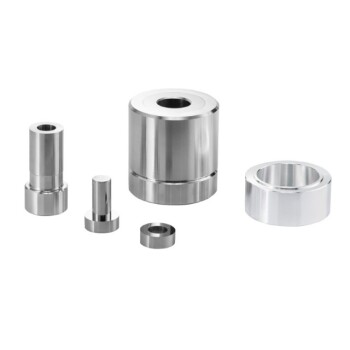
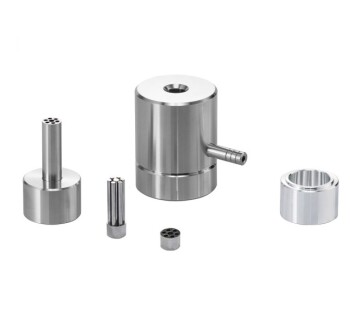
The primary purpose of a hardened steel die is to serve as a robust containment vessel capable of withstanding extreme uniaxial pressures—often reaching 720 MPa—during the cold sintering process. It ensures the wetted ceramic powder undergoes necessary densification and particle rearrangement without mechanical failure or loss of dimensional precision.
The die functions as a high-precision pressure chamber that enables low-temperature densification by sustaining massive mechanical loads while preventing the premature escape of the essential liquid phase.
The Mechanics of Pressure and Containment
Withstanding Extreme Uniaxial Pressure
The cold sintering process for NaSICON electrolytes relies on mechanical force rather than extreme heat to densify materials.
The die must sustain pressures up to 720 MPa without yielding or deforming. Standard steel would likely fail or warp under this specific load, necessitating the use of hardened steel to maintain structural integrity.
Precision Under Thermal Load
While cold sintering occurs at lower temperatures than traditional sintering, the die is still subjected to heating around 150°C.
The hardened steel must maintain its precise dimensions and hardness at this temperature. This stability ensures that the pressure applied to the powder remains constant and uniform throughout the heating cycle.
Facilitating the Sintering Mechanism
Driving Particle Rearrangement
The core mechanism of cold sintering involves mechanically forcing particles to slide past one another to fill voids.
The die provides the rigid boundary required to translate the applied force into particle rearrangement. Without this unyielding confinement, the powder would simply displace laterally rather than densifying into a solid mass.
Preserving the Liquid Phase
The "wetted" ceramic powder contains a transient liquid phase that facilitates the chemical bonding of particles.
A critical function of the die is preventing the premature loss of this liquid. By maintaining a precision fit under pressure, the die ensures the liquid remains in contact with the particles long enough to drive the sintering reaction before it evaporates or escapes.
Understanding the Constraints and Risks
The Trade-off of Precision vs. Leakage
The effectiveness of the die is heavily dependent on the precision of its customization.
If the clearance between the die walls and the punch is even slightly off, the high pressure will force the liquid phase out too early. This leads to incomplete densification and a weak electrolyte structure.
Material Hardness Limits
While hardened steel is robust, it has upper limits regarding repeated cycling at 720 MPa.
Operators must monitor the die for signs of fatigue or scoring. Any surface imperfections inside the die can lock the sample or create stress concentrators that lead to catastrophic failure under maximum load.
Ensuring Process Success
If your primary focus is High Density:
- Verify that your die is rated specifically for 720 MPa to ensure it can maximize particle rearrangement without elastic deformation.
If your primary focus is Chemical Stoichiometry:
- Prioritize the precision fit of the die components to prevent the loss of the liquid phase, which is vital for the correct chemical reaction.
The hardened steel die is not just a container; it is an active mechanical component that makes low-temperature ceramic processing physically possible.
Summary Table:
| Feature | Requirement for Cold Sintering | Role in NaSICON Processing |
|---|---|---|
| Material | Hardened Steel | Withstands uniaxial pressure up to 720 MPa without deformation. |
| Thermal Stability | Up to 150°C | Maintains dimensional precision during low-temperature heating cycles. |
| Containment | High-Precision Fit | Prevents premature escape of the liquid phase to ensure densification. |
| Internal Surface | Smooth/Polished | Facilitates particle rearrangement and prevents sample locking or fatigue. |
Elevate Your Material Research with KINTEK Precision Engineering
Achieving full densification in NaSICON solid electrolytes requires hardware that never yields. KINTEK specializes in high-performance laboratory equipment, providing the hardened steel dies and hydraulic pellet presses specifically engineered to sustain the 720 MPa loads demanded by cold sintering processes.
Whether you are developing next-generation batteries or advanced ceramics, our portfolio offers the reliability you need:
- Precision Dies & Hydraulic Presses: For consistent, high-pressure pelletizing and sintering.
- High-Temperature Solutions: From muffle and tube furnaces to specialized CVD/PECVD systems.
- Advanced Research Tools: Including high-pressure reactors, planetary ball mills, and essential consumables like crucibles and PTFE products.
Don't let equipment limitations stall your innovation. Contact KINTEK today to discuss your specific pressure and temperature requirements with our technical experts!
Related Products
- Ring Press Mold for Lab Applications
- Special Shape Press Mold for Lab
- CVD Diamond Wire Drawing Die Blanks for Precision Applications
- Ball Press Mold for Lab
People Also Ask
- How to use a press mold? Master the Art of Creating Consistent Ceramic Forms
- Why are pressure molds with non-conductive resin inner walls required for battery testing? Ensure Data Accuracy
- What is the press mould method? A Guide to Consistent, Detailed Ceramic Forms
- What is the function of press molds during the preparation of SiCf/Ti-43Al-9V composites? Achieve Structural Precision
- What is a press mold used for? Achieve Repeatable Precision and Efficiency