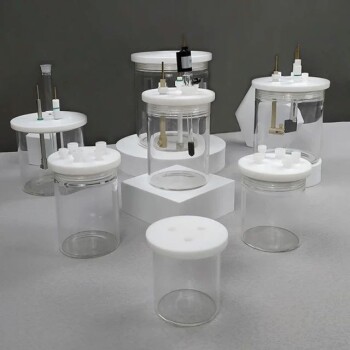
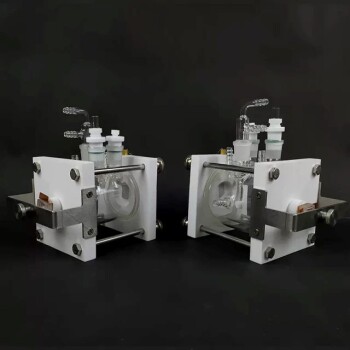
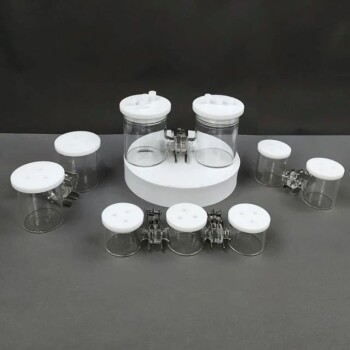
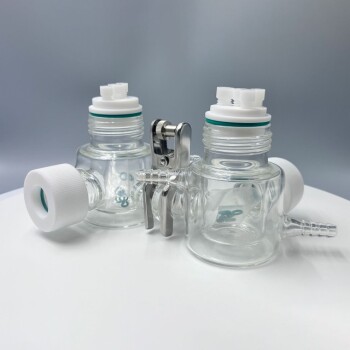
The primary purpose of an electrolytic extraction apparatus is to isolate specific, chemically stable precipitates from the bulk material of T91 steel. By utilizing targeted chemical electrolytes—specifically aqueous solutions of ammonium sulfate and citric acid—at a set current density, the apparatus selectively dissolves the surrounding iron matrix while preserving critical phases like M23C6 and MX.
Electrolytic extraction is the bridge between a solid steel sample and high-precision data. By chemically stripping away the overwhelming iron background, it delivers a pure residue of precipitates, enabling accurate quantitative analysis via X-ray Diffraction (XRD) and Inductively Coupled Plasma (ICP) spectroscopy.
The Mechanics of Selective Dissolution
To understand the value of this apparatus, one must look at how it manipulates the chemical stability of different microstructural components.
Targeting the Iron Matrix
The core function of the apparatus is selective dissolution. The electrolyte solution is formulated to attack the iron matrix of the T91 steel specifically.
Under a controlled current, the iron dissolves into the solution, effectively disappearing from the solid sample.
Preserving Stable Phases
While the matrix dissolves, specific carbides and intermetallic compounds remain intact.
Precipitates such as M23C6 and MX phases are chemically stable enough to withstand the electrolytic attack, remaining as a solid residue.
Control via Current Density
The process relies on a set current density to maintain precision.
If the current is too high or low, the selectivity may be compromised; the apparatus ensures the conditions are optimized for the specific electrolyte and steel grade.
Enabling Quantitative Analysis
The extraction process is rarely the end goal; it is a critical preparation step for downstream analytical techniques.
Preparing for X-ray Diffraction (XRD)
XRD requires a concentrated sample of the phases of interest to produce clear diffraction patterns.
By removing the iron matrix, the apparatus eliminates background interference, allowing for precise identification of phase composition.
Facilitating ICP Spectroscopy
Inductively Coupled Plasma (ICP) spectroscopy is used to determine the elemental composition of materials.
Isolating the precipitates ensures that the spectroscopic data reflects only the composition of the M23C6 and MX phases, rather than an average of the entire steel block.
Understanding the Limitations
While highly effective, electrolytic extraction is not a universal solution for all microstructural analysis.
Dependency on Chemical Stability
This method works only for precipitates that are chemically stable in the chosen electrolyte.
If a phase is less stable than the iron matrix, it will dissolve alongside the bulk material and be lost to the analysis.
Electrolyte Specificity
The success of the extraction depends entirely on the electrolyte recipe.
As noted, ammonium sulfate and citric acid are effective for T91 steel, but changing the alloy or target precipitate would likely require a completely different chemical setup.
Making the Right Choice for Your Goal
When planning your analysis of T91 steel, consider how this extraction technique aligns with your data requirements.
- If your primary focus is structural identification (XRD): Use electrolytic extraction to remove matrix noise, ensuring your diffraction peaks clearly represent the M23C6 and MX crystal structures.
- If your primary focus is elemental quantification (ICP): Rely on this apparatus to produce a clean residue, allowing you to measure the exact stoichiometry of the precipitates without iron contamination.
The electrolytic extraction apparatus converts a complex, noisy steel sample into a clean signal, empowering you to perform quantitative analysis with confidence.
Summary Table:
| Feature | Electrolytic Extraction Process Details |
|---|---|
| Primary Objective | Selective dissolution of the iron matrix to isolate stable precipitates |
| Target Phases | M23C6 and MX phases (carbides and intermetallic compounds) |
| Electrolyte Type | Aqueous solutions of ammonium sulfate and citric acid |
| Key Control Parameter | Precise current density for optimal selectivity |
| Downstream Analysis | X-ray Diffraction (XRD) and ICP Spectroscopy |
Elevate Your Material Analysis with KINTEK
Precision in metallurgical research requires high-quality tools that ensure repeatable results. KINTEK specializes in advanced laboratory equipment, including electrolytic cells and electrodes specifically designed for demanding extraction and analysis tasks.
Whether you are characterizing precipitates in T91 steel or conducting specialized battery research, our comprehensive portfolio—ranging from high-temperature furnaces and vacuum systems to cooling solutions and essential ceramics—is engineered to meet the highest scientific standards.
Ready to optimize your lab’s throughput and data accuracy? Contact KINTEK today to discuss our customized equipment solutions for your research needs.
References
- Ji Li, Gang Yang. Effect of Silicon on Dynamic/Static Corrosion Resistance of T91 in Lead–Bismuth Eutectic at 550 °C. DOI: 10.3390/ma15082862
This article is also based on technical information from Kintek Solution Knowledge Base .
Related Products
- Three-dimensional electromagnetic sieving instrument
- Side Window Optical Electrolytic Electrochemical Cell
- Quartz Electrolytic Electrochemical Cell for Electrochemical Experiments
- Multifunctional Electrolytic Electrochemical Cell Water Bath Single Layer Double Layer
- Electrolytic Electrochemical Cell with Five-Port
People Also Ask
- Why is sieving equipment essential for the classification of processed bio-activated carbon? Optimize Performance
- What are the limitations of sieving? Understanding the Constraints of Particle Size Analysis
- What are advantages and disadvantages of sieving method? A Guide to Reliable & Cost-Effective Particle Sizing
- How is sieving important? The Critical Role of Particle Size Analysis in Quality Control
- What is sieving and how does it work? A Guide to Accurate Particle Size Analysis