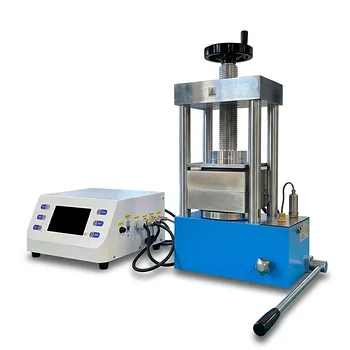
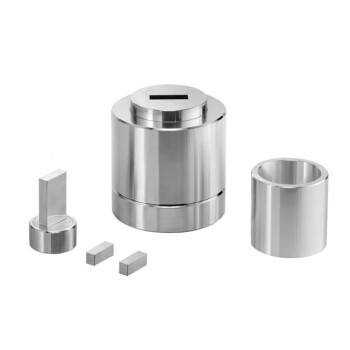
The primary purpose of using a laboratory hydraulic press for Al-LLZ powder is to bridge the gap between loose particles and a solid, sinter-ready component. By applying high pressure, the press compacts the powder into a "green body," significantly reducing the voids between particles. This process increases the initial density and mechanical strength of the material, which is a prerequisite for successful processing in the kiln.
Core Takeaway: The quality of the final ceramic is determined before sintering begins. Achieving high green body density via hydraulic pressing is the single most effective way to minimize residual pores, prevent structural collapse, and ensure uniform densification during high-temperature treatment.
The Mechanics of Densification
The transformation from loose powder to a high-performance ceramic relies on the initial physical state of the material.
Eliminating Particle Voids
Loose Al-LLZ powder contains a significant amount of empty space, or voids. The hydraulic press forces particles to rearrange and pack tightly, mechanically reducing these gaps. This creates the high initial density required for the material to become a solid electrolyte.
Establishing Green Strength
Before heating, the molded shape is fragile. The pressure creates mechanical interlocking between particles, resulting in a green body with sufficient strength to be handled. This structural integrity ensures the sample does not crumble or deform during transfer to the furnace.
Why High Density Matters for Sintering
The effectiveness of the sintering process—where the material actually densifies—is directly dependent on the compaction step.
Facilitating Mass Transport
Sintering requires particles to be in tight physical contact. By minimizing the distance between grains, the hydraulic press creates the necessary pathways for mass transport and grain bonding to occur efficiently at high temperatures.
Preventing Structural Collapse
If the initial density is too low, the material structure is unstable. During the intense heat of sintering, a poorly compacted body is prone to collapsing or deforming. High compaction pressure creates a stable architecture that maintains its geometric shape under thermal stress.
Reducing Residual Porosity
Pores left in the green body often translate to defects in the final product. Compacting the Al-LLZ powder minimizes the starting porosity, which directly leads to a denser, stronger final ceramic with fewer residual pores after firing.
Understanding the Trade-offs
While pressure is essential, the application of that pressure requires precision to avoid introducing new defects.
The Risk of Density Gradients
If the hydraulic press does not apply pressure uniformly, the green body will have areas of varying density. During sintering, these areas will shrink at different rates, leading to warping, deformations, or structural failure.
Micro-Cracking Dangers
Applying pressure too rapidly or unevenly can create internal stresses. These stresses often manifest as micro-cracks within the green body. While invisible initially, these cracks will propagate during sintering, resulting in a fractured or compromised final component.
Making the Right Choice for Your Goal
To maximize the effectiveness of your Al-LLZ preparation, align your pressing strategy with your specific processing objectives.
- If your primary focus is maximizing final density: Apply the highest stable pressure the mold can withstand to minimize initial voids and reduce the distance particles must diffuse during sintering.
- If your primary focus is geometric accuracy: Prioritize the uniformity of pressure application to prevent density gradients that cause warping or anisotropic shrinkage during heating.
The hydraulic press is not merely a shaping tool; it is the instrument that defines the structural ceiling of your final material.
Summary Table:
| Feature | Impact on Al-LLZ Green Body | Sintering Benefit |
|---|---|---|
| Void Elimination | Reduces empty space between particles | Minimizes residual porosity in final ceramic |
| Mechanical Interlocking | Increases green body structural strength | Prevents crumbling or deformation during handling |
| Particle Proximity | Maximizes contact points between grains | Accelerates mass transport and grain bonding |
| Pressure Uniformity | Ensures consistent density distribution | Prevents warping and anisotropic shrinkage |
| Compaction Force | Creates a stable architectural foundation | Prevents structural collapse under thermal stress |
Elevate Your Material Research with KINTEK Precision
Achieving the perfect green body density is critical for the performance of solid electrolytes like Al-LLZ. KINTEK specializes in advanced laboratory solutions designed to give you total control over your material preparation.
Our comprehensive range of laboratory hydraulic presses (manual, electric, and isostatic) ensures uniform compaction, while our high-temperature furnaces and crushing and milling systems provide the end-to-end consistency your research demands. From pellet presses to PTFE consumables and ceramics, we empower researchers to eliminate defects and maximize densification.
Ready to optimize your powder processing workflow? Contact KINTEK today to discover how our high-performance equipment can enhance your lab's efficiency and results.
Related Products
- Round Bidirectional Press Mold for Lab
- Laboratory Hydraulic Press Split Electric Lab Pellet Press
- Laboratory Hydraulic Press Lab Pellet Press Machine for Glove Box
- Laboratory Hydraulic Press Lab Pellet Press for Button Battery
- Manual Lab Heat Press
People Also Ask
- How to use a press mold? Master the Art of Creating Consistent Ceramic Forms
- What is the press mould method? A Guide to Consistent, Detailed Ceramic Forms
- What is the function of press molds during the preparation of SiCf/Ti-43Al-9V composites? Achieve Structural Precision
- What is a press mold used for? Achieve Repeatable Precision and Efficiency
- What is the purpose of specialized pressure devices in sulfide solid-state batteries? Ensure Chemo-Mechanical Stability