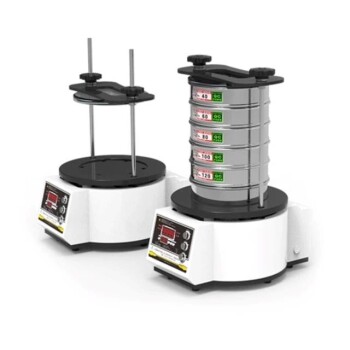
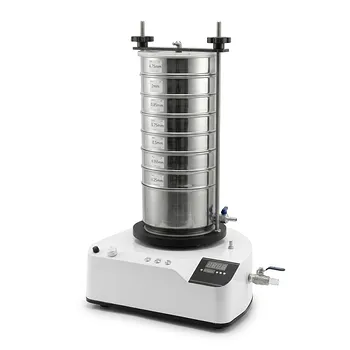
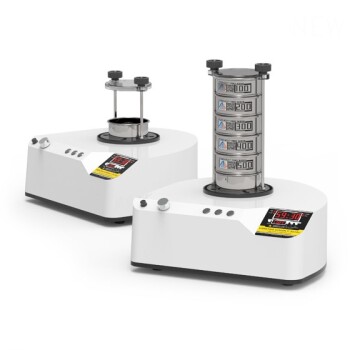
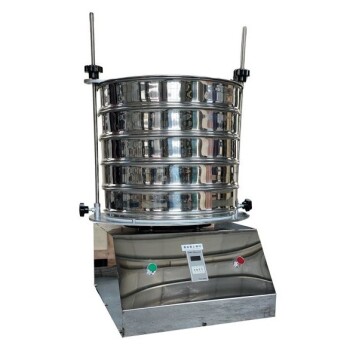
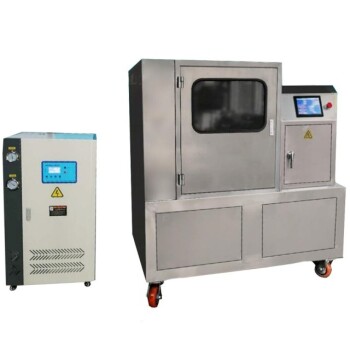
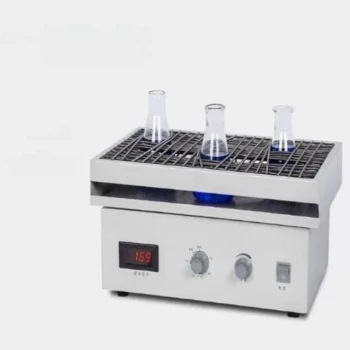
The primary purpose of a mechanical vibrating sieve in biomass preparation is to classify pulverized powder into a specific, uniform particle size, typically smaller than 400 μm. By physically separating larger, irregular chunks and breaking up agglomerates, the sieve ensures the biomass sample is physically consistent before it undergoes thermal processing or analysis.
Core Takeaway Particle size uniformity is the foundation of accurate thermal analysis. By eliminating variations in heat conduction caused by irregular sizes, mechanical sieving ensures that your experimental data is reproducible and truly representative of the final torrefied product's properties.
The Critical Role of Particle Uniformity
Controlling Heat Conduction
In thermal analysis, the way a particle absorbs heat is dictated by its physical volume. Large particles conduct heat differently than fine dust.
Using a sieve removes these size discrepancies. This standardization ensures that heat conduction remains constant across the entire sample during testing.
Ensuring Experimental Reproducibility
Reliable science requires consistent inputs to generate consistent outputs. If the particle size varies between batches, the thermal reaction data will fluctuate unpredictably.
Sieving the biomass creates a baseline of uniformity. This allows researchers to attribute changes in results to the material properties, rather than inconsistencies in sample preparation.
Achieving Representative Sampling
The goal of analyzing a small sample is to understand the properties of the larger bulk product.
If the sample contains random, oversized particles, it no longer represents the true behavior of the material. Sieving ensures the sample accurately reflects the specific properties of the torrefied product you aim to study.
Mechanism of Action
Classification and Separation
The vibrating sieve functions as a physical filter for the pulverized biomass.
It sets a strict upper limit on particle dimension, such as 400 μm. Any material exceeding this threshold is retained on the mesh, while the compliant powder passes through.
Managing Agglomeration
During the pulverization or ball milling stages, fine powders often clump together to form larger masses known as agglomerates.
The mechanical vibration helps break these loosely bound clusters or separate them entirely. This prevents "false" large particles from entering the final testing stage.
Common Pitfalls and Trade-offs
The Trade-off Between Yield and Precision
Strictly classifying biomass to sizes under 400 μm inevitably results in material loss.
You must sacrifice the volume of the "oversized" particles to guarantee data integrity. Attempting to use the entire pulverized batch without sieving will compromise the accuracy of thermal analysis.
The Risk of Micro-Variations
Even with sieving, screen blinding (clogging) can occur if the moisture content is too high.
While the sieve ensures size uniformity, it must be operated correctly to prevent forcing pliable, oversized particles through the mesh. Consistency in the sieving process itself is as important as the mesh size selected.
Making the Right Choice for Your Goal
To maximize the reliability of your biomass research, apply the following guidelines:
- If your primary focus is Thermal Analysis: Prioritize the removal of all particles >400 μm to eliminate heat conduction variables and prevent thermal lag.
- If your primary focus is Product Consistency: Use the sieve to remove agglomerates that could lead to density variations in the final torrefied product.
Ultimately, the mechanical sieve transforms a variable raw material into a standardized scientific sample, serving as the first step toward credible data.
Summary Table:
| Feature | Function in Biomass Preparation | Benefit to Research |
|---|---|---|
| Classification | Filters particles to specific sizes (e.g., <400 μm) | Eliminates heat conduction discrepancies |
| Agglomerate Removal | Breaks up clusters formed during milling | Ensures material density and sample uniformity |
| Standardization | Creates a consistent physical baseline | Guarantees experimental reproducibility |
| Filtering | Removes oversized, irregular chunks | Provides representative data for bulk products |
Optimize Your Sample Preparation with KINTEK Precision
Don't let inconsistent particle sizes compromise your research integrity. KINTEK specializes in high-performance laboratory equipment designed for the most demanding biomass and material science applications.
Our comprehensive range includes:
- Advanced Sieving Equipment: Achieve perfect particle classification for thermal analysis.
- Crushing & Milling Systems: Reliable pulverization for uniform sample bases.
- High-Temperature Solutions: Muffle, tube, and vacuum furnaces for precise torrefaction.
- Specialized Lab Tools: From pellet presses to ceramic crucibles and PTFE products.
Ready to elevate your lab's efficiency and data reproducibility? Our experts are here to help you select the ideal equipment tailored to your specific research goals.
Contact KINTEK Today for a Professional Consultation
References
- Mohamed Khairy, Ahmed Elwardany. The influence of torrefaction on the biochar characteristics produced from sesame stalks and bean husk. DOI: 10.1007/s13399-023-03822-9
This article is also based on technical information from Kintek Solution Knowledge Base .
Related Products
- Vibratory Sieve Shaker Machine Dry Three-Dimensional Vibrating Sieve
- Laboratory Vibratory Sieve Shaker Machine Slap Vibrating Sieve
- Laboratory Vibratory Sieve Shaker Machine for Dry and Wet Three-Dimensional Sieving
- Laboratory Test Sieves and Vibratory Sieve Shaker Machine
- Laboratory Wet Three-Dimensional Vibratory Sieve Shaker Machine
People Also Ask
- How is a vibratory sieve shaker used in the particle size analysis of mechanically alloyed powders? Expert Guide
- Why use a vibratory sieve shaker for PET powder? Achieve Precise Particle Size Control for Chemical Research
- What is the principle of vibratory sieve shaker? Achieve Accurate Particle Size Analysis
- What is the function of a vibratory sieve shaker? Achieve Precise Particle Size Analysis
- What is the use of vibratory sieve shaker? Achieve Precise Particle Size Analysis for Your Lab