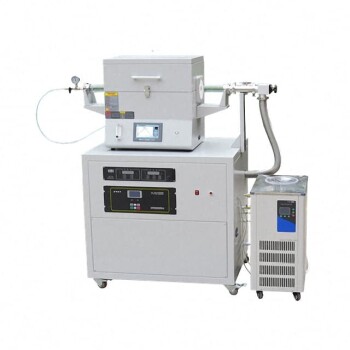
Controlled atmosphere tube furnaces are the critical catalyst for precise chemical reduction.
In the synthesis of Cobalt-oxide/Cobalt (Co-oxide/Co) inverted nanostructures, the controlled atmosphere tube furnace provides the specific physical environment required for hydrogen reduction reactions. By maintaining temperatures between 180°C and 500°C and introducing high-purity hydrogen, the furnace facilitates the reduction of precursor powders into high-purity Cobalt-oxide (CoO) nanoparticles. This process is essential for ensuring powder reactivity and preventing unintended phase transformations that would degrade the material's properties.
The core role of the tube furnace is to provide a stable, oxygen-free thermal environment that enables the precise reduction of cobalt precursors. This ensures the formation of high-purity nanostructures while allowing for the fine-tuning of oxidation states and particle morphology.
The Necessity of a Reducing Atmosphere
Facilitating Hydrogen Reduction
The furnace acts as a sealed reaction chamber where high-purity hydrogen is introduced to interact with precursor powders. This chemical environment is what allows the transition from a precursor state to the desired CoO nanoparticles.
Preventing Unintended Phase Transformations
Without a strictly controlled atmosphere, cobalt is highly susceptible to uncontrolled oxidation. The furnace's sealing capabilities exclude ambient oxygen, ensuring that the material achieves the correct crystalline phase rather than turning into unwanted oxide variants.
Tuning Oxidation States
Similar to the synthesis of other metal oxides, the ability to control the concentration of reducing gases (like a H₂/Ar mix) allows researchers to optimize the photocatalytic or magnetic activity of the composite. Precise gas control prevents "over-reduction," which could turn the entire sample into metallic cobalt rather than the desired oxide-metal inverted structure.
Precision Thermal Management
Maintaining Temperature Uniformity
The furnace’s ability to provide a uniform temperature field is the primary guarantee for controlling the size distribution of the particles. Uniform heat ensures that all precursor powders react at the same rate, preventing a mix of oversized and undersized nanoparticles.
Driving Precursor Decomposition
Thermal energy within the furnace drives the thermal decomposition of organic ligands or salts in the precursor. This process is necessary to "clean" the cobalt atoms, allowing them to form an ordered crystalline structure, such as the alpha-NaFeO2 structure found in similar cobalt-based materials.
Inducing Phase Transitions
By operating within the specific 180°C to 500°C range, the furnace provides the exact thermodynamic conditions required for phase changes. This precision is what allows for the synthesis of "inverted" nanostructures, where the arrangement of the oxide and metal phases is strictly controlled.
Understanding the Trade-offs
Temperature Sensitivity
Operating at the lower end of the temperature scale (near 180°C) may result in incomplete reduction or poor crystallinity. Conversely, exceeding 500°C can lead to excessive grain growth, destroying the "nano" scale of the structures and reducing the material's surface area.
Gas Flow and Pressure Risks
While high-purity hydrogen is necessary for reduction, the flow rate and pressure must be meticulously managed. If the flow is too low, the reaction may be uneven; if too high, it can lead to safety hazards or the physical displacement of fine precursor powders within the tube.
Atmosphere Sealing Integrity
The greatest pitfall in this synthesis is a compromised seal. Even trace amounts of oxygen leaking into the furnace during the cooling phase can cause the surface of the nanostructures to re-oxidize, fundamentally altering the "inverted" nature of the Co-oxide/Co material.
How to Apply This to Your Project
When utilizing a tube furnace for cobalt nanostructure synthesis, your approach should vary based on your specific material requirements.
- If your primary focus is phase purity: Prioritize a furnace with high-vacuum sealing capabilities and utilize high-purity (99.999%) hydrogen to ensure no oxygen interference.
- If your primary focus is particle size control: Ensure the furnace has a long "constant temperature zone" and use a slow heating ramp to prevent rapid, uneven nucleation of the nanoparticles.
- If your primary focus is structural integrity: Use an inert gas purge (like Nitrogen or Argon) both before and after the hydrogen reduction phase to protect the material during heating and cooling cycles.
The controlled atmosphere tube furnace is not merely a heater, but a sophisticated chemical reactor that dictates the final crystalline and structural identity of cobalt nanostructures.
Summary Table:
| Key Feature | Role in Synthesis | Performance Impact |
|---|---|---|
| Reducing Atmosphere | Facilitates hydrogen reduction reactions | High-purity CoO nanoparticle formation |
| Atmosphere Sealing | Excludes oxygen and prevents re-oxidation | Preservation of "inverted" nanostructures |
| Thermal Uniformity | Ensures consistent reaction rates | Controlled particle size distribution |
| Precise Gas Control | Manages H₂/Ar flow and concentration | Fine-tuned oxidation states and reactivity |
Precision Heat Treatment for Your Advanced Research
Unlock the full potential of your material synthesis with KINTEK’s high-performance controlled atmosphere tube furnaces. Specifically designed for demanding applications like Cobalt-oxide/Cobalt nanostructure synthesis, our furnaces provide the vacuum integrity and thermal stability required for flawless hydrogen reduction.
Beyond our specialized tube furnaces (available in horizontal, vertical, and rotary configurations), KINTEK offers a full suite of laboratory solutions tailored for researchers and industrial labs:
- Advanced Furnaces: Muffle, vacuum, CVD, PECVD, and induction melting systems.
- Sample Preparation: High-efficiency crushing and milling systems, and hydraulic presses (pellet, hot, isostatic).
- Reaction Technology: High-temperature high-pressure reactors and autoclaves.
- Lab Essentials: Cooling solutions (ULT freezers, freeze dryers) and high-purity consumables like crucibles and ceramics.
Ready to enhance your lab's efficiency and material purity? Contact our technical experts today to find the ideal equipment for your specific synthesis requirements!
References
- Maral Ghoshani, Daryoosh Vashaee. Exploring the Enhancement of Exchange Bias in Innovative Core/Shell/Shell Structures: Synthesis and Magnetic Properties of Co-Oxide/Co and Co-Oxide/Co/Co-Oxide Inverted Nanostructures. DOI: 10.3390/nano13050880
This article is also based on technical information from Kintek Solution Knowledge Base .
Related Products
- 1200℃ Controlled Atmosphere Furnace Nitrogen Inert Atmosphere Furnace
- 1700℃ Controlled Atmosphere Furnace Nitrogen Inert Atmosphere Furnace
- 1400℃ Controlled Atmosphere Furnace with Nitrogen and Inert Atmosphere
- Controlled Nitrogen Inert Hydrogen Atmosphere Furnace
- Mesh belt controlled atmosphere furnace
People Also Ask
- Why is a high-temperature furnace with a controlled atmosphere required for S@MMPC? Master Precision Synthesis
- What is controlled atmosphere furnace? Precision Heating Without Oxidation for Superior Materials
- Can you braze copper to brass without flux? Yes, but only under these specific conditions.
- What is the function of a high-precision controlled atmosphere furnace for Alloy 617? Simulate Extreme VHTR Conditions
- What is a controlled atmosphere furnace for heat treatment? Master Surface Chemistry and Metallurgy