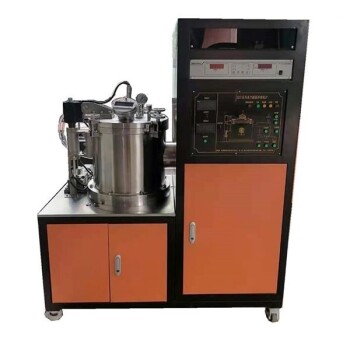
The high-frequency induction melting furnace acts as the central processing unit for creating chemically precise super duplex stainless steel. It utilizes electromagnetic induction to rapidly generate intense heat within high-purity raw metals—specifically iron, chromium, nickel, and copper—to ensure a complete and uniform melt.
Core Takeaway The primary role of this furnace is to guarantee homogeneity through electromagnetic stirring. It transforms raw elements into a chemically uniform liquid state, providing a reliable baseline for studying how specific elemental additions affect the alloy's final properties.
The Mechanics of Precision Melting
Rapid Heating via Induction
The furnace does not rely on external heat sources that transfer energy slowly. Instead, it employs electromagnetic induction.
This process generates eddy currents directly within the metal raw materials. The resistance of the metal to these currents causes it to heat up rapidly and melt from the inside out.
The Role of Electromagnetic Stirring
Melting the metal is only half the battle; ensuring the mix is uniform is the other. The electromagnetic field generated by the furnace provides a natural magnetic stirring force.
This automatic stirring action vigorously mixes the liquid metal. It ensures that heavier and lighter elements do not separate, resulting in a homogeneous distribution of alloying elements throughout the batch.
Ensuring Chemical Integrity
Creating a Precise Base Material
Super duplex stainless steels require exact chemical ratios to function correctly. The high-frequency induction furnace provides a chemically precise base material.
By starting with high-purity inputs and mixing them thoroughly, the furnace eliminates variables caused by uneven composition. This allows researchers to isolate specific variables.
Studying Elemental Additions
Once the base material is homogeneous, scientists can accurately test modifications. The primary reference highlights the importance of this for studying elemental additions, such as copper.
Because the base mixture is chemically stable and uniform, any change in the alloy’s properties can be definitively attributed to the added copper, rather than inconsistencies in the melting process.
Understanding the Trade-offs
Dependence on Raw Material Purity
While the induction furnace is excellent for mixing, it is not primarily a refining tool for "dirty" inputs. It relies on high-purity raw metals as the starting point.
Unlike blast furnaces which use slag to remove impurities from crude ore, induction melting generally preserves what is put into it. If the input materials contain impurities, the final alloy will likely retain them.
Atmosphere Control
While the primary text focuses on the induction mechanism, it is important to note that the environment matters. Without a controlled atmosphere (like a vacuum or inert gas), sensitive elements can oxidize.
Supplementary data suggests that for reactive elements, managing the oxygen pressure or using an inert atmosphere is critical to prevent the loss of alloying elements during the high-temperature melt.
Making the Right Choice for Your Goal
To maximize the effectiveness of a high-frequency induction melting furnace, align your process with your specific objectives:
- If your primary focus is Research and Development: Prioritize the use of high-purity raw materials to create a flawless control sample for studying the effects of micro-alloying elements like copper.
- If your primary focus is Alloy Homogeneity: Rely on the inherent electromagnetic stirring of the induction process to mix elements with vastly different densities, ensuring the final ingot has uniform mechanical properties.
Success in creating super duplex stainless steel lies not just in melting the metal, but in the relentless pursuit of chemical uniformity.
Summary Table:
| Feature | Benefit in Super Duplex Steel Production |
|---|---|
| Induction Heating | Rapid, internal heating prevents external contamination and ensures speed. |
| Magnetic Stirring | Vigorous mixing of elements (Fe, Cr, Ni, Cu) to prevent density segregation. |
| Homogeneity | Provides a chemically precise base material for accurate R&D and testing. |
| Process Control | Minimizes variables, allowing for definitive study of elemental additions like copper. |
Elevate Your Alloy Research with KINTEK Precision
Precise chemical uniformity is the foundation of high-performance super duplex stainless steel. KINTEK specializes in advanced induction melting furnaces, providing the electromagnetic stirring and temperature control essential for your most demanding metallurgical applications.
Beyond melting, KINTEK offers a comprehensive suite of laboratory solutions, including:
- High-Temperature High-Pressure Reactors & Autoclaves
- Crushing, Milling, and Sieving Systems
- Precision Hydraulic Presses & Pellet Tools
- Ceramic Crucibles & Specialized Consumables
Ensure the integrity of your research with equipment designed for precision. Contact KINTEK today to discuss your specific laboratory needs and discover how our high-performance systems can streamline your alloy development.
References
- Kyeong-Ho Kong, Yongsoo Park. Effects of Cu Addition on the Microstructure and Localized Corrosion Resistance of Hyper Duplex Stainless Steels Aged at 748 K. DOI: 10.2320/matertrans.m2015022
This article is also based on technical information from Kintek Solution Knowledge Base .
Related Products
- Vacuum Heat Treat Furnace and Levitation Induction Melting Furnace
- Lab-Scale Vacuum Induction Melting Furnace
- Vacuum Arc Induction Melting Furnace
- Non Consumable Vacuum Arc Induction Melting Furnace
- 600T Vacuum Induction Hot Press Furnace for Heat Treat and Sintering
People Also Ask
- What are the advantages of a vacuum induction melting furnace? Achieve High-Purity Alloys with Precision VIM
- What is the function of a vacuum induction melting furnace? Essential Guide for High-Purity FeCrAl Alloy Production
- What are the key components inside the vacuum chamber of a vacuum induction melting furnace? A Guide to the Core Melting Assembly
- Why use VIM for rare earth steel? Essential Precision for Melting Reactive Lanthanum and Cerium
- What is the primary function of a vacuum induction melting furnace in Ni-Mo-Cr-Fe master alloy prep? Ensure High Purity