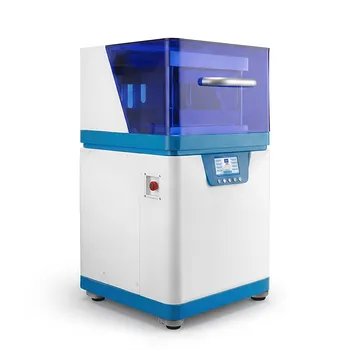
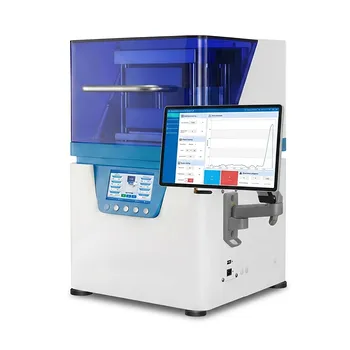
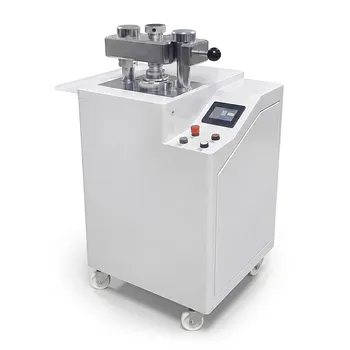
The essential function of a high-tonnage laboratory hydraulic press is the consolidation of loose elemental powders into a cohesive "green compact." In the preparation of TiPtHf alloys, this equipment applies significant axial pressure to high-purity titanium, platinum, and hafnium powders within precision molds at room temperature. This process, known as cold pressing, establishes the necessary mechanical interlocking and density required for successful downstream thermal processing and melting.
The hydraulic press serves as a critical bridge between raw metal powders and a stable alloy precursor. By ensuring high-density contact and compositional uniformity, it creates a structurally sound entity that minimizes internal voids and prepares the material for uniform melting.
The Role of Compaction in Alloy Development
Cold Pressing and Initial Particle Bonding
In the initial stages of TiPtHf alloy preparation, the hydraulic press operates at room temperature to force titanium, platinum, and hafnium particles into intimate contact.
The application of high pressure, often reaching levels such as 50 bars or significantly higher depending on the specific alloy requirements, triggers initial bonding between powder particles.
This mechanical interlocking is particularly effective with ductile components like titanium, which deform under pressure to lock around harder or more noble particles like platinum.
Formation of the Green Compact
The resulting product of this pressing stage is known as a green compact, a solid block that possesses a specific geometric shape and sufficient structural integrity for handling.
Without this step, loose powders would be susceptible to compositional shifting or loss during the transition to a melting furnace or sintering environment.
The press provides the essential hardware foundation to ensure that the raw material entity is compact and compositionally uniform before any heat is applied.
Optimizing Material Properties for Downstream Processing
Density Uniformity and Void Reduction
A primary goal of using a high-tonnage press is the expulsion of air trapped between powder particles, which significantly increases the bulk density of the material.
By reducing large internal pores, the press ensures that the final product will have geometric accuracy and a consistent internal structure.
Precise pressure control allows researchers to achieve a stable deformation rate, which is vital for maintaining a consistent density profile across the entire sample.
Ensuring Chemical Homogeneity
For complex alloys like TiPtHf or high-entropy alloys, maintaining the exact ratio of elements is paramount to achieving desired performance characteristics.
The hydraulic press secures the relative positions of the mixed powders, preventing the segregation of heavy elements (like hafnium and platinum) from lighter ones (like titanium).
This structural stability is essential for ensuring chemical uniformity during subsequent stages, such as laser ablation or high-temperature vacuum sintering.
Critical Constraints and Technical Trade-offs
Pressure Limits and Die Integrity
While higher pressure generally leads to better compaction, exceeding the yield strength of the precision mold or the material's limit can cause structural failure.
Using excessive force may lead to die sticking or micro-cracking within the green body, which can compromise the integrity of the alloy during the melting phase.
Conversely, insufficient pressure results in a fragile compact that may crumble during transport, leading to material loss and inconsistent alloy ratios.
The Challenge of Powder Elasticity
Some metal powders exhibit "spring-back," where the material slightly expands after the pressure is released from the hydraulic press.
If not carefully managed through precise load application and dwell times, this elasticity can result in internal stresses that lead to delamination.
Balancing the tonnage with the specific flow characteristics of Ti, Pt, and Hf powders is a technical requirement that demands expert calibration of the press settings.
Strategic Implementation for Alloy Synthesis
How to Apply This to Your Project
To achieve the best results when preparing TiPtHf or similar high-purity alloys, consider your primary objective when configuring the press:
- If your primary focus is handling durability: Utilize higher axial pressures to maximize mechanical interlocking between ductile titanium and noble metal particles.
- If your primary focus is chemical homogeneity: Ensure the powders are thoroughly pre-blended and use a floating die to provide more uniform pressure distribution across the compact.
- If your primary focus is minimizing contamination: Perform the pressing at room temperature (cold pressing) to avoid oxidation and use high-purity precision molds that do not react with the alloy components.
The high-tonnage hydraulic press is the foundational tool that transforms a simple mixture of powders into a high-performance metallurgical precursor.
Summary Table:
| Process Stage | Function of Hydraulic Press | Impact on TiPtHf Alloy Quality |
|---|---|---|
| Cold Pressing | Consolidates Ti, Pt, and Hf powders | Establishes initial mechanical bonding |
| Compaction | Expels trapped air & reduces voids | Increases bulk density and structural integrity |
| Stabilization | Secures relative positions of elements | Prevents segregation of heavy Pt and Hf particles |
| Calibration | Precise pressure and dwell control | Minimizes internal stress and "spring-back" |
Elevate Your Alloy Synthesis with KINTEK Precision
Achieving the perfect green compact is the first step toward high-performance metallurgical research. KINTEK specializes in high-precision laboratory equipment, offering a robust selection of high-tonnage hydraulic presses (pellet, hot, and isostatic) designed to ensure superior density and chemical homogeneity for your complex alloys.
Beyond compaction, our comprehensive portfolio supports your entire workflow—from crushing and milling systems to high-temperature vacuum furnaces, CVD systems, and high-pressure reactors. Whether you are developing TiPtHf alloys or high-entropy materials, KINTEK provides the reliability and technical support you need to succeed.
Ready to optimize your material preparation? Contact our experts today for a tailored solution!
References
- Elija Moletsane, Chris Machio. The effect of increasing hafnium on the microstructure, phase transformation temperatures and hardness of TiPtHf potential shape memory alloys. DOI: 10.1051/matecconf/202338803008
This article is also based on technical information from Kintek Solution Knowledge Base .
Related Products
- Automatic Hydraulic Hot Press with 500x500mm Heating Plates and Multi Stage PLC Control for Material Sintering
- Heated Hydraulic Press Machine with Heated Plates for Vacuum Box Laboratory Hot Press
- Automatic High Temperature Heated Hydraulic Press Machine with Heated Plates for Lab
- Manual High Temperature Heated Hydraulic Press Machine with Heated Plates for Lab
- 24T 30T 60T Heated Hydraulic Press Machine with Heated Plates for Laboratory Hot Press
People Also Ask
- How do hydraulic presses facilitate material solidification in Low-Temperature LPS? Optimize Your Material Densification
- Why is 800 MPa required for TiNiPdCu alloy green bodies? Master High-Density Compaction for Superior Material Strength
- How does KBr pellet preparation facilitate FTIR of high-ash mud? Precision Sample Prep for Structural Analysis
- Why is an industrial hydraulic press with precision stainless steel molds used? For Uniform Mo-Fe Precursor Compacts.
- Purpose of Coaxial Ring Molds & Presses in EM Testing? Achieve Precise VNA Data & Fit