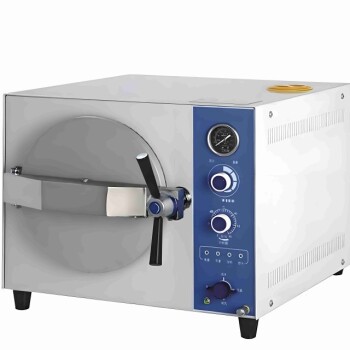
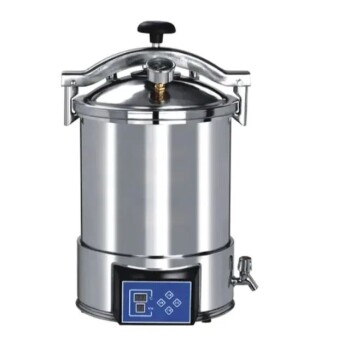
The primary role of a hydrothermal synthesis autoclave is to provide a sealed, high-temperature, and high-pressure aqueous environment for synthesizing ceramic nano-powders. This specialized vessel allows for the precise creation of materials like BaTiO3 with specific morphologies and the high surface activity necessary for advanced processing.
By generating nano-particles with high surface energy and solubility, this reactor produces the high-quality raw materials essential for the dissolution-precipitation mechanism used in the Cold Sintering Process.
Creating the Optimal Synthesis Environment
To understand the autoclave's value, one must look at how it manipulates the physical environment to alter chemical outcomes.
High-Pressure Aqueous Conditions
The autoclave operates by creating a sealed environment. This allows water to remain liquid at temperatures far above its normal boiling point, acting as a powerful solvent.
This high-pressure state facilitates chemical reactions that are difficult or impossible to achieve under standard atmospheric conditions.
Controlled Nucleation and Growth
The reactor allows for precise regulation of internal temperature regimes and stirring frequencies.
These controls induce uniform nucleation, ensuring that nanocrystals grow consistently rather than randomly.
Versatility Without Reconfiguration
A significant advantage of this system is its flexibility. It can produce nano-metal oxides with various particle size distributions and morphologies without requiring hardware changes.
Enhancing Material Properties of BaTiO3
The autoclave is not just about making powder; it is about making reactive powder.
Specific Morphology
The process allows engineers to dictate the shape and structure of the final nano-particles.
Achieving a specific morphology is critical for defining the physical characteristics of the final ceramic product.
High Surface Activity
Nano-particles produced via hydrothermal synthesis possess high surface energy.
This energy makes the particles more chemically active, which is a desirable trait for subsequent manufacturing steps.
Increased Solubility
The resulting BaTiO3 powders exhibit high solubility. This is a direct result of the synthesis conditions and the particle's surface characteristics.
Enabling the Cold Sintering Process
The ultimate goal of using this autoclave is often to prepare feedstock for the Cold Sintering Process (CSP).
The Dissolution-Precipitation Mechanism
CSP relies heavily on a specific chemical pathway known as the dissolution-precipitation mechanism.
Standard ceramic powders often lack the reactivity to trigger this mechanism effectively at low temperatures.
High-Quality Raw Materials
The high surface energy and solubility of hydrothermally synthesized powders make them ideal candidates for this process.
They serve as high-quality raw materials that dissolve and precipitate efficiently, allowing for the densification of ceramics at significantly lower temperatures.
Understanding the Operational Trade-offs
While hydrothermal autoclaves offer superior product quality, they introduce specific challenges that must be managed.
Process Sensitivity
The quality of the output is highly sensitive to process parameters. Slight deviations in temperature or stirring speed can alter the particle size distribution.
Sealed System Limitations
Because the environment is sealed under high pressure, real-time monitoring and adjustment can be more complex than in open-system synthesis.
You must rely on pre-programmed regimes and robust sensor data rather than direct visual observation.
Making the Right Choice for Your Goal
Whether you require a hydrothermal autoclave depends on the specific demands of your downstream processing.
- If your primary focus is enabling Cold Sintering: Prioritize this method to generate powders with the high surface energy and solubility required for the dissolution-precipitation mechanism.
- If your primary focus is precise particle uniformity: Leverage the reactor's ability to control stirring and temperature to ensure consistent nucleation and defined morphology.
Control the synthesis environment, and you control the fundamental performance of your ceramic material.
Summary Table:
| Feature | Role in Nano-Powder Preparation | Impact on BaTiO3 Properties |
|---|---|---|
| High-Pressure Environment | Keeps water liquid above boiling point | Enables synthesis of high-purity nanocrystals |
| Controlled Nucleation | Regulates temperature and stirring | Ensures uniform particle size and morphology |
| Surface Energy Control | Induces high surface activity | Enhances chemical reactivity for sintering |
| Solubility Optimization | Produces high-solubility powders | Facilitates the dissolution-precipitation mechanism |
Elevate Your Material Research with KINTEK
Ready to achieve superior precision in ceramic synthesis? KINTEK specializes in advanced laboratory solutions, offering a comprehensive range of high-temperature high-pressure reactors and autoclaves designed specifically for hydrothermal synthesis.
Our equipment empowers researchers and manufacturers to produce high-quality ceramic nano-powders like BaTiO3 with the exact morphology and high surface energy required for cutting-edge Cold Sintering Processes. Beyond reactors, we provide a full suite of laboratory tools—from crushing and milling systems to high-temperature furnaces and hydraulic presses—ensuring you have the high-performance environment needed for innovative material development.
Maximize your lab's efficiency and material reactivity today. Contact us now to find the perfect solution for your research!
Related Products
- High Pressure Laboratory Autoclave Reactor for Hydrothermal Synthesis
- Customizable Laboratory High Temperature High Pressure Reactors for Diverse Scientific Applications
- Laboratory High Pressure Steam Sterilizer Vertical Autoclave for Lab Department
- Desktop Fast Laboratory Autoclave Sterilizer 35L 50L 90L for Lab Use
- Portable High Pressure Laboratory Autoclave Steam Sterilizer for Lab Use
People Also Ask
- What role does a high-pressure reactor (autoclave) play in the synthesis of NiCuFe-LDH? Master Hydrothermal Growth
- What Role Does a High-Pressure Reactor or Autoclave Play in HA Catalyst Synthesis? Achieve High Surface Area Materials
- What equipment is required for hydrothermal synthesis of Ga0.25Zn4.67S5.08? Optimize Your Semiconductor Production
- What is the function of a high-pressure reactor in the hydrothermal synthesis of boehmite? Expert Process Insights
- What role does an autoclave play in the synthesis of MnO2 nanofibers? Mastering Hydrothermal Growth