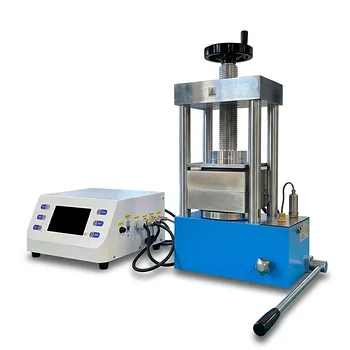
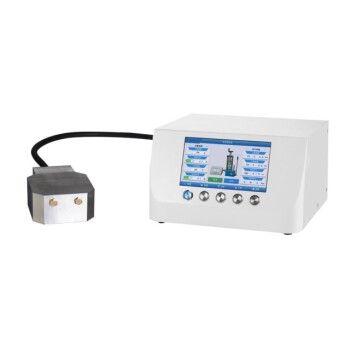
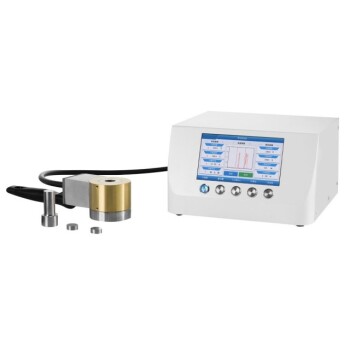
A heated laboratory hydraulic press facilitates densification by generating a controlled environment where high uniaxial pressure and low-temperature heating act simultaneously. By applying pressures as high as 780 MPa while maintaining temperatures around 140°C, the press creates the specific thermodynamic conditions required to densify materials like Mg-doped NASICON without the extreme heat of traditional firing.
The core function of this equipment is to enable a dissolution-precipitation mechanism. The synergy of mechanical pressure, moderate heat, and trace solvents allows ceramic particles to rearrange and fuse at a fraction of standard sintering temperatures.
The Mechanics of Cold Sintering
Simultaneous Application of Forces
The heated hydraulic press is unique because it does not treat pressure and temperature as separate manufacturing steps.
It applies high uniaxial pressure and low-temperature heating at the exact same moment. This simultaneity is critical for the Cold Sintering Process (CSP) to function effectively.
The Role of High Pressure
Pressure is the primary driver of physical compaction in this process.
By exerting up to 780 MPa of force, the press physically forces ceramic particles into intimate contact. This significantly increases the density of the "green body" (the unfired ceramic) before the chemical processes even fully take hold.
The Role of Low-Temperature Heat
Unlike traditional sintering that requires temperatures often exceeding 1000°C, this process operates at a much lower range, such as 140°C.
This moderate heat is sufficient to facilitate the chemical reactions needed for densification, while avoiding the energy costs and potential material degradation associated with high-temperature firing.
Triggering the Dissolution-Precipitation Mechanism
Activating Trace Solvents
The process relies on the presence of trace solvents mixed with the ceramic powder.
The heated press creates the ideal environment for these solvents to momentarily dissolve the surface edges of the ceramic particles.
Particle Rearrangement
Under the immense pressure of the press, the now-wetted particles are able to slide past one another.
This allows for particle rearrangement, leading to a much tighter packing structure than dry pressing could achieve alone.
Neck Growth and Densification
As the process continues, the dissolved material reprecipitates between the particles.
This causes the growth of necks—solid bridges connecting the particles—which locks the structure in place and solidifies the material into a dense ceramic.
Understanding the Operational Trade-offs
The Necessity of Balance
While powerful, this process relies on a precise balance of variables.
If the pressure is insufficient (significantly below 780 MPa), the particles will not be close enough for the solvent to bridge the gaps effectively.
Thermal Constraints
Conversely, the temperature must be carefully controlled.
It must be high enough (e.g., 140°C) to drive the reaction and evaporate the solvent, but not so high that the solvent boils off before particle rearrangement can occur.
Making the Right Choice for Your Goal
When utilizing a heated laboratory hydraulic press for CSP, your approach should depend on the specific outcome you need for your Mg-doped NASICON or similar ceramic.
- If your primary focus is maximum density: Prioritize maintaining the high uniaxial pressure (near 780 MPa) throughout the entire heating cycle to ensure optimal particle packing.
- If your primary focus is energy efficiency: Leverage the low-temperature capability (140°C) to reduce thermal budget, ensuring the solvent chemistry is optimized to work at this lower threshold.
Success in Cold Sintering depends not just on force or heat, but on the precise synchronization of both to trigger the chemical bonding of particles.
Summary Table:
| Parameter | Specification/Role | Impact on Densification |
|---|---|---|
| Uniaxial Pressure | Up to 780 MPa | Forces particles into intimate contact; increases green body density. |
| Temperature | Approximately 140°C | Activates trace solvents and drives the dissolution-precipitation mechanism. |
| Mechanism | Dissolution-Precipitation | Facilitates particle rearrangement and neck growth between ceramic grains. |
| Process Sync | Simultaneous Heat & Pressure | Triggers chemical bonding at a fraction of traditional firing temperatures. |
Elevate Your Material Research with KINTEK Precision
Ready to achieve superior densification in your Cold Sintering Processes? KINTEK specializes in advanced laboratory equipment designed for the most demanding research applications. From high-performance heated hydraulic presses (pellet, hot, isostatic) capable of precise pressure and thermal control to crushing systems, milling equipment, and high-temperature furnaces, we provide the tools necessary for breakthrough ceramic and battery research.
Our expertise extends to high-pressure reactors, electrolytic cells, and essential consumables like PTFE and crucibles, ensuring your lab is equipped for excellence. Let our technical experts help you select the perfect system for your Mg-doped NASICON or advanced material projects.
Contact KINTEK Today for a Specialized Consultation
Related Products
- 30T 40T Split Automatic Heated Hydraulic Press Machine with Heated Plates for Laboratory Hot Press
- 600T Vacuum Induction Hot Press Furnace for Heat Treat and Sintering
- Automatic Heated Hydraulic Press Machine with Heated Plates for Laboratory Hot Press 25T 30T 50T
- 24T 30T 60T Heated Hydraulic Press Machine with Heated Plates for Laboratory Hot Press
- Automatic High Temperature Heated Hydraulic Press Machine with Heated Plates for Lab
People Also Ask
- What are the advantages of using a laboratory hydraulic press for hot pressing? Achieve Peak Nano-Composite Density
- What are the core advantages of using a laboratory hot press to produce Bi2Se3? Achieve 93% Density & High Conductivity
- Why is a laboratory hydraulic hot press essential for high-density, additive-free Silicon Carbide? Unlock Pure SiC.
- How does a laboratory hydraulic hot press ensure the quality of PHBV/natural fiber composites? Expert Guide
- What is the function of a laboratory hydraulic hot press in the assembly of solid-state photoelectrochemical cells?