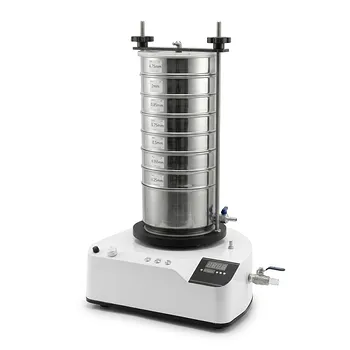
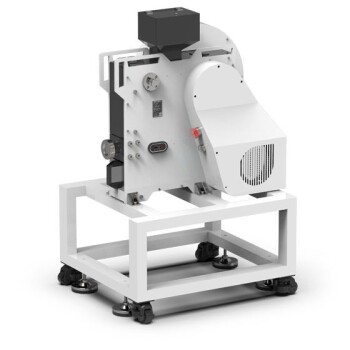
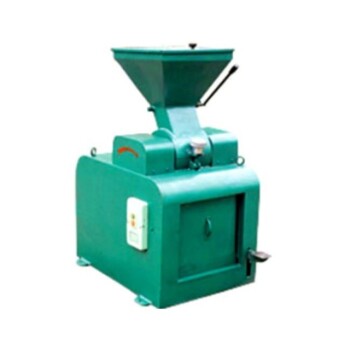
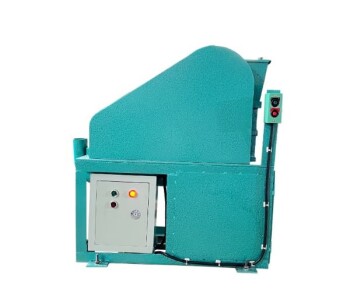
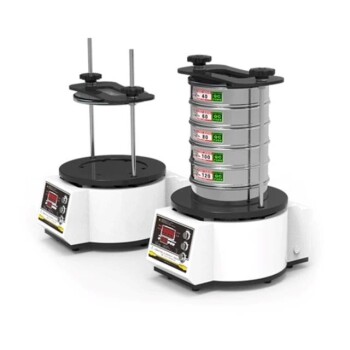
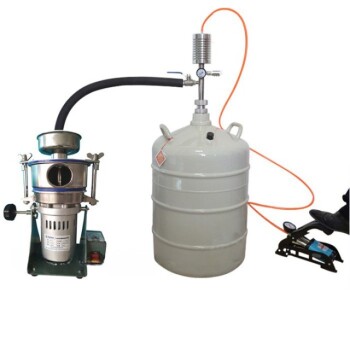
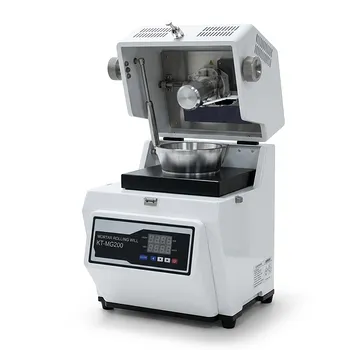
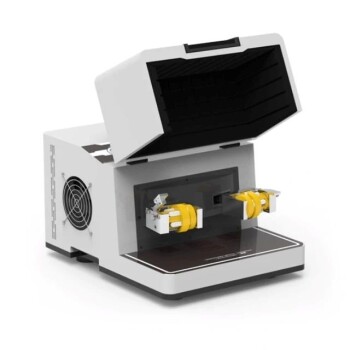
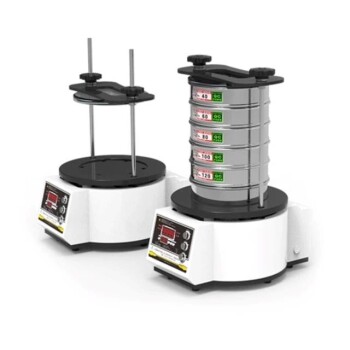
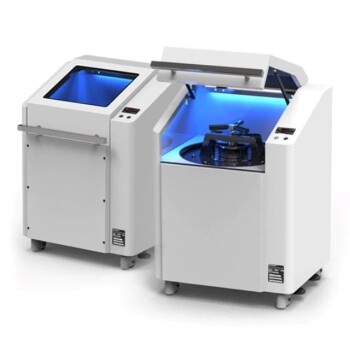
The primary role of a laboratory crushing and sieving system in this context is to mechanically fracture and segregate reduced iron ingots into precise particle size fractions to control chemical reactivity. By separating the material into specific ranges—such as fine powders (-0.5+0.1 mm) for pH adjustment and coarser granules (+1-0.5 mm) for acid leaching—engineers can dictate the speed and efficiency of subsequent chemical reactions.
Precise particle size control is the fundamental lever for optimizing chemical processing; it ensures that reduced iron is physically tuned to maximize leaching kinetics and facilitate accurate pH regulation without wasting raw material.
Optimizing Reactivity Through Size Segmentation
The crushing and sieving process is not merely about size reduction; it is about functional classification. Different stages of iron oxide pigment production require the iron to behave differently chemically, which is dictated by its physical dimensions.
Targeting pH Adjustment
For the delicate process of pH adjustment, the system must isolate fine powders.
The primary reference specifies a particle size range of -0.5+0.1 mm for this purpose. The increased surface area of these finer particles allows for rapid dissolution, providing immediate feedback and control over the solution's acidity.
Facilitating Acid Leaching
Conversely, the main leaching reactions require a more controlled, sustained release of iron.
Here, the system targets coarser powders in the +1-0.5 mm range. This larger particle size ensures a steady reaction rate, preventing the runaway kinetics that might occur with finer dust while ensuring the material is small enough to dissolve completely.
Improving Leaching Kinetics
The ultimate goal of this segmentation is to optimize leaching kinetics.
By standardizing the input material, you ensure a thorough reaction between the metallic iron and the acid solution. This prevents unreacted cores (from particles that are too large) and excessive reaction spikes (from particles that are too small).
The Principles of Surface Area and Uniformity
While the application here is reduced iron, the underlying physical principles mirror those used in other material processing industries.
Maximizing Specific Surface Area
Crushing increases the specific surface area of the material.
Just as increasing surface area in biomass allows for better chemical penetration, increasing the surface area of iron exposes more metal atoms to the acid. This facilitates a more uniform and thorough penetration of the chemical reagents into the material structure.
Ensuring Process Consistency
Sieving ensures that every batch of reactant has the same physical profile.
Uniformity is critical for predictability. If the particle size varies too widely, the chemical reaction becomes erratic. A strict sieving protocol guarantees that the density and reactivity of the feedstock remain constant, leading to a predictable output quality in the final pigment.
Understanding the Trade-offs
While crushing and sieving are essential, they introduce variables that must be managed to avoid processing inefficiencies.
The Risk of "Fines" Generation
Aggressive crushing can produce excessive "fines" (particles smaller than 0.1 mm).
While fine particles react fast, particles that are too small can cause handling issues, dust hazards, or reactions that are too violent to control safely. A balanced system aims to maximize the usable fractions while minimizing waste dust.
The Cost of Oversize Recirculation
Particles larger than 1 mm generally cannot be used effectively in the leaching process.
These "oversize" particles must be separated and recirculated back into the crusher. This increases the energy consumption of the pretreatment phase and requires a sieving system capable of efficiently handling high recirculation loads without clogging.
Making the Right Choice for Your Goal
To maximize the efficiency of your iron oxide pigment production, you must configure your crushing and sieving system based on the specific chemical step you are targeting.
- If your primary focus is Acid Leaching: Prioritize the isolation of the +1-0.5 mm fraction to ensure steady, thorough dissolution kinetics without reaction spikes.
- If your primary focus is pH Regulation: maximize the yield of the -0.5+0.1 mm fraction to provide the rapid reactivity required for precise acidity control.
By treating particle size as a critical process variable rather than a mere physical characteristic, you gain total control over the efficiency and quality of your final product.
Summary Table:
| Process Goal | Targeted Particle Size | Functional Role in Production |
|---|---|---|
| pH Adjustment | -0.5 + 0.1 mm (Fine) | High surface area for rapid dissolution and acidity control. |
| Acid Leaching | +1 - 0.5 mm (Coarse) | Controlled, sustained release for steady reaction kinetics. |
| Process Stability | Uniformity Control | Eliminates unreacted cores and prevents erratic reaction spikes. |
| Efficiency | Sieve Segmentation | Minimizes wasteful 'fines' and manages oversize recirculation. |
Maximize Your Lab's Processing Efficiency with KINTEK
Precision in particle size is the foundation of chemical consistency. KINTEK specializes in high-performance laboratory equipment, offering advanced crushing and milling systems and sieving equipment designed to deliver the exact fractions required for your research or production needs.
Whether you are optimizing iron oxide pigments or conducting advanced material analysis, our comprehensive portfolio—including hydraulic presses, high-temperature furnaces, and chemical reactors—ensures your lab has the tools to succeed.
Take control of your material pretreatment today. Contact our specialists at KINTEK to find the perfect solution for your lab's unique requirements.
References
- Bagdaulet Kenzhaliyev, Arailym Mukangaliyeva. Production of iron oxide pigment from the metallic component of ilmenite smelting. DOI: 10.51301/ejsu.2025.i1.02
This article is also based on technical information from Kintek Solution Knowledge Base .
Related Products
- Laboratory Test Sieves and Sieving Machines
- Laboratory Vibratory Sieve Shaker Machine for Dry and Wet Three-Dimensional Sieving
- Laboratory Jaw Crusher
- Laboratory Sealed Hammer Crusher for Efficient Sample Preparation
- Sealed Jaw Crusher High Efficiency Environmental Protection Safe and Reliable
People Also Ask
- What are laboratory test sieves used for? A Guide to Particle Size Analysis
- How do you calculate the sieve test? Master Particle Size Distribution for Quality Control
- How does a lab test sieve contribute to biomass charcoal powder preparation? Achieve Uniform Particle Size
- What are the specifications for test sieves? A Guide to ASTM & ISO Standards for Accurate Particle Analysis
- What materials are required for sieving? Achieve Accurate Particle Size Analysis