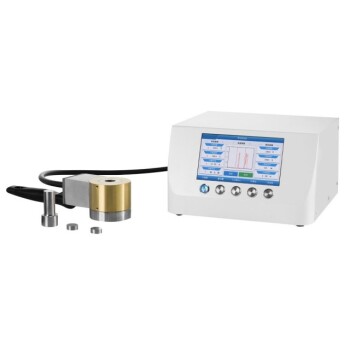
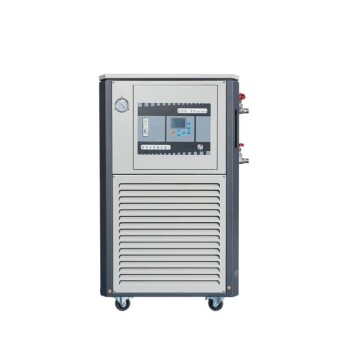
A high-precision laboratory heating system serves as the critical control mechanism for isolating the thermal variables affecting electrolyte performance. By applying a constant heating rate—specifically 10 K/min—and maintaining temperatures between 848 K and 948 K, researchers can accurately map the exponential decline of ohmic resistance as temperature rises. This controlled environment allows for the quantification of thermal sensitivity independent of other variables like gas composition.
Precise thermal regulation reveals that temperature is the dominant factor driving changes in ohmic resistance, far outweighing the influence of gas composition. This insight confirms the necessity of rigorous thermal management strategies for optimizing industrial-scale fuel cell stacks.
Mechanisms of Thermal Analysis
Establishing Consistent Heating Rates
To determine an accurate relationship between variables, the input energy must be applied consistently. The laboratory heating system provides a constant heating rate of 10 K/min.
This linearity ensures that any observed changes in resistance are a direct result of temperature magnitude, rather than fluctuations in how the heat is applied.
Defining the Temperature Window
The system is designed to maintain specific test temperatures within a critical high-heat window, ranging from 848 K to 948 K.
Holding these temperatures effectively simulates the operating conditions required for high-performance electrolytes. It allows researchers to capture data at stable plateaus rather than just during transient heating phases.
Interpreting the Resistance-Temperature Relationship
The Exponential Correlation
Data derived from this high-precision heating reveals an exponential relationship between temperature and ohmic resistance.
As the laboratory system drives the temperature up, the ohmic resistance decreases significantly. This confirms that the electrolyte's conductivity is highly thermally activated.
Isolating Variables: Temperature vs. Composition
A key role of the heating system is to create a baseline that allows for the comparison of different stress factors.
Experimental results indicate that temperature changes have a much greater impact on resistance than alterations in gas composition. Without the precise thermal locking provided by the heating system, isolating this dominance of thermal influence would be impossible.
Understanding the Limits of Laboratory Data
Idealized Conditions vs. Operational Reality
While a laboratory heating system offers perfect uniformity, it represents an idealized environment.
In real-world industrial stacks, maintaining the uniform 10 K/min heating rate or a perfectly static temperature across a large volume is difficult.
The Challenge of Scale-Up
The data obtained is critical for theoretical optimization, but it assumes a controlled thermal environment.
Engineers must account for the fact that industrial stacks may experience thermal gradients that do not exist in the small-scale, precision-heated laboratory setup.
Implications for Fuel Cell Development
Understanding the dominance of temperature over gas composition shifts the focus of design and engineering.
- If your primary focus is Fundamental Research: Prioritize the precision of your heating elements to ensure the exponential resistance curve is not distorted by thermal noise.
- If your primary focus is Industrial Stack Design: Invest heavily in thermal management systems to maintain the optimal temperature range (848–948 K), as this yields better performance gains than tweaking gas flow compositions.
By leveraging precise thermal control, you transform raw experimental data into a roadmap for highly efficient thermal management in commercial applications.
Summary Table:
| Parameter | Specification/Detail | Impact on Research |
|---|---|---|
| Heating Rate | 10 K/min (Constant) | Ensures linear energy application for accurate variable isolation |
| Temperature Range | 848 K to 948 K | Simulates high-performance operational environments |
| Relationship Type | Exponential | Confirms ohmic resistance decreases as temperature increases |
| Variable Dominance | Temperature > Gas Composition | Identifies temperature as the primary driver of conductivity |
| Key Application | Thermal Management | Guides the design of efficient industrial-scale fuel cell stacks |
Elevate Your Material Research with KINTEK’s Precision Thermal Solutions
Precise temperature control is the cornerstone of accurate electrolyte and fuel cell development. At KINTEK, we specialize in high-performance laboratory equipment designed to eliminate thermal noise and provide the consistent environments required for breakthrough research.
Whether you are mapping resistance curves or scaling industrial stacks, our extensive portfolio offers the reliability you need:
- High-Temperature Furnaces: Muffle, tube, vacuum, and atmosphere furnaces for exact thermal regulation.
- Advanced Electrochemical Tools: Electrolytic cells, electrodes, and specialized battery research consumables.
- Precision Systems: High-pressure reactors, autoclaves, and hydraulic presses for advanced material synthesis.
Ready to achieve superior accuracy in your lab? Contact our technical experts today to find the perfect heating and material processing solution for your specific application.
References
- Timothy A. Barckholtz, Bárbara Bosio. Experimental and Modeling Investigation of CO3=/OH– Equilibrium Effects on Molten Carbonate Fuel Cell Performance in Carbon Capture Applications. DOI: 10.3389/fenrg.2021.669761
This article is also based on technical information from Kintek Solution Knowledge Base .
Related Products
- Laboratory Scientific Electric Heating Blast Drying Oven
- Automatic Heated Hydraulic Press Machine with Heated Plates for Laboratory Hot Press
- Cylindrical Lab Electric Heating Press Mold for Laboratory Applications
- 30T 40T Split Automatic Heated Hydraulic Press Machine with Heated Plates for Laboratory Hot Press
- Heated Hydraulic Press Machine with Heated Plates Split Manual Laboratory Hot Press
People Also Ask
- How does a laboratory electric drying oven contribute to the formation of the initial coating? Expert Insights
- What role does a precision laboratory drying oven play in the synthesis of GO-PANI nanocomposites? Protect Material Integrity
- What role does a laboratory drying oven play in the preparation of zinc oxide nanoparticle precursors?
- What is the necessity of using a laboratory drying oven when processing MoO3/GO composite nanopowders? Find out here.
- What is the role of a laboratory drying oven in cellulose citrate production? Ensure Material Stability & Purity